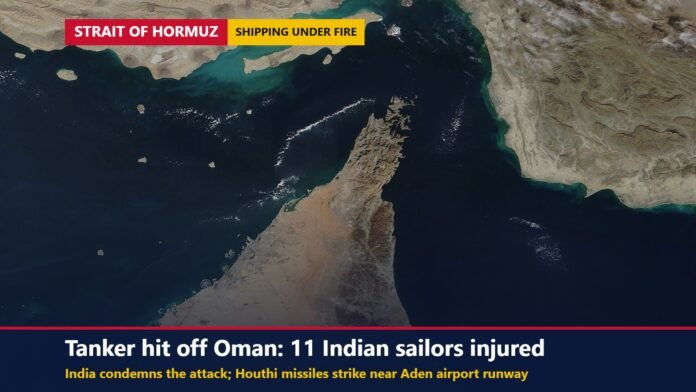
October 7: A projectile struck the Panama-flagged oil tanker On Peace off the coast of Oman on Tuesday, starting a fire and injuring 12 of the 19 people on board. Seventeen of the crew were Indian, and 11 of the injured are Indian nationals, India’s Ministry of External Affairs said. Oman’s air force flew 10 of the injured to hospital in Khasab, Al Jazeera reported. No one has claimed the attack. On Wednesday, Yemen’s Houthis fired missiles and drones at Aden’s international airport, and one missile landed near the runway minutes before a passenger flight from Cairo was due, Yemen’s transport ministry said.
Key highlights
- The tanker was hit about 9 nautical miles off Limah in Oman’s Musandam governorate, near the Strait of Hormuz, according to Al Jazeera and Baird Maritime.
- “We condemn the attack earlier today on a Panama-flagged commercial vessel MT On Peace off the coast of Oman,” the Ministry of External Affairs said, as quoted by Business Standard.
- Ten Indian seafarers have been killed in the region since late February, when the war on Iran began, Al Jazeera reported, citing Indian figures.
- At least four other commercial ships have been hit since October 3, Baird Maritime reported.
- Brent crude rose to $101.51 a barrel on the day of the attack, against $72.48 before the war, according to Al Jazeera.
What happened to the On Peace
The On Peace is an LR2 tanker, a class of large product carrier, and is owned by Onex, a shipping company based in Dubai, according to Baird Maritime and The National. The projectile struck above the waterline, The National reported, and a fire broke out on board. The UK Maritime Trade Operations centre confirmed the strike in a post on X.
Of the 19 crew, 12 were hurt. Oman’s military airlifted 10 of them to hospital in Khasab, the main town of Musandam, Baird Maritime reported. No deaths have been reported. The reports reviewed do not say what kind of projectile was used or who fired it.
India’s response
The Ministry of External Affairs called for “an immediate cessation of such attacks”, Business Standard reported. “The continuing incidents of attacks on shipping in the region remain a cause of deep concern for India,” it said, according to The National. Baird Maritime quoted a further line from the statement: “The targeting of commercial shipping, seafarers and civilian infrastructure in the region must end, and navigation and commerce through international waterways must be restored at the earliest.”
In the same statement India condemned an attack on a merchant ship in the Black Sea in which two foreign seafarers were killed and Indian crew members were injured; Romanian authorities rescued the three Indians on board, Business Standard reported.
A week of attacks on ships
The On Peace is one of several vessels hit in the same waters in a few days. Baird Maritime listed four others since October 3.
| Date | Ship | Type |
|---|---|---|
| October 4 | Vela Gas | LPG carrier |
| October 5 | Maran Gas Mystras | LNG carrier |
| October 5–6 | Cameroon Prosperity | Very large crude carrier |
| October 5–6 | Ghana Prosperity | Very large crude carrier |
| October 6 | On Peace | LR2 tanker; 12 crew injured, 11 of them Indian |
Counts differ by source. Al Jazeera reported at least seven other tanker incidents in the past week, and The National, citing The Wall Street Journal, said nine commercial vessels had been attacked near the strait in recent weeks.
Baird Maritime noted that India’s Directorate General of Shipping has barred the deployment of Indian seafarers through the Strait of Hormuz since July 16. The reports do not say when or where the crew of the On Peace joined the ship.
Aden airport: a missile near the runway
On Wednesday the Houthis fired at least two ballistic missiles and several drones at Aden International Airport, in the city that serves as the seat of Yemen’s internationally recognised government, the country’s Ministry of Transport said, as reported by Al Jazeera. One missile struck near the runway “minutes before the Yemeni flight from Cairo was to land”. “This incident could easily have turned a civilian flight into a horrific humanitarian disaster,” the ministry said. The terminal was evacuated, two aircraft were moved off the tarmac and the Cairo flight was diverted to Jeddah. The ministry’s statement gave no casualty figures.
The Houthis said they had targeted “Saudi military supplies” at the Badr camp near the airport, and claimed attacks on Saudi airports in Riyadh and Abha. Major-General Turki al-Maliki, spokesperson for the Saudi-led coalition, said a Houthi ballistic missile had been intercepted and destroyed north of Riyadh, Al Jazeera reported. The Houthi claims about Saudi airports have not been confirmed by Riyadh in the reports reviewed.
Oil is flowing, but at a price
Despite the attacks, crude exports from the Middle East had recovered to 18.3 million barrels a day by September 30, close to the level before the war, Al Jazeera reported. The price has not recovered: Brent stood at $101.51 a barrel on the day the On Peace was hit, about 40 per cent above the $72.48 at which it traded before the war began. The National reported that Iran has tied a full reopening of the strait to a list of seven demands. The Group of Seven agreed earlier this month to release oil and diesel from emergency reserves, as we reported.
What it means for India and Asia
Three things stand out for Indian readers. The first is the human cost. Indian seafarers make up a significant share of the crews on the world’s merchant ships, so when a tanker is hit in the Gulf the injured are often Indian, as they were here: 11 of 12. Ten have been killed since February. The ban on sending Indian crews through the strait, in force since July, has not removed that risk.
The second is the oil bill. India imports most of the crude it uses, and much of it comes through these waters. A price above $100 a barrel feeds straight into inflation, the pressure the Reserve Bank of India cited when it raised its policy rate on Wednesday (report in Hindi).
The third is the widening of the war. The strike near Aden’s runway and the missile shot down north of Riyadh came in the same week that Pakistan and Türkiye agreed to send forces to Saudi Arabia. Each new front raises the cost of insurance and of shipping for every Asian economy that buys Gulf oil and gas, from India to Japan.
What to watch
- The condition of the injured crew and any consular update from India’s embassy in Muscat.
- Whether anyone claims the attack on the On Peace, or any government names a culprit.
- Whether India tightens its advisory for seafarers further.
- Flights at Aden airport, and any Saudi-led response to the Houthi strikes.
Sources
- Al Jazeera: Oman evacuates injured crew from attacked tanker in Strait of Hormuz
- Business Standard: 11 Indians injured as projectile hits ship in Hormuz, India condemns attack
- The National: India condemns strike on oil tanker owned by Dubai company in Strait of Hormuz
- Baird Maritime: 12 injured in attack on tanker in Strait of Hormuz
- Al Jazeera: Yemen’s Houthis attack Aden airport; Saudi forces down missile near Riyadh

The International Desk covers world and Asian affairs, diplomacy and conflict, with a focus on what they mean for India. Stories are checked against at least two credible sources before publication.