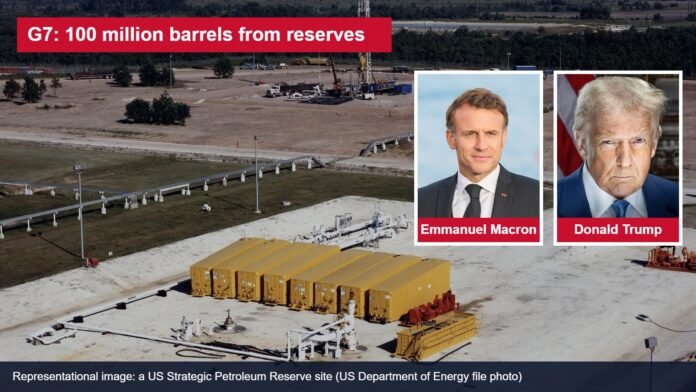
October 4: The Group of Seven (G7) countries have agreed to release 100 million barrels of crude oil and diesel from their emergency reserves over the next four months, with a large part of the diesel to be released in the first 20 days. The decision was announced on Friday, October 2, in a joint statement issued by French President Emmanuel Macron’s office after a video call of G7 leaders. It follows pressure from Washington, where fuel prices have become an issue before the November 3 midterm elections. Brent crude fell 1.48% to $100.80 a barrel after the announcement, The National reported.
Key highlights
- Volume and timeline: 100 million barrels over four months, starting immediately, including what the statement calls “a front-loaded substantial diesel release within the first 20 days”.
- Coordination: The release will be carried out through the International Energy Agency (IEA).
- No export curbs: G7 members also pledged not to restrict exports of energy products to one another.
- Prices: Brent fell to $100.80 and West Texas Intermediate (WTI) fell 2.66% to $90.40 a barrel, according to The National.
- Not disclosed: The reports do not give each country’s share or the exact split between crude and diesel.
What the G7 agreed
Macron convened the video conference after speaking with US President Donald Trump, ABC News reported. The G7 consists of Britain, Canada, France, Germany, Italy, Japan and the United States. The leaders’ statement said the release of 100 million barrels would “begin immediately over four months”.
The declaration said the step was being taken in coordination with the IEA and was meant to support global energy security and market stability, according to Meduza. Chinese broadcaster CGTN described the volume as “up to” 100 million barrels of diesel and crude oil.
The leaders also promised to “refrain from export restrictions on energy and energy products between G7 countries”, ABC News reported. That line matters because Trump had threatened to ban US diesel exports.
Why Washington pushed for it
Fuel prices have risen sharply since the US-Israeli conflict with Iran began on February 28. The National reported that diesel in the United States has reached $6.50 a gallon, nearly $3 higher than a year ago. In Europe, diesel hit a record €2.24 a litre, up from €1.59 before the conflict.
US Treasury Secretary Scott Bessent had urged Europe to act immediately. “American farmers, truckers, and businesses should not be left carrying the burden,” he said, as quoted by ABC News. Meduza reported that the United States had demanded that France and Germany release diesel from their reserves and had threatened an export ban if they refused. It noted that European countries have become more dependent on US fuel supplies.
The European Commission pushed back on the threat. Spokeswoman Anna-Kaisa Itkonen said the EU would “fully reject any ban on diesel”, according to ABC News. After the agreement, Trump said the process would “begin immediately” and spoke of a “massive amount” of diesel coming from European reserves.
How tight the market is
Macron said supply through the Gulf has improved. “Oil shipment figures have improved in recent days, and between Hormuz and the Yanbu pipeline … we are seeing three-quarters of the prewar volumes moving today,” he said, as quoted by The National. Yanbu is Saudi Arabia’s Red Sea export outlet, which lets some crude bypass the Strait of Hormuz.
The step follows an earlier coordinated release. IEA members committed to releasing 400 million barrels in March, and IEA chief Fatih Birol has said about two-thirds of that has already reached the market, The National reported.
The first market reaction was modest. Brent’s fall of 1.48% left it just above $100 a barrel, and WTI was at $90.40, according to The National. Diesel is the fuel for trucks, farm machinery and much of industry, which is why the price figures above matter beyond the petrol pump.
Shipping risk has not gone away
Attacks on commercial ships in the Gulf are continuing. India’s embassy in Oman said it coordinated the rescue of five Indian nationals from the Kuwait-flagged tanker MT Kazimah III after it was struck by a projectile in the Strait of Hormuz, PTI reported. All five were moved ashore safely, and the embassy thanked the Omani authorities. The mission gave no further details and did not say who fired the projectile.
The Federal reported that the tanker was carrying crude oil and was bound for Lomé in Togo, and that no injuries were reported. It added that more than 4,500 Indian seafarers work on commercial vessels in the Persian Gulf region.
What it means for India
India is not a member of the G7 and is not part of this release. The effect on India comes through global prices, because the country imports most of the crude oil it uses. A sustained fall in Brent would ease pressure on the import bill, the rupee and fuel retailers. A fall of less than 2% on the first day does not change that picture much.
Crude has stayed near or above $100 for weeks, and that has already weighed on Indian markets. Read our earlier coverage: oil above $100 sends Asian markets lower as Hormuz risk grows, the US sends a third aircraft carrier towards Iran and the US 10-year yield at its highest since 2002.
What to watch
- The first 20 days: How much diesel actually reaches the market, and from which countries.
- Country shares: The G7 has not published a breakdown of who releases how much.
- Hormuz traffic: Whether shipments keep recovering, or new attacks on tankers push insurance and freight costs up again.
- US politics: Fuel prices remain a campaign issue before the November 3 midterms, as Meduza and ABC News noted.
Sources
- The National: G7 members agree to release 100 million barrels of diesel and other reserves
- ABC News: G7 countries to release 100 million barrels of diesel and oil to curb fuel prices
- Meduza: G7 to release 100 million barrels of oil and diesel from strategic reserves
- CGTN: G7 to release 100 million barrels of oil and diesel from reserves
- ThePrint (PTI): 5 Indian nationals rescued after projectile hits tanker in Strait of Hormuz
- The Federal: Five Indians rescued after Kuwait-flagged tanker hit by projectile in Strait of Hormuz

The Business Desk covers markets, the economy, companies and personal finance. Stories are checked against at least two credible sources before publication.