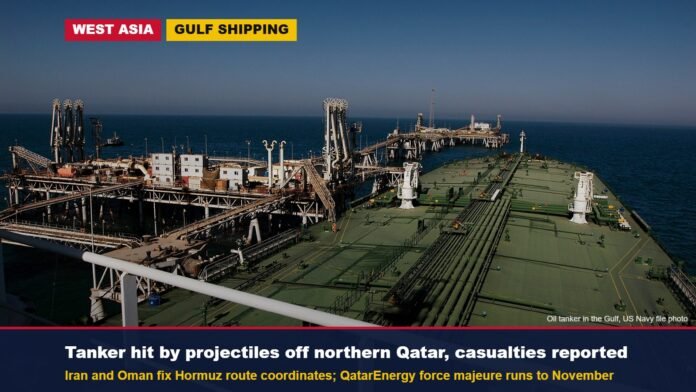
October 8: A tanker was hit by multiple projectiles about 51 nautical miles north of Madinat ash Shamal, off Qatar’s northern coast, on Wednesday, and casualties were reported, the UK Maritime Trade Operations centre (UKMTO) said. UKMTO did not say how many people were hurt or killed, or name the ship. On the same day Iran said it had agreed with Oman on the coordinates of “safe” transit routes through the Strait of Hormuz, while a senior Revolutionary Guards adviser said the strait stays closed under Iranian control until Tehran’s demands are met.
Update, October 11: Ships have been struck in or near the Strait of Hormuz almost every day in October, with 12 attacks in one week. Read: A ship hit almost every day: Hormuz in October.
Update (October 9): On Thursday a Saudia airliner was damaged by fire at Riyadh airport during a Houthi missile attack, and Indian airlines suspended Riyadh flights. Details: Saudia jet damaged in Riyadh attack.
Key highlights
- The attack site is about 94 km north of Madinat ash Shamal (51 nautical miles × 1.852 km).
- The location falls within Qatar’s exclusive economic zone. Qatar had not commented.
- UKMTO has in the past used the word “casualties” to mean deaths among seafarers. The extent of the casualties in this case is not known.
- Iran’s foreign ministry spokesman Esmaeil Baghaei announced the route deal with Oman. The coordinates were not published.
- QatarEnergy has extended force majeure on LNG deliveries to Asia and Europe through the end of November. Buyers in Bangladesh, Pakistan and at least one buyer in India were notified.
What happened off Qatar
It was the first reported attack on a tanker in the western half of the Gulf in weeks, and attacks in the middle of the Gulf are unusual. No one has claimed it. UKMTO said authorities were investigating and advised ships to proceed with caution and report suspicious activity.
The attack came a day after the Panama-flagged tanker On Peace was hit off Oman’s Musandam peninsula, near the Strait of Hormuz, injuring 11 Indian crew members. Our report on that attack: Tanker with 17 Indian crew hit near the Strait of Hormuz.
How many ships have been hit: the counts differ
| Source | What it says | Period |
|---|---|---|
| UKMTO | Nine attacks on tankers in the Strait of Hormuz | October so far; about half of September’s total for the strait and the Gulf combined |
| Public record | At least 12 tankers attacked in Hormuz | Since September 29 |
| Joint Maritime Information Center (JMIC) | Threat level “severe” in the Strait of Hormuz; “moderate” in the Arabian Gulf and the Gulf of Oman | Current |
The counts cover slightly different periods and are not directly comparable, so we show both.
The Iran–Oman route deal
Iran’s foreign ministry spokesman Esmaeil Baghaei said on Wednesday that Iran and Oman had agreed on the geographic coordinates of designated safe transit routes for ships entering and leaving the strait, and on how those coordinates would be passed to the relevant international maritime body. The deal builds on a framework the two countries announced in August: Oman said on August 25 that they would set up a temporary corridor, clear mines and work towards a permanent corridor. Iran’s deputy foreign minister Kazem Gharibabadi said the next day that the temporary route would be seven miles wide, with part of the entry and exit in Iranian waters.
President Masoud Pezeshkian confirmed the agreement but tied a reopening of the strait to the United States meeting its commitments under what he called the “Islamabad memorandum”. On the same day Mohammad Reza Naqdi, an adviser to the Islamic Revolutionary Guard Corps, said routes Tehran considers “illegal” would soon be blocked, naming the southern route along Oman’s coast, and that the strait remains closed under IRGC control until Iran’s demands are met. The route deal therefore does not, by itself, mean ships can pass safely.
Qatar’s gas, and who waits for it
| Item | Detail | Source |
|---|---|---|
| Force majeure on LNG deliveries to Asia and Europe | Extended by one month, through the end of November | Public record |
| Buyers notified | Customers in Bangladesh, Pakistan, at least one buyer in India, and Italy’s Edison | Public record |
| Sales lost in six months of war | About $24 billion; exports down by as much as 96% | Industry estimate (August) |
| LNG flows through Hormuz | Rising since September, but still more than 75% below pre-war levels | Public record |
| New loan | $3 billion over five years from Bank of China, ICBC, Agricultural Bank of China and China Construction Bank (Asia), for working capital | Unconfirmed deal details |
What it means for Asia
The force majeure notices show which Asian buyers are waiting for Qatari gas: customers in Bangladesh and Pakistan and at least one Indian buyer. An attack north of Qatar, inside the Gulf and well away from the strait itself, suggests that ships near Gulf terminals are also exposed, not only those passing through Hormuz. For India, this week has already brought one attack with Indian casualties. The loan from four Chinese banks shows Chinese lenders stepping in while Qatar’s gas sales remain largely frozen.
What to watch
- The name, flag and crew of the tanker hit off Qatar, and the number and condition of the casualties.
- Whether the Iran–Oman coordinates are published and whether shipping bodies advise their use.
- Any move by the IRGC against the southern route along Oman’s coast.
- QatarEnergy’s decision on force majeure after November.

The International Desk covers world and Asian affairs, diplomacy and conflict, with a focus on what they mean for India. Stories are checked against at least two credible sources before publication.