
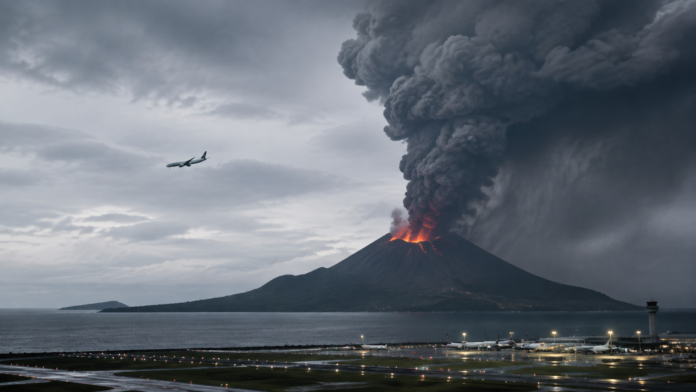

JAKARTA, 7 September 2026: Indonesia kept eight airports closed until 6 p.m. local time on Monday after tests continued to detect volcanic ash from Anak Krakatau in airspace around Jakarta and several other cities. The government also opened five alternative airports around the clock and arranged free rail and bus transfers for stranded passengers, turning the story from Sunday’s mass cancellations into a continuing national transport operation.
The eight affected airports include Soekarno-Hatta and Halim Perdanakusuma in the Jakarta region, Radin Inten II in Lampung, Husein Sastranegara in Bandung, Budiarto in Curug, Pondok Cabe in South Tangerang, Taufik Kiemas in Pesisir Barat and Atung Bungsu in South Sumatra. Indonesia’s Transport Ministry said reopening would depend on safety checks rather than a fixed promise.
What changed on September 7
- The closure of eight airports was extended through 6 p.m. Monday after further ash tests.
- Kertajati, Ahmad Yani, Juanda, Yogyakarta International and Adi Soemarmo airports were designated for 24-hour alternative operations.
- Free ground transport was arranged to move some passengers from Soekarno-Hatta to other Java hubs.
- Singapore Airlines listed ten Jakarta–Singapore cancellations for September 7.
- Authorities continued ash tests and required aircraft inspections before operations could resume.
Why ash can close airports far from a volcano
Volcanic ash is made of hard fragments of rock and glass, not soft smoke. It can reduce visibility, damage windscreens and contaminate aircraft systems. When sucked into a jet engine, ash can melt in the hot section and then solidify on cooler components, potentially disrupting airflow or causing power loss. Aviation authorities therefore treat a confirmed ash hazard conservatively even when an airport is far from the erupting crater.
Anak Krakatau lies in the Sunda Strait between Java and Sumatra, more than 150 kilometres from Jakarta. Distance alone does not determine the risk. Wind direction and speed vary by altitude, allowing an ash cloud to travel across flight paths and airport areas. Indonesia’s Transport Ministry said paper tests were being conducted every 30 minutes at the affected airports while meteorological and aviation agencies monitored changing wind layers.
Alternative airports and passenger movement
The five alternative hubs stretch across Java. Kertajati serves West Java, Ahmad Yani serves Semarang, Juanda serves Surabaya, Yogyakarta International serves the Yogyakarta region and Adi Soemarmo serves Solo. Their 24-hour availability gives airlines more options, but a diversion still depends on aircraft range, crew duty limits, gate capacity, ground handling and onward transport.
The government and airport operator InJourney coordinated free train and bus services from Soekarno-Hatta to alternative hubs. That does not mean every passenger can be rebooked immediately. Airlines must rebuild schedules after aircraft and crews are displaced, and international passengers may face additional immigration, baggage and connection requirements.
International flights remain affected
Singapore Airlines’ advisory listed ten flights cancelled on September 7, including services in both directions between Singapore and Jakarta. The airline warned that the situation remained fluid and advised customers to check flight status, update contact details and use its rebooking or refund channels. Scoot issued a separate advisory for affected services.
By Monday, the eruption had halted about 2,300 flights, according to the Associated Press. An earlier Sunday tally put the number of stranded travellers at about 170,000, while Indonesian state news agency ANTARA reported 209 cancellations at Soekarno-Hatta in one earlier update. These figures cover different reporting windows and should not be added together; schedules were still changing.
Volcano status and public safety
Indonesia’s Geological Agency said the continuous 25-hour eruption had ended on Sunday, but Anak Krakatau remained active on Monday with moderate intermittent eruptions, dark ash emissions and small local earthquakes. Authorities maintained a three-kilometre exclusion zone around the active crater. No deaths were reported and no evacuation order covered populated areas, with the nearest settlement more than 16 kilometres away. The absence of an evacuation does not reduce the aviation hazard: ash risk depends on airspace conditions, while community evacuation depends on threats at ground level.
Authorities also warned residents not to approach the volcano for photographs or sightseeing. Fine ash can irritate the eyes and lungs, contaminate water and reduce road visibility. Travellers should rely on airport and airline notices rather than social-media images, because ash movement can change faster than viral posts are updated.
A regional resilience test
The disruption exposes the wider importance of Jakarta’s main airport to Southeast Asian transport networks. Airlines that cannot use Soekarno-Hatta must find scarce slots elsewhere, while passengers connect by road or rail across Java. The response therefore depends on coordination among aviation, meteorology, rail, road and emergency agencies.
For readers following other regional security and transport pressures, The Press of Asia’s Freedom Edge 2026 explainer covers the current Northeast Asian exercise, while our Philippines Coast Guard command report explains another pressure point along vital Asian sea lanes.
What passengers should do
Passengers should check the operating airline’s app or website before leaving for the airport, keep contact information updated and avoid relying on a third-party schedule alone. Those moved to an alternative airport should confirm whether ground transfer is included and whether checked baggage follows the revised itinerary. Refund and rebooking rules vary by airline and ticket type.
The central fact by Monday afternoon was clear: eight airports remained closed through 6 p.m. under an extended safety decision, while five alternatives and ground transfers were activated. Reopening could follow successful ash and aircraft checks, but officials had not promised a stable timetable. The story remains operationally fluid and should be updated when a new official NOTAM or ministry notice changes the status.