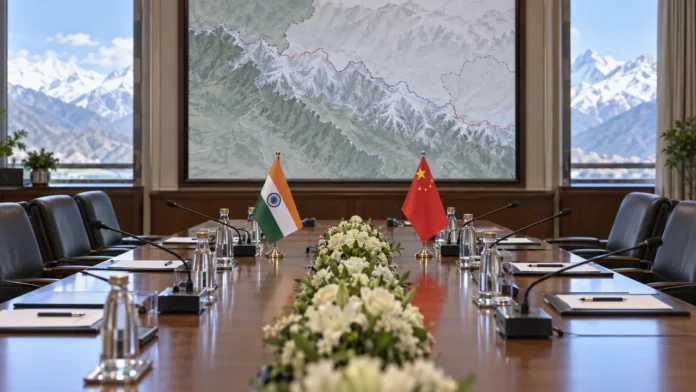

India-China military talks were held over two consecutive days in the eastern sector, according to the Ministry of External Affairs, as both sides continued efforts to manage friction along the Line of Actual Control.
The meeting was held first at Wacha on the Indian side on September 6 and then at Damai on the Chinese side on September 7. The talks took place against the backdrop of tensions in the Taksing area of Arunachal Pradesh’s Upper Subansiri district.
What the Ministry of External Affairs confirmed
MEA spokesperson Randhir Jaiswal described the engagement as the first Senior Highest Military Commander-Level Flag Meeting in the eastern sector. The two-day format gave commanders from both sides an opportunity to discuss local concerns while using a channel intended to prevent incidents from escalating.
Lieutenant General Girish Kalia, commander of the Indian Army’s III Corps, met his Chinese counterpart along with other officers, The Indian Express reported. The meeting followed understandings reached by the countries’ Special Representatives in August 2025 and August 2026, as well as Working Mechanism for Consultation and Coordination meetings held in Beijing and New Delhi in May and August 2026.
Why the eastern-sector mechanism matters
India and China already use a Corps Commander-level mechanism in the western sector. Since the 2020 border crisis, the two sides have held 23 rounds of talks at the Chushul-Moldo meeting point in eastern Ladakh. Those discussions have produced disengagement arrangements at several friction points, although the broader boundary dispute remains unresolved.
The new eastern-sector engagement is significant because military communication close to the ground can reduce the risk of misunderstandings. It does not, by itself, amount to a settlement or a withdrawal agreement. Any durable change would need to be reflected in official statements, verifiable field arrangements and continued diplomatic engagement.
Diplomacy continues ahead of the BRICS summit
The talks came weeks after National Security Adviser Ajit Doval met Chinese Foreign Minister Wang Yi in Beijing on August 25 in their roles as Special Representatives for the boundary question. They also occurred ahead of the BRICS leaders’ summit scheduled in New Delhi for September 12-13, which Chinese President Xi Jinping is expected to attend.
A leaders’ meeting can provide political direction, but the practical work of managing the LAC is normally carried out through military commanders and established diplomatic channels. The two tracks therefore need to be read together rather than as substitutes for one another.
Why regular contact matters
The immediate value of the new format lies in crisis prevention. Senior officers can compare patrol-related accounts, clarify local movements and establish whom to contact when units encounter one another. Such procedures are especially useful where terrain, weather and limited visibility can complicate communication. They cannot resolve competing territorial claims, but they can buy time for diplomats and reduce the chance that a local episode grows into a wider confrontation. Consistency will matter more than the symbolism of a single meeting.
What to watch next
The clearest indicators of progress will be whether the two governments issue matching descriptions of the talks, whether local commanders maintain regular contact and whether any new confidence-building steps are announced. Observers will also watch for language on border peace in statements surrounding the BRICS summit.
For now, the two-day meeting shows that India and China are widening communication at a time when troops remain deployed in sensitive areas. Dialogue can help stabilise the situation, but claims of a breakthrough would be premature without specific, independently verifiable outcomes.
Reporting basis: Ministry of External Affairs remarks as reported by The Indian Express on September 9, 2026. Featured image is an AI-generated editorial illustration and does not depict the actual meeting.