
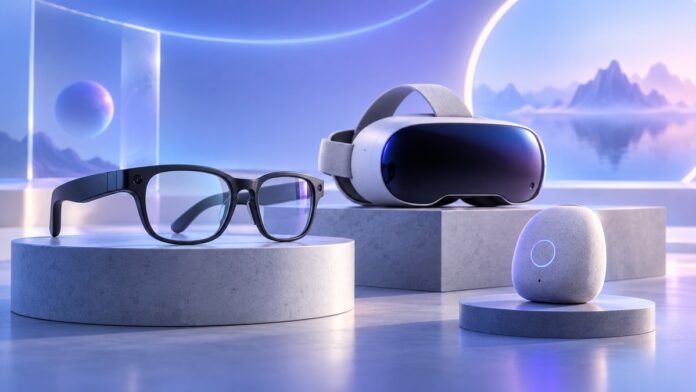
MENLO PARK, 24 September 2026: Meta used Connect 2026 to place artificial-intelligence agents and lighter wearable devices at the centre of its next computing platform. The company announced Meta VR Glasses, its first Ray-Ban Meta Audio glasses, a wider AI-glasses lineup and an expansion of the Muse personal AI agent.
The announcements span products with firm prices and release windows as well as concepts that remain less specific. Readers should distinguish devices scheduled for sale from features Meta says are coming later.
Key announcements
- Meta VR Glasses are scheduled for spring 2027 at $1,299.99.
- The VR device weighs about 100 grams and uses a 5K “Infinite Display”, according to Meta.
- Ray-Ban Meta Audio offers open-ear audio and AI without a camera.
- Meta claims up to 12 hours of use, plus up to 48 hours through the charging case, for the audio glasses.
- Muse will work through Meta’s AI glasses and a small companion device called Muse Charm.
- Meta says its AI-glasses portfolio will exceed 100 styles by the end of 2026.
Meta VR Glasses: a lighter form of spatial computing
Meta describes the new VR Glasses as a cinema, workspace and console in a glasses-like device. The company says users will be able to open multiple virtual displays, navigate with eye tracking and hand gestures and access Meta AI. Its 100-gram target is significantly lighter than conventional headsets, although comfort and battery performance will need independent testing.
The spring 2027 release window and $1,299.99 price make this a premium product. Meta’s “IMAX-quality” cinema claim is marketing language until reviewers can assess resolution, field of view, optics and sustained performance in real use.
Ray-Ban Meta Audio goes camera-free
The Ray-Ban Meta Audio line combines open-ear speakers, microphones and AI features without a camera. Meta says audio is the most-used function on its current glasses, and the camera-free design may appeal to buyers who want hands-free assistance while reducing some privacy concerns associated with wearable cameras.
The product weighs 43 grams and is offered in Clubmaster and Burbank frames. Meta lists a starting price of €349 in several European markets. The company has not announced an India price or launch date, so any claim that the product is immediately available in India would be premature.
Muse moves from screens to wearables
Meta says Muse on AI glasses can turn conversation into tasks such as adding items to a shopping list or finding a time to meet a friend. Muse is currently available in the United States, Canada and Mexico, with additional markets promised later.
Muse Charm is a pocket-sized device built for voice interaction with the agent. Meta says it will share more information later in 2026. That makes Charm an announced device concept, not a fully specified retail product.
What this means for the AI-device race
Meta’s strategy is to make the AI agent persistent across phones, computers and glasses. The competitive question is whether consumers prefer an assistant embedded in familiar eyewear or a separate AI gadget. Privacy controls, battery life, repairability and regional language support will matter as much as demonstrations on stage.
The launch also follows major hardware moves across Asia’s AI supply chain. The Press of Asia has reported on Alibaba’s Zhenwu V900 and Qwen 4 roadmap and Huawei’s Atlas 960E AI SuperPoD. Meta’s announcements show how consumer devices are becoming another front in the same wider competition.
Price, access and privacy questions
The products will not arrive everywhere at the same time. Meta has named a US price for VR Glasses and European pricing for Ray-Ban Meta Audio, but regional taxes, language support and retail availability may differ. Buyers in India should wait for a local announcement rather than convert foreign prices and assume an equivalent launch.
Camera-free audio glasses remove one obvious concern, yet microphones and cloud-based AI still create privacy questions. Users will need clear controls for recording, data retention and accidental activation. Regulators and reviewers are also likely to examine how visibly the devices signal when sensing or assistance features are active.
What happens next
Independent hands-on reviews will be needed to test the claimed battery life, image quality and comfort. Meta must also publish broader availability, privacy documentation and India-specific pricing before buyers in the region can make informed decisions.
Sources / References
- Meta Newsroom: Meta VR Glasses
- Meta Newsroom: Ray-Ban Meta Audio and Muse
- Meta for Developers: Connect 2026 programme

The Tech Desk covers technology, artificial intelligence and cybersecurity. Stories are checked against at least two credible sources before publication.