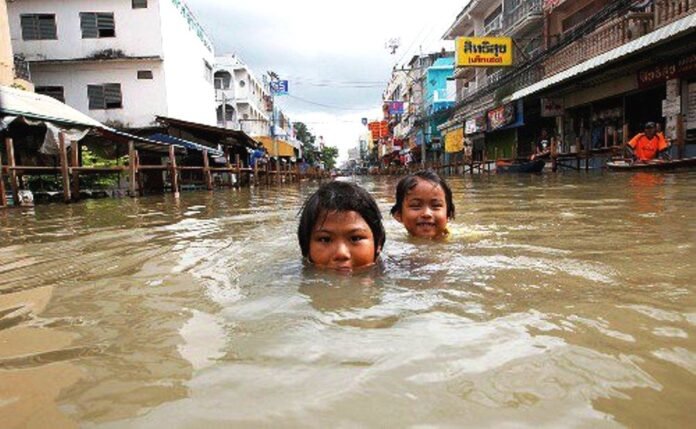
Bangkok, September 26: Authorities in Bangkok declared a flood disaster across the Thai capital on Saturday after almost two days of non-stop rain left major roads under water, stranded vehicles and forced hundreds of residents into emergency shelters.
Latest Update (September 28): Flooding has spread well beyond Bangkok. According to Thai Enquirer’s September 28 summary:
- 25 provinces are affected, with 174,803 households (545,022 people) hit outside Bangkok and about 52,000 more households in Bangkok.
- Eight deaths have been reported: five in Sa Kaeo, two in Chanthaburi and one in Saraburi.
- Special public holidays have been declared on September 28-29 for Bangkok, Nonthaburi, Pathum Thani and Samut Prakan. Bangkok has opened 233 temporary shelters and evacuated about 4,200 people.
- Airports are operating, and the Stock Exchange of Thailand confirmed normal trading, Bernama reported.
- The government plans to revive a 250 billion baht water-management project, including the Chainat–Pa Sak–Gulf of Thailand diversion canal.
Sources: Thai Enquirer, Bernama. The original report below was published on September 26.
Key highlights
- Bangkok was officially declared a flood-disaster area on Saturday, September 26.
- Rain fell almost continuously from Thursday afternoon into Saturday; accumulated rainfall in major canals exceeded 20 cm, according to the Associated Press. The National reported close to 300 mm in 48 hours.
- More than 84,000 people in 21 provinces had been affected by Saturday, and about 900 people had moved into more than 200 shelters, AP reported.
- Flights at Bangkok’s main airport continued normally, but travellers were advised to allow extra time to reach the airport.
- The Thai Meteorological Department expects heavy rain to continue through Sunday.
What happened
The worst flooding was in central and eastern Bangkok, where water rose quickly on arterial roads such as Phetchaburi Road. Cars were left half-submerged, motorcyclists pushed their bikes through the water and some regional bus services from Bangkok to the eastern provinces were suspended.
Governor Chadchart Sittipunt said the situation posed a risk to lives and could damage public and private property, with conditions most serious near the city’s canals. He also said the water should recede once the rain stops, and that city teams were working to drain it as fast as possible.
The Bangkok Metropolitan Administration opened schools as temporary shelters, while the Thai military set up shelters and field kitchens. Residents living next to canals were told on Saturday to move belongings to higher ground. Government buildings opened their car parks so people could move vehicles out of low-lying streets.
No deaths linked to Saturday’s Bangkok flooding had been reported by the time of publication.
Why Bangkok floods so quickly
Bangkok sits only a little above sea level on the flat delta of the Chao Phraya river, and much of its drainage depends on a network of canals (khlongs) and pumping stations. When very heavy rain falls in a short period, the canals fill faster than water can be pumped out, and low-lying roads flood first.
This week’s rain came from two systems working together: a strong low-pressure area that moved in from central Vietnam, and a southwest monsoon that strengthened over the Andaman Sea and the Gulf of Thailand. The Thai Meteorological Department had already warned Bangkok and 70 provinces of heavy to very heavy rain, flash floods, run-off from forests and landslides for September 23–27, and forecast waves of 2–3 metres in the upper Gulf, higher in thunderstorms.
Not 2011 — but a warning
Older residents told reporters they had not seen rain like this in 10 to 15 years. The comparison many Thais make is with the 2011 floods, when water from the northern provinces moved slowly south and swamped parts of Bangkok for weeks. Saturday’s flooding is different: it is mainly local rain overwhelming city drainage, and officials expect it to drain faster once the rain eases.
The risk now is the combination of more rain through Sunday and already-full canals. The country is also still recovering from last November’s floods in the south, which killed at least 145 people.
What it means for Indian travellers
Thailand is one of the most popular short-haul destinations for Indian tourists, and Bangkok is the main entry point. Airport operations were normal on Saturday, but road access was badly affected. Travellers with flights over the weekend should:
- leave for the airport 2–3 hours earlier than usual, as the Tourism Authority of Thailand advised;
- check with their airline for delays caused by weather diversions;
- avoid low-lying areas near canals and follow local advisories;
- use Thailand’s Disaster Alert app, the LINE account @1784DDPM or the 1784 hotline for official updates.
Asia’s wet September
Bangkok’s flood caps a month of severe weather across Asia. Nepal is still dealing with the aftermath of deadly floods (see Nepal flood toll reaches 1,367 as India sends more relief and the new barrier-lake risk), and Typhoon Dujuan forced schedule changes at the Asian Games in Japan (read more).
What happens next
Forecasters expect heavy rain to continue until Sunday. If it eases as predicted, the city says water on main roads should start draining away. Authorities have kept emergency teams and pumping equipment on standby, and the disaster declaration allows the city to use emergency funds and resources more quickly. The Press of Asia will update this report if the situation changes.
Sources / References
- Associated Press, via KSAT: “Heavy rain and flooding in Bangkok disrupts traffic and prompts evacuations” (September 26, 2026)
- Al Arabiya English: “Bangkok declares flood disaster as heavy rain disrupts traffic, prompts evacuations” (September 26, 2026)
- The National: “Thai capital Bangkok declared disaster zone amid flooding” (September 26, 2026)
- Nation Thailand: “Bangkok and 70 provinces warned of flash floods and rough seas” (Thai Meteorological Department warning)

The International Desk covers world and Asian affairs, diplomacy and conflict, with a focus on what they mean for India. Stories are checked against at least two credible sources before publication.