Kathmandu/New York, September 27: Nepal’s Prime Minister Balendra Shah has used his first address to the UN General Assembly to propose a Himalayan Climate Resilience Mechanism led jointly by Nepal, India and China — a plan to share satellite data, watch dangerous glacial lakes and coordinate early warnings and disaster help across borders. The proposal comes a month after the deadliest disaster in Nepal’s recent history, and as heavy rain in Nepal pushes floodwater towards Bihar this weekend.
Key highlights
- Shah proposed the mechanism in his maiden speech to the 81st UN General Assembly on September 24 (New York time).
- It would be led by Nepal, India and China and would share satellite data and expertise, monitor glacial lakes, strengthen early-warning systems and coordinate cross-border disaster assistance.
- He cited the August 26 Bhotekoshi-Trishuli disaster, which he called a “Himalayan tsunami”: more than 1,400 dead, according to UN News (Business Standard put the toll at 1,452), with thousands still missing.
- He said recovery would cost around 10% of Nepal’s GDP and called for grant-based climate finance rather than loans.
- India and China have not publicly responded to the proposal.
What Nepal is proposing
The idea is simple: the rivers and glaciers of the Himalaya cross national borders, but the data about them often does not. Shah proposed that Nepal, India and China jointly run a mechanism that would share satellite imagery and technical expertise, track glacial lakes that could burst, build joint early-warning systems and organise help across borders when disaster strikes.
“Climate change does not recognise borders. Glaciers and floods do not travel with a visa,” he told the Assembly, according to Business Standard. He described the Hindu Kush Himalaya as home to nearly two billion people and “part of the planet’s life-support system”, and said the mountains should “become a laboratory of international cooperation”.
The disaster behind the proposal
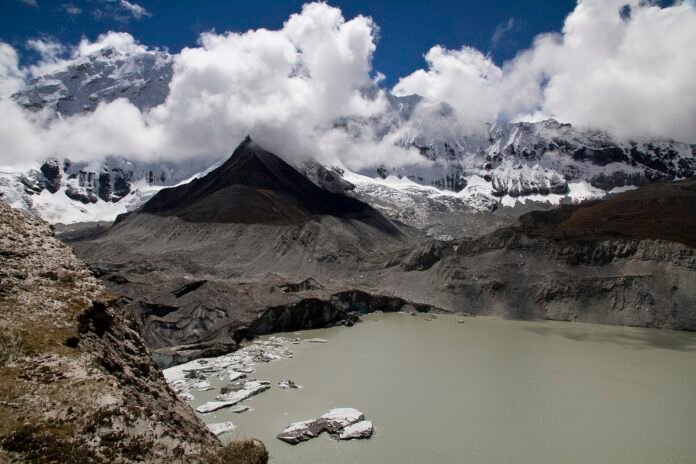
On August 26 an ice-and-rock avalanche near the Nepal-Tibet border set off a flood surge down the Bhotekoshi and Trishuli river valleys. Shah called it a “Himalayan tsunami”. UN News reported that more than 1,400 people were killed and more than 6,000 were missing; Business Standard gave figures of 1,452 dead and 4,700 to 6,000 missing. He said rebuilding would cost around a tenth of Nepal’s GDP, and thanked India and China for prompt help.
Shah used the disaster to argue for climate justice. Nepal produces less than 0.1% of global greenhouse gas emissions, he said, yet faces some of the worst impacts. He called current climate funds, including the Loss and Damage Fund, “grossly inadequate” and said “climate justice cannot just remain a beautiful phrase in a United Nations document”.
Why it matters for India
- Floods start upstream: rivers such as the Kosi, Gandak and Bagmati rise in Nepal and flood Bihar and Uttar Pradesh. This weekend Bihar put 17 districts on high alert after heavy rain in Nepal — see our Bihar flood report. Earlier, shared real-time data would give Indian districts more warning time.
- Glacial lake risk: glacial lake outburst floods (GLOFs) threaten Sikkim, Uttarakhand and Himachal Pradesh as well as Nepal. A regional monitoring system would cover lakes that sit across borders.
- A diplomatic test: India and China cooperate on some river-data sharing but relations remain sensitive. A three-way mechanism would need both to agree on data sharing in a strategically sensitive region.
Background
For our earlier coverage of Nepal’s floods, read Nepal flood toll reaches 1,367 as India sends more relief and the new barrier-lake flood risk. The death toll has risen since those reports.
What happens next
A proposal at the UN is a starting point, not an agreement. The mechanism would need formal responses from New Delhi and Beijing, and technical talks on what data to share and how. Regional bodies such as the Kathmandu-based ICIMOD, which already works on Himalayan glacier monitoring, could play a role. The Press of Asia will follow any official response from India or China.
Sources / References
- UN News: “Nepal PM urges climate justice after ‘Himalayan tsunami'” (September 2026)
- Business Standard: “Nepal PM proposes Himalayan climate resilience mechanism with India, China” (September 25, 2026)
- The Himalayan Times: “PM Shah proposes Nepal-India-China climate resilience mechanism at UN”

The International Desk covers world and Asian affairs, diplomacy and conflict, with a focus on what they mean for India. Stories are checked against at least two credible sources before publication.