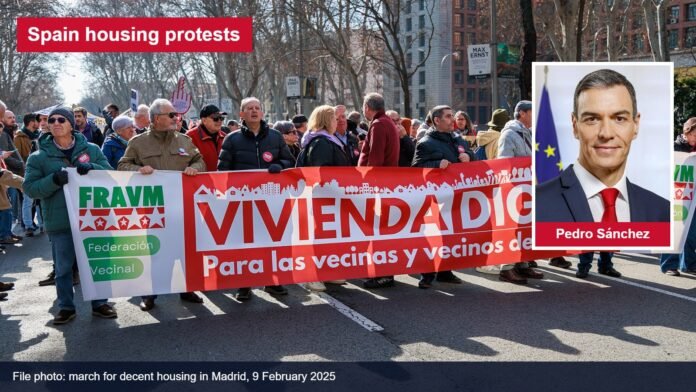
October 4: Tens of thousands of people marched in Madrid and about 50 other Spanish cities on Saturday, a day after parliament rejected two government decrees meant to halt evictions and extend rental contracts. The Spanish government put the Madrid crowd at about 70,000, while the Tenants’ Union claimed 500,000, The Olive Press reported. Organisers say they will now work with labour unions towards a general strike. Prime Minister Pedro Sánchez is reported to be considering a snap election in November.
Key highlights
- Protests: The main march was at Madrid’s Puerta del Sol, with demonstrations in about 50 cities, according to Reuters and Al Jazeera.
- The vote: On Friday, October 2, Congress rejected two housing decrees by 178 votes to 172 and 184 votes to 166, The Olive Press reported.
- The trigger: The movement grew after an 87-year-old pensioner was evicted from her Madrid home more than a week ago, Al Jazeera reported.
- Valencia: Police used rubber bullets and tear gas, and a group of protesters entered a cultural building.
- Politics: The opposition wants an election. The earliest possible polling date is November 20, according to The Olive Press.
What happened on the streets
Reuters reported that protesters in Madrid gathered at Puerta del Sol behind a banner calling for a general strike. The government estimated the crowd at around 70,000. The Tenants’ Union, which led the call, gave a figure of 500,000, according to The Olive Press. The two numbers are far apart and neither has been independently checked.
Tenants’ Union spokesperson Valeria Racu said a general strike would be called after talks with labour unions, Reuters reported. Thousands also marched in Valencia, Bilbao and the Canary Islands, according to The Olive Press. Protests in Barcelona and Hospitalet de Llobregat did not go ahead because of rain, Reuters reported. The Olive Press said the Barcelona march has been moved to Monday.
The most serious trouble was in Valencia. Al Jazeera reported that police used rubber bullets and tear gas, and that about 30 protesters briefly occupied a building in the City of Arts and Sciences complex. The Olive Press reported that a small group broke through police lines at the Palau de les Arts, where a real estate summit was being held, and that five people were arrested and nine police officers were injured. Reuters separately reported that police arrested three members of a far-right group.
What parliament rejected
The two decrees were brought by Sánchez’s minority left-wing government. According to The Olive Press, they would have halted evictions of tenants, forced extensions of residential rental contracts and placed restrictions on so-called vulture funds.
The first decree fell by 178 votes to 172, with the conservative Popular Party (PP), the far-right Vox and the Catalan separatist party Junts voting against, the newspaper reported. The second fell by 184 votes to 166, with the Basque party PNV and Coalición Canaria also voting no. Al Jazeera reported that Junts argued the measures would tighten the housing market.
The eviction that started it
Al Jazeera reported that the protest movement was set off by the eviction of an 87-year-old pensioner from her home in Madrid more than a week ago. After that, people began setting up tent camps to demand reforms. The Olive Press named the pensioner as Maricarmen Abascal and described her case as the one that brought public anger over housing to a head.
Racu told the crowd that eight days of “people’s power” can achieve more than eight years, as quoted by Al Jazeera.
What the government and opposition are saying
Deputy Prime Minister Yolanda Díaz blamed the parties that voted against the decrees. She said the next evictions “will carry the names of” PP leader Alberto Núñez Feijóo, Vox leader Santiago Abascal and Junts spokesperson Míriam Nogueras, The Olive Press reported. Minister Pablo Bustinduy said a general election would become a “referendum on housing”, according to the same report.
Feijóo urged Sánchez to call elections, Al Jazeera reported. Spanish media said Sánchez wanted to see the strength of Saturday’s protests before deciding his next step.
What happens next
- Election call: The Olive Press reported that the earliest possible polling date is November 20, and that a formal announcement would have to come by Tuesday to meet constitutional deadlines. It said a decision was expected over the weekend, with an announcement at a party meeting on Monday. Reuters also reported that Sánchez is considering a snap election in November.
- General strike: The Tenants’ Union says it will set a date after talks with labour unions. No date has been announced.
- Barcelona: The postponed march is due on Monday, according to The Olive Press.
Spain is not the only country heading into a tense vote. Also read: Brazil votes on Sunday with Lula and Flávio Bolsonaro neck and neck.
Sources
- Reuters via The Business Standard: Tens of thousands protest across Spain over housing crisis
- Al Jazeera: Tens of thousands protest in Spain after failed housing reforms
- The Olive Press: Madrid protests after Pedro Sánchez’s housing reforms blocked in Congress

The International Desk covers world and Asian affairs, diplomacy and conflict, with a focus on what they mean for India. Stories are checked against at least two credible sources before publication.