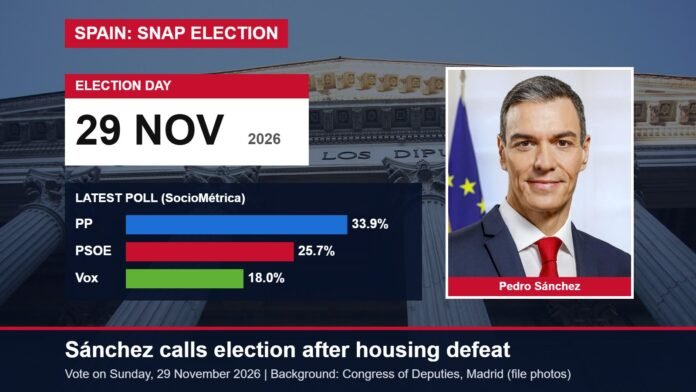
October 5: Spain’s Prime Minister Pedro Sánchez on Monday called an early general election for Sunday, 29 November, three days after parliament rejected his minority government’s housing decrees and two days after mass protests over rents and evictions. In a statement from the Moncloa Palace he said he had called an extraordinary cabinet meeting to dissolve parliament. His term had been due to run until July 2027, The National reported.
Key highlights
- Date: Sunday, 29 November 2026. The decree is to be published in the official gazette on Tuesday.
- Trigger: Congress rejected two housing decrees on Friday, 2 October, by 178 votes to 172 and 184 to 166.
- Sánchez: “We need to renew people’s support.”
- Poll: SocioMétrica puts the People’s Party (PP) on 33.9%, the Socialists on 25.7% and Vox on 18%.
- Stakes: A PP government backed by Vox would bring the far right into Spain’s national government for the first time since the death of Francisco Franco.
What Sánchez announced
The Spanish government’s own account says Sánchez informed the head of state and then called an extraordinary Council of Ministers for Monday morning to dissolve the Cortes Generales, with the formal election decree to appear in the Official State Gazette the next day.
“We need to renew people’s support,” he said in the televised statement, in the Reuters translation carried by Al Jazeera. “We need to mobilise and win a much larger progressive majority in Parliament.” He also conceded ground: “I also know that part of that social majority is dissatisfied today.”
According to the Moncloa text, Sánchez warned against what he called a “far-right wave”, defended his record on growth and jobs, and said that injustices remain, above all in access to housing, and that fixing them needs a much broader majority.
Why now
On Friday Congress voted down two government decrees meant to halt evictions and extend rental contracts. The margins were 178 to 172 and 184 to 166, as we reported in our account of the weekend protests. On Saturday the government put the crowd in Madrid at about 70,000, while the Tenants’ Union claimed 500,000.
The protests grew after the eviction of an 87-year-old woman from the Madrid flat she had lived in since 1956, Greek City Times reported. Average rents have nearly doubled in a decade and home prices are up about 90%, according to property data cited by Al Jazeera.
Housing is not the only pressure. Euronews lists a migration crisis in the Spanish enclave of Ceuta in late July, court cases involving people close to the prime minister and a run of defeats in Congress. The National puts the number of undocumented migrants who reached Ceuta at 80,000; Euronews says tens of thousands. The National adds that the government has not passed a budget in this term.
The opposition and the polls
PP leader Alberto Núñez Feijóo said voters must decide “whether they want four more years of what we’ve been living through, or whether they want to give change a chance”, Al Jazeera reported. The National quoted him as saying “We are ready”.
The SocioMétrica poll cited by The National gives the PP 33.9%, the Socialists (PSOE) 25.7% and Vox 18%. Polls point to a PP-led government that may need the support of Vox, Al Jazeera reported.
The left has its own problems. Deputy Prime Minister Yolanda Díaz has said she will not stand again, and her Sumar alliance is due to present new leadership on 17 October, Greek City Times reported.
Timeline
- 2 October: Congress rejects two housing decrees.
- 3 October: Protests in Madrid and about 50 other cities.
- 5 October: Sánchez announces the dissolution of parliament.
- 6 October: The election decree is due in the Official State Gazette.
- 17 October: Sumar is due to present its new leadership.
- 29 November: Election day.
Analysis: the Asia angle
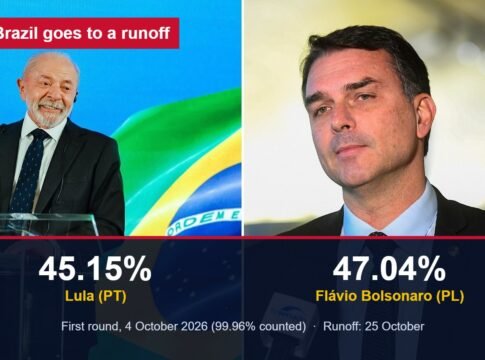
Analysis by the International Desk. Sánchez has made four trips to China as prime minister. On the most recent, in April, he met President Xi Jinping and agreed a new Permanent Strategic Dialogue, and said that “we have elevated political dialogue with China to its highest level in the last fifty-three years”, according to the Spanish government. Investment in electric vehicles, batteries and wind energy was among the subjects discussed. Whether that approach survives a change of government is one of the things Asian governments and investors will watch in this campaign. Spain’s vote also follows Brazil’s first round, where a left-wing incumbent is also trailing a challenger from the right.
References
- La Moncloa (Government of Spain): Pedro Sánchez anuncia la convocatoria de elecciones generales para el 29 de noviembre
- Al Jazeera, with Reuters: Spain’s Pedro Sanchez announces snap election amid housing crisis
- Euronews: Spain’s Sánchez calls snap election for 29 November after housing defeat
- The National: Spain’s Sanchez calls snap election after housing protests
- Greek City Times: Spain’s Pedro Sánchez calls snap election as housing crisis threatens his grip on power
- La Moncloa: Pedro Sánchez on his April 2026 trip to China

The International Desk covers world and Asian affairs, diplomacy and conflict, with a focus on what they mean for India. Stories are checked against at least two credible sources before publication.