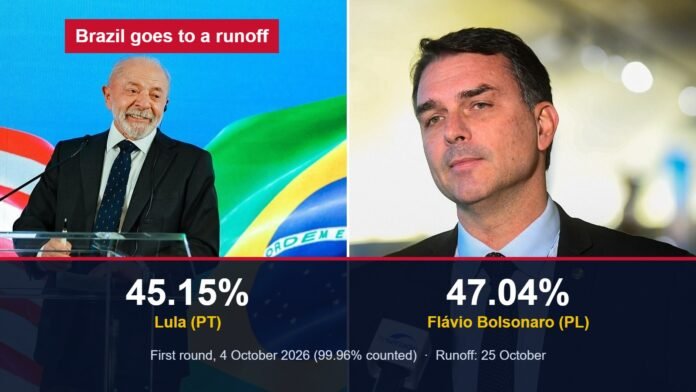
October 5: Brazil’s presidential election is going to a second round. With 99.96% of polling stations counted, Senator Flávio Bolsonaro of the Liberal Party (PL) had 47.04% of the vote in Sunday’s first round and President Luiz Inácio Lula da Silva of the Workers’ Party (PT) had 45.15%, according to the official count. Neither reached the 50% needed to win outright. The two will face each other in a runoff on Sunday, October 25.
Key highlights
- Flávio Bolsonaro (PL): 47.04%, or 56,098,129 votes.
- Lula (PT): 45.15%, or 53,845,563 votes.
- Gap: 1.89 percentage points, about 2.25 million votes.
- Counted: 499,070 of 499,248 polling stations. The 178 still out cannot change the result.
- Runoff: Sunday, October 25.
The result in numbers
The other candidates were far behind. The author and psychiatrist Augusto Cury won 2.89%, the businessman Renan Santos 2.24%, Ronaldo Caiado of Goiás 2.18% and Romeu Zema of Minas Gerais 0.27%. Both have served as state governors. Six more candidates each got less than 0.2%.
The race tightened sharply as the count went on. With about 65% of votes counted, Flávio Bolsonaro was ahead by 7.3 points. The gap shrank to under two points as results came in from the north-east, where Lula is strongest.
The result is better for the challenger than the last polls suggested. Three surveys taken in late September all had Lula slightly ahead in the first round, as we reported before the vote: Brazil votes with Lula and Flávio Bolsonaro neck and neck.
A country split by region
The map shows the same divide Brazil has seen in recent elections:
- Flávio Bolsonaro led in 15 states, including São Paulo (51.9%), Rio de Janeiro (53.0%), Minas Gerais (48.2%), Paraná (59.9%) and the Federal District (51.3%).
- Lula led in 12 states, including Bahia (66.1%), Ceará (63.3%) and Pernambuco (63.5%).
Brazilians also voted for Congress and state governors. The PL was leading in the races for 19 of the 54 Senate seats being contested. The right gained ground.
Who the two candidates are
Lula, 80, is seeking a fourth term as president. His running mate is Vice President Geraldo Alckmin.
Flávio Bolsonaro is a senator from Rio de Janeiro and the son of former president Jair Bolsonaro, who is serving a 27-year prison sentence for attempting a coup.
The campaign was dominated by crime, corruption and US President Donald Trump. Two days before the vote, the United States suspended consular services across Brazil, citing security concerns, and Lula’s party called the move an attempt to influence the election. Brazilian police said then that preventive searches had found no evidence of a threat.
What happens next
- Three weeks of campaigning: The runoff is on October 25. Only the top two candidates take part.
- The votes in play: Cury, Santos, Caiado and Zema together won about 7.6% of the vote. Where those voters go will matter more than anything else, because the gap between the two leaders is under two points.
- Turnout in the north-east: Lula’s late recovery in the count came from there.
- Congress: Final seat counts will show how much support the next president can expect in the legislature.
Why it matters in Asia
Brazil is a founding member of BRICS alongside India and China, and China is its largest trading partner. A change of government in Brasília could alter how the country lines up between Washington and Beijing, and how active it stays in BRICS. Neither candidate’s runoff platform on these questions has been set out in the reports reviewed for this article, so this is a point to watch, not a prediction.
Also read: Spain’s housing protests and the snap election Sánchez is weighing.

The International Desk covers world and Asian affairs, diplomacy and conflict, with a focus on what they mean for India. Stories are checked against at least two credible sources before publication.