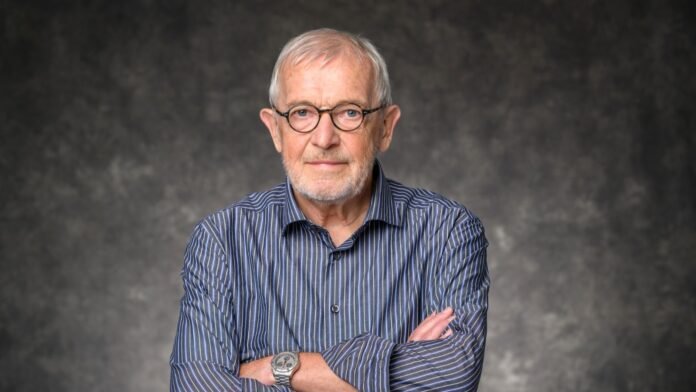
October 6: The 2026 Nobel Prize in Physics was awarded on Tuesday to Francis Halzen of the University of Wisconsin-Madison, “for decisive contributions to the IceCube Neutrino Observatory and the discovery of high-energy neutrinos of astrophysical origin”, according to the American Institute of Physics (AIP), which published the citation. Halzen is the only winner this year, Forbes reported. The prize is worth 12 million Swedish kronor, about $1.2 million.
Key highlights
- Winner: Francis Halzen, a professor at the University of Wisconsin-Madison since 1972 and the lead scientist of IceCube since 2001.
- The detector: Thousands of light sensors frozen into a cubic kilometre of ice at the South Pole.
- The discovery: In 2013 IceCube detected high-energy neutrinos from outside the solar system for the first time.
- Sole winner: The prize is not shared.
- Asia’s part: Universities in Japan, South Korea and Taiwan are members of the IceCube collaboration.
What IceCube is
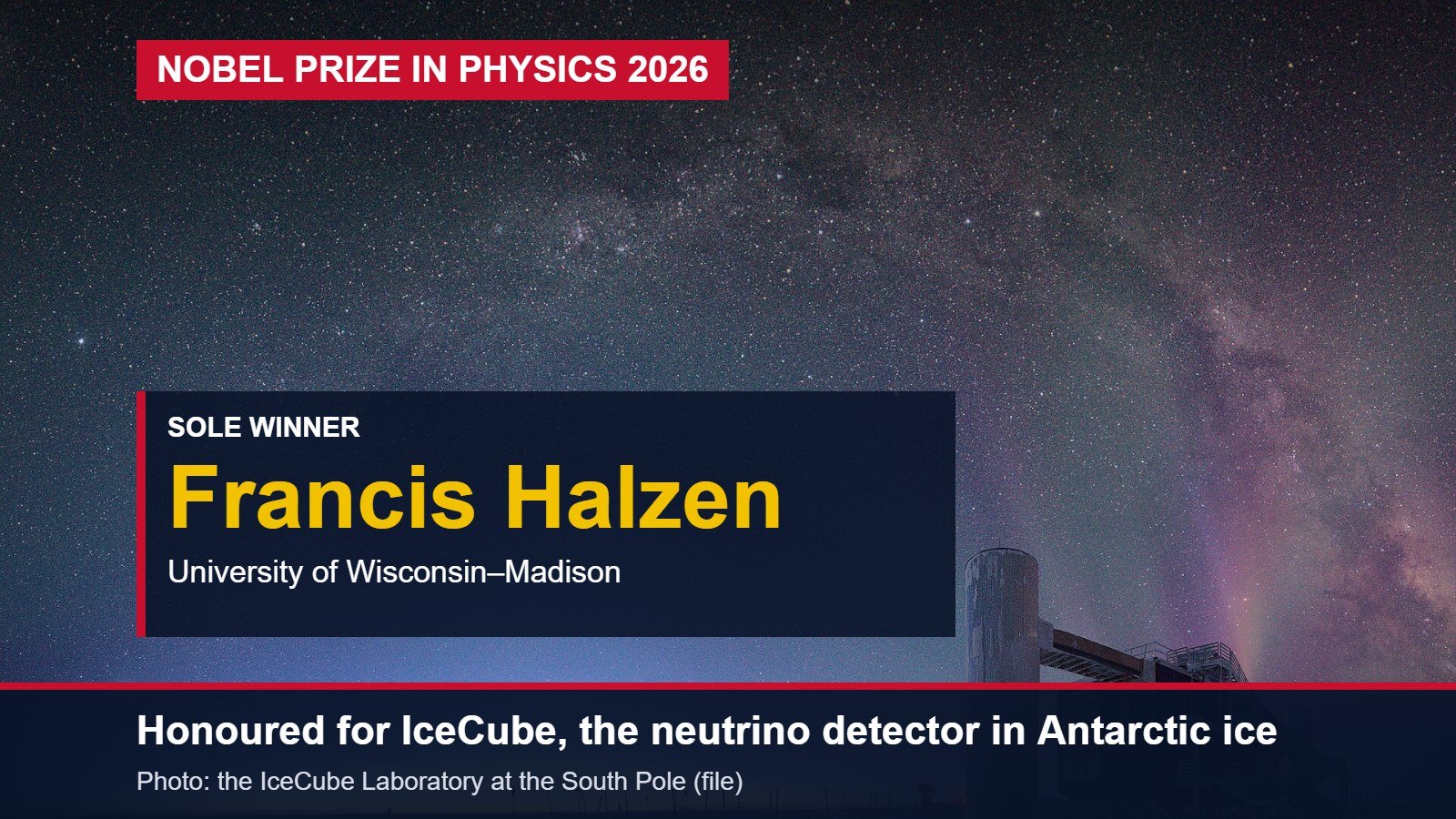
Neutrinos are particles that pass through almost everything, which makes them very hard to catch. Halzen first set out his idea of using the Antarctic ice itself as a detector in 1988, Forbes and the AIP said. When a neutrino does hit an atom in the ice, it produces a flash of light, and the sensors record it.
The University of Wisconsin-Madison describes IceCube as the world’s largest telescope and “perhaps strangest”: thousands of light sensors embedded in a cubic kilometre of Antarctic ice, paid for by the US National Science Foundation and run by an international collaboration. The AIP said the detector lies about two kilometres under the surface.
“Francis Halzen has led an international team of researchers and engineers who have provided us with a fantastic instrument,” said Mark Pearce, chair of the Nobel committee for physics, as quoted by Forbes.
“This is a celebration of a very unusual project. It is difficult to imagine that we could have pulled this off anywhere but at UW-Madison,” Halzen said in the university’s statement.
What it has found
The University of Wisconsin-Madison lists four results:
- 2013: The first detection of high-energy neutrinos from outside the solar system.
- September 2017: A high-energy neutrino traced to a supermassive black hole in the direction of the constellation Orion.
- 2022: The first evidence of high-energy neutrinos from an active galaxy 47 million light-years away.
- 2023: Neutrinos detected from our own galaxy, the Milky Way.
The university said the detector has recently been upgraded, its first major expansion since it was completed 15 years ago.
Who Francis Halzen is
Halzen took a master’s degree in physics at the University of Louvain in 1966 and a doctorate in 1969, and joined the faculty at Wisconsin in 1972, Forbes reported. He has been IceCube’s principal investigator since 2001, according to the AIP. The university said he is the sixth physicist connected to it to win a Nobel Prize.
The Asia link
IceCube is run by a collaboration of 58 institutions in 14 countries, according to the project’s own list, which is dated April 2025. Four of them are in Asia: Chiba University in Japan, Sungkyunkwan University and Chung-Ang University in South Korea, and Academia Sinica in Taiwan.
What comes next
The prize will be presented in Stockholm on 10 December, Physics World reported. The medicine prize was announced on Monday and went to three pioneers of optogenetics, as we reported this morning: Nobel Prize in Medicine 2026. The Peace Prize is due on Friday.
Sources
- University of Wisconsin-Madison: Professor Francis Halzen named 2026 Nobel laureate in physics
- AIP Publishing: AIP congratulates 2026 Nobel Prize winner in physics
- Forbes: University of Wisconsin professor wins the 2026 Nobel Prize in Physics
- Physics World: Francis Halzen wins Nobel Prize in Physics
- IceCube Neutrino Observatory: Institution list
- Nobel Prize (YouTube): Announcement of the 2026 Nobel Prize in Physics

The International Desk covers world and Asian affairs, diplomacy and conflict, with a focus on what they mean for India. Stories are checked against at least two credible sources before publication.