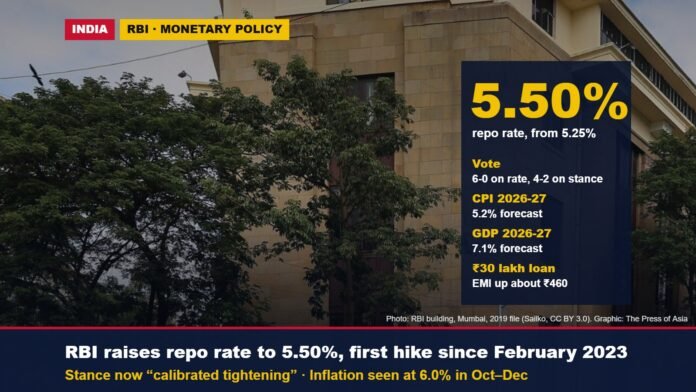
October 7: The Reserve Bank of India’s Monetary Policy Committee (MPC) raised the repo rate by 0.25 percentage points to 5.50% on Wednesday, its first increase since February 2023. The committee also changed its stance from “neutral” to “calibrated tightening”, meaning gradual tightening as needed. Governor Sanjay Malhotra said rate cuts were “off the table in the near term”. The RBI kept its retail inflation forecast for 2026-27 at 5.2% and its growth forecast at 7.1%.
Update (October 8): A day after the decision, PNB, Bank of Baroda, Indian Bank, Bank of India, Indian Overseas Bank and Tamilnad Mercantile Bank raised their repo-linked lending rates by 0.25%.
Key highlights
- Repo rate up from 5.25% to 5.50%. The Standing Deposit Facility (SDF) rate is now 5.25%, and the Marginal Standing Facility (MSF) rate and Bank Rate 5.75%.
- The rate decision was unanimous. On the change of stance, two external members, Dr Nagesh Kumar and Prof. Ram Singh, favoured keeping a neutral stance.
- The RBI expects inflation to reach 6.0% in the October–December quarter.
- Retail inflation was 4.8% in August 2026, up from 4.5% in July.
- Repo-linked home loans will cost more: on a 20-year loan of ₹30 lakh, the EMI rises by about ₹460 (our calculation below).
- The next MPC meeting is on December 2–4, 2026.
The decision
The MPC resolution says the committee decided to raise the policy repo rate by 25 basis points to 5.50%, taking the SDF rate to 5.25% and the MSF rate and Bank Rate to 5.75%. It also decided to change the stance to “calibrated tightening”. The rate decision was unanimous. On the stance, the resolution records that two members, Dr Nagesh Kumar and Prof. Ram Singh, wanted it kept at neutral. The repo rate is the rate at which the RBI lends short-term money to banks; when it rises, money becomes costlier for banks and they raise lending rates.
The RBI’s projections
| Period | Retail inflation (CPI) | Real GDP growth |
|---|---|---|
| July–September 2026 (Q2) | 4.9% | 7.2% |
| October–December 2026 (Q3) | 6.0% | 6.9% |
| January–March 2027 (Q4) | 5.7% | 6.8% |
| Full year 2026-27 | 5.2% | 7.1% |
| April–June 2027 (Q1, 2027-28) | 5.6% | 7.1% |
The resolution projects core inflation, which excludes food and fuel, at 4.4% for 2026-27. The growth forecast was raised by 0.4 percentage points to 7.1%, and the economy grew 7.8% in April–June 2026.
Why the rate was raised
The resolution says inflation and its outlook are no longer as benign as last year, and that retail inflation could average about 5.8% over the next three quarters. Food and fuel prices drove August’s rise, but core inflation also increased, to 4.2% in August from 3.9% in July. The Governor’s statement points to volatile international oil prices, a deficient southwest monsoon, El Niño conditions and sharp rises in items such as sugar and onions.
What the Governor said
Governor Malhotra said further rate cuts were not on the table in the near term and that cyclical inflation risks were no longer as mild as before. Asked how far and how long rates would rise, he said it would depend on actual growth and inflation data and the outlook. The Governor also said the RBI will set up a Technical Consultative Committee for Financial Markets.
How much your EMI rises: our calculation
Since October 2019, banks’ new floating-rate home loans have been linked to an external benchmark, and most banks chose the repo rate. Rates on these loans reset at least once every three months, so the increase will reach borrowers quickly. The table assumes the bank passes on the full 0.25%, a 20-year loan, and a rate rising from 7.50% to 7.75%. Your figures will differ if your bank’s rate or remaining tenure differs.
| Loan amount | Old EMI (7.50%) | New EMI (7.75%) | Monthly increase | Extra interest over the term |
|---|---|---|---|---|
| ₹20 lakh | ₹16,112 | ₹16,419 | ₹307 | about ₹74,000 |
| ₹30 lakh | ₹24,168 | ₹24,628 | ₹460 | about ₹1.11 lakh |
| ₹50 lakh | ₹40,280 | ₹41,047 | ₹767 | about ₹1.84 lakh |
| ₹75 lakh | ₹60,419 | ₹61,571 | ₹1,152 | about ₹2.76 lakh |
A similar calculation for a 25-year loan: on ₹50 lakh, the EMI rises by ₹817. Banks may instead keep the EMI unchanged and extend the tenure; the instalment then stays the same but total interest rises. Fixed deposit rates usually change later and more slowly than lending rates.
The repo rate’s path
| When | Repo rate | What happened |
|---|---|---|
| February 2023 | 6.50% | The last hike before this one |
| February 2025 | 6.25% | Easing cycle begins |
| April 2025 | 6.00% | Cut of 0.25% |
| June 2025 | 5.50% | Cut of 0.50% |
| December 2025 | 5.25% | Cut of 0.25%; unchanged until August 2026 |
| October 2026 | 5.50% | Hike of 0.25%; stance changed to “calibrated tightening” |
What to watch
- The minutes, released on October 21, confirm all six members voted for the hike; watch whether the two members who preferred a neutral stance hold that view in December.
- The next policy meeting on December 2–4, 2026.
- When and by how much banks raise their repo-linked lending rates.
What it means for India
The hike is small, but the signal is big. Changing the stance along with the rate keeps the door open to more increases, and the Governor has clearly ended hopes of a cut. The RBI itself expects inflation to reach 6% in October–December, well above its 4% target. The two dissents on the stance show the committee is not united on how far tightening should go. At the same time, the growth forecast was raised, suggesting the RBI believes the economy can absorb somewhat higher rates. For borrowers, the era of cheaper loans has paused for now.
Sources
- RBI: Governor’s Statement, October 7, 2026
- RBI: Resolution of the Monetary Policy Committee, October 5–7, 2026
- RBI: Minutes of the MPC meeting, October 5–7, 2026
Note: this report is for information, not investment or loan advice. Ask your bank for your exact EMI. This article was first published in Hindi and has been translated. The Press of Asia now publishes in English only.

The Business Desk covers markets, the economy, companies and personal finance. Stories are checked against at least two credible sources before publication.