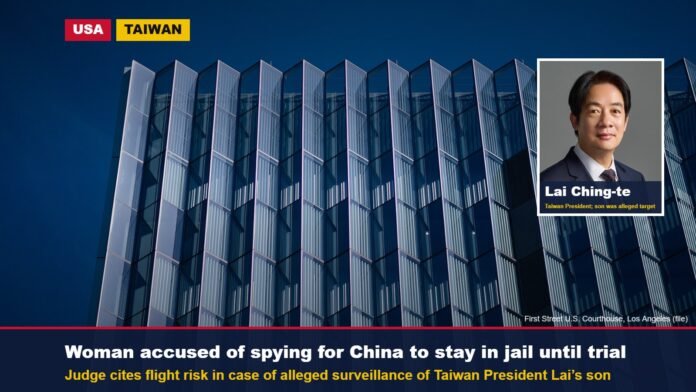
October 8: A federal judge in Los Angeles on Wednesday ordered Wanying Zhang, the California real estate agent accused of spying on the son of Taiwan’s President Lai Ching-te for China, to remain in custody until trial. US Magistrate Judge Steve Kim agreed with prosecutors that the 34-year-old posed too great a risk of fleeing, after they told the court she had not been truthful about the properties and money she holds. Zhang has not been indicted, and the charge against her is an allegation that she has not yet answered at trial.
Key highlights
- Judge Kim noted “inconsistencies” about the number of properties and assets Zhang owns and “where the money is coming from”.
- Prosecutor Amanda Elbogen told the court Zhang received $190,000 in a Chinese bank account from an “unregistered cryptocurrency exchange” business and had travelled to China 12 times since 2014.
- Zhang offered more than $1.2 million in property as bond. Her lawyer, Craig Harbaugh, called the asset discrepancy a “misunderstanding”.
- A preliminary hearing is set for as early as October 19, unless prosecutors obtain an indictment first.
- The charge, acting as an agent of China without notifying the US Attorney General, carries up to 10 years in prison, the Justice Department has said.
What the court heard
Elbogen called Zhang a “secret agent of a hostile foreign power” and said, “She has been lying to her own family about who she is.” She told the court that Zhang had claimed on asset forms to own one property when she owned several. She added: “She lied to pretrial services. She’s a real estate agent; she should know what properties she owns.”
The FBI was concerned that Zhang might leave the country if released. Prosecutors said her parents, brother and sister live in China, that her brother has worked for the Chinese government, that she regularly has money deposited in a Chinese bank account, and that she has owned a business in China. A Chinese passport was not found when agents searched her home. Prosecutors said she had travelled abroad 29 times in total.
Harbaugh, her private lawyer, argued that the only spying allegation dates to September 2025 and that her last contact with her alleged Chinese handlers was in October 2025. He described the government’s theory as treating her as a “sleeper agent for the last 10 years”, and said it was not supported. Zhang, who lives in Orange County, works as a realtor at a firm in Irvine where her husband also works.
The two sides at a glance
| Issue | Prosecution | Defence |
|---|---|---|
| Flight risk | Family in China, a brother who has worked for the Chinese government, regular deposits in a Chinese bank account, 12 trips to China since 2014 | Offered more than $1.2 million in property as bond |
| Assets | Said she claimed one property on asset forms but owns several | Called the discrepancy a “misunderstanding” |
| The alleged spying | Acting under the direction of Chinese officials from June to September 2025 (Signal SCV, citing prosecutors) | Only one alleged act, in September 2025; last contact with handlers in October 2025 |
| Overall picture | “Secret agent of a hostile foreign power” (Elbogen) | Government treats her as a “sleeper agent for the last 10 years”, which the defence says is not supported |
How the case has moved
| Date | Step | Source |
|---|---|---|
| June 2025 | Zhang allegedly meets Chinese officials in China | US Justice Department |
| September 1, 2025 | Alleged surveillance of the home, family and cars of Lai Ting-yu, the president’s elder son, near Seattle | US Justice Department |
| October 2025 | Last contact with alleged handlers, according to the defence | Public record |
| Sunday, October 4, 2026 | Arrested at Los Angeles International Airport before a planned flight to China | US Justice Department |
| Monday, October 5 | First court appearance; a federal public defender represents her; detention hearing set for Wednesday | Signal SCV |
| Wednesday, October 7 | Judge Steve Kim orders her held until trial | Public record |
| As early as October 19 | Preliminary hearing, unless an indictment comes first | Public record |
What a detention hearing decides
A detention hearing is not a verdict. Under the US Bail Reform Act, a judge decides whether any set of release conditions can reasonably make sure a defendant returns to court and does not endanger others. The factors the law lists include the nature of the charge, the weight of the evidence, and the person’s history and characteristics, such as family ties, financial resources and travel (18 U.S.C. § 3142). In Zhang’s case, the questions about her property and money weighed against release, according to the reports. The ruling says nothing about whether she is guilty.
What it means for Taiwan and the region
When the arrest was announced, Taiwan’s Presidential Office called the case “transnational repression”. The detention order keeps the case in the news as Taipei and Washington watch for signs of Chinese pressure on Taiwanese leaders and their families abroad. China’s embassy in Washington did not comment publicly at the time of the arrest, and no Chinese response to Wednesday’s hearing has been reported. Our earlier report on the arrest has the details of the complaint: FBI arrests California realtor accused of spying on Taiwan President Lai’s son for China.
What to watch
- Whether a grand jury indicts Zhang before the preliminary hearing set for as early as October 19.
- Any appeal of the detention order by the defence.
- Any response from Beijing, and any further statement from Taiwan’s Presidential Office.
Sources
- US Department of Justice: California Woman Arrested on Charges Alleging She Acted as Agent of China and Spied on Relatives of U.S. Based High-Ranking Taiwanese Government Official
- Cornell Law School, Legal Information Institute: 18 U.S. Code § 3142, Release or detention of a defendant pending trial

The International Desk covers world and Asian affairs, diplomacy and conflict, with a focus on what they mean for India. Stories are checked against at least two credible sources before publication.