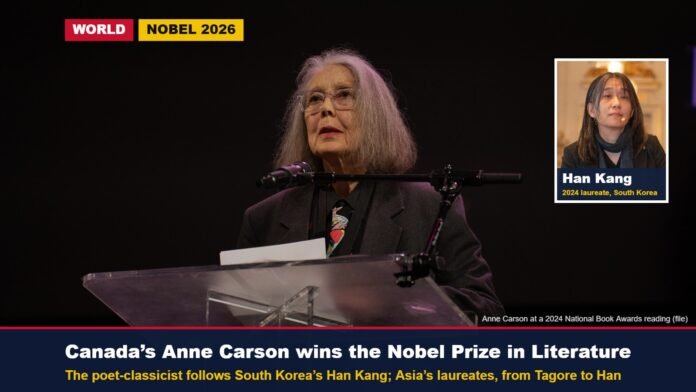
October 8: The Swedish Academy has awarded the 2026 Nobel Prize in Literature to Anne Carson, the Canadian poet, essayist, translator and classicist, “for her bold and inventive oeuvre that, in playful dialogue with the classical tradition, has created new forms for contemporary literature”, Euronews reported. Carson, 76, was born in Toronto in 1950. She follows the Hungarian novelist László Krasznahorkai, who won in 2025, and South Korea’s Han Kang, who won in 2024. The prize is worth 12 million Swedish kronor, about $1.2 million, and will be presented in Stockholm on December 10, The National reported.
Key highlights
- Anders Olsson, chair of the Nobel Committee for Literature, said Carson’s work centres on “the philologist’s obsession with words and the poet’s desire for new meaning”, according to The National.
- She was in Iceland when the Academy reached her by phone and was “taken by surprise”, said Ingrid Carlberg, the Academy’s permanent secretary, The National reported.
- Carson is the 19th woman to win the literature prize, which has now been awarded 119 times to 123 laureates, Euronews said.
- Her best-known books include Autobiography of Red (1998), a novel in verse, and Nox (2010), written after her brother’s death.
- Asia’s record: by our count from the Nobel list, nine of the 123 literature laureates were born in or are citizens of Asian countries. Rabindranath Tagore in 1913 was the first, and Han Kang in 2024 the most recent.
Who is Anne Carson
Carson became interested in ancient Greek at secondary school, where a Latin teacher taught her Greek during lunch breaks, The National reported. She earned a doctorate in classics at the University of Toronto in 1981 and has taught at universities in Canada and the United States, including McGill University and the University of Michigan. Her work mixes poetry, essay and translation, and often sets modern lives against Greek myth and literature.
Olsson praised her “extraordinary ability to give the classical literary tradition an intensely contemporary feel” and described Nox as “a creation as sculptural as it is literary”, The National reported.
| Year | Work | Notes |
|---|---|---|
| 1986 | Eros the Bittersweet | Listed among her notable works by Euronews |
| 1995 | The Glass Essay | Listed by The National |
| 1998 | Autobiography of Red | Novel in verse reworking the myth of Geryon (The National) |
| 2001 | The Beauty of the Husband | “A Fictional Essay in 29 Tangos” (The National) |
| 2010 | Nox | Book written after her brother’s death (The National) |
| 2012 | Antigonick | Reworking of Sophocles’ Antigone (The National) |
| 2019 | Norma Jeane Baker of Troy | Listed among her notable works by Euronews |
| 2024 | Wrong Norma | Finalist for the US National Book Award for Poetry (The National) |
Her earlier honours include a MacArthur Fellowship (2000), the T. S. Eliot Prize (2001), the Griffin Poetry Prize (2001 and 2014) and Spain’s Princess of Asturias Award for Literature (2020), according to The National.
Asia and the literature prize
Carson has no particular link to Asia, but her win comes two years after South Korea’s Han Kang, and it is a good moment to look at Asia’s place in the prize’s history. The table lists laureates born in, or citizens of, Asian countries, using the Wikipedia list of laureates, which follows the Nobel Foundation’s records.
| Year | Laureate | Country as listed | Language |
|---|---|---|---|
| 1913 | Rabindranath Tagore | India (British Raj) | Bengali and English |
| 1966 | Shmuel Yosef Agnon (shared with Nelly Sachs) | Israel (born in Austria-Hungary) | Hebrew |
| 1968 | Yasunari Kawabata | Japan | Japanese |
| 1994 | Kenzaburō Ōe | Japan | Japanese |
| 2000 | Gao Xingjian | France (born in China) | Chinese and French |
| 2006 | Orhan Pamuk | Turkey | Turkish |
| 2012 | Mo Yan | China | Chinese |
| 2017 | Kazuo Ishiguro | United Kingdom (born in Japan) | English |
| 2024 | Han Kang | South Korea | Korean |
What the table shows
- Nine of 123. By our count, about 7% of all literature laureates have this Asian connection.
- A 53-year gap. After Tagore in 1913, no laureate from Asia was chosen until Agnon in 1966.
- Japan leads. Japan has two laureates who wrote in Japanese, Kawabata and Ōe, and a third, Ishiguro, was born there.
- One woman. Han Kang is the only woman in the table.
- India’s single entry. Tagore remains the only laureate listed under India, 113 years after his prize.
What it means
Four of the last seven literature prizes have now gone to women: Louise Glück in 2020, Annie Ernaux in 2022, Han Kang in 2024 and Carson in 2026, based on Euronews’ list of recent female winners. Carson’s prize rewards a writer who works across forms and languages, translating and reinventing Greek texts for modern readers. For Asian readers, the more useful lesson may be in the table above: in more than a century the prize has gone to writers in Asian languages only eight times, and many of the region’s major literatures, including those in Hindi, Urdu, Bahasa and Vietnamese, have never been recognised.
What to watch
- The Nobel Peace Prize, announced on Friday, October 9.
- The Nobel Memorial Prize in Economic Sciences, on Monday, October 12.
- Carson’s Nobel lecture before the award ceremony in Stockholm on December 10.
Earlier this week: Nobel Prize in Chemistry goes to Henri Kagan and Japan’s Kenso Soai.
Sources
- Euronews: Canadian poet Anne Carson wins 2026 Nobel Prize in Literature
- The National: Why Anne Carson won the 2026 Nobel Prize in Literature
- NobelPrize.org: Nobel Prize in Literature 2026, press release
- Wikipedia: List of Nobel laureates in Literature

The International Desk covers world and Asian affairs, diplomacy and conflict, with a focus on what they mean for India. Stories are checked against at least two credible sources before publication.