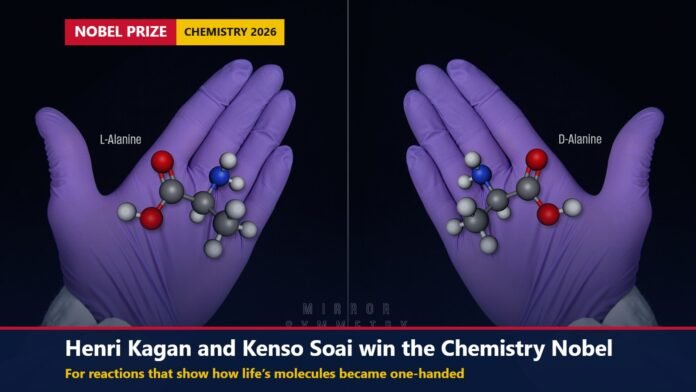
October 7: The Royal Swedish Academy of Sciences on Wednesday awarded the 2026 Nobel Prize in Chemistry to Henri B. Kagan of France and Kenso Soai of Japan “for the discovery of non-linear effects and autocatalysis in asymmetric organic synthesis”. Their reactions showed how a small excess of one mirror-image form of a molecule can grow into a large one, and in Soai’s case into almost nothing but that form. The two share 12 million Swedish kronor equally, the Academy said.
Key highlights
- Kagan, born in 1930 in Boulogne-Billancourt, is professor emeritus at Université Paris-Sud. Soai, born in 1950 in Hiroshima, is professor emeritus at Tokyo University of Science.
- The Academy dates Kagan’s discovery to 1986 and Soai’s to 1995, with a further result from Soai in 2003.
- “Henri Kagan and Kenso Soai have provided a solution to a chemical mystery that is over a century old,” said Heiner Linke, chair of the Nobel Committee for Chemistry.
- The work matters to drug makers because, in many medicines, only one of the two mirror-image forms has the wanted effect.
- “This is the most exciting day in my life,” Soai said on hearing the news, the Royal Society of Chemistry reported.
The problem: left hands and right hands
Many molecules come in two forms that are mirror images of each other, like a left and a right hand. Chemists call this chirality. The two forms contain the same atoms joined in the same order, but they cannot be placed on top of each other. In an ordinary laboratory reaction both forms are made in equal amounts.
Living things do not work that way. The amino acids in proteins are almost all of one hand and the sugars in DNA of the other. This is called homochirality, and how it arose has been an open question for more than a century. The Royal Society of Chemistry said the laureates’ work explains “a possible way” in which the chiral molecules on Earth settled into one handedness.
What the two laureates found
Kagan, 1986: non-linear effects. To make more of one hand than the other, chemists add a helper molecule, a catalyst, that is itself handed. The natural assumption was that the purity of the product could never be better than the purity of the catalyst: a catalyst that was 60 per cent one hand would give a product that was at best 60 per cent one hand. Kagan’s group showed that this straight-line relationship does not always hold. In some reactions a catalyst of modest purity gives a product of much higher purity. The Academy described it as a way of producing “a greater excess of one mirror-image molecule than previously achievable”.
Soai, 1995 and 2003: a reaction that copies its own hand. Soai found a reaction in which the product acts as the catalyst for making more of itself. If the first few molecules formed are slightly more of one hand, they speed up the making of that same hand, and the imbalance grows with every round. The Academy said he designed the first reaction with the potential for homochirality in 1995 and in 2003 demonstrated a reaction that produced only one of the two possible mirror images. The reaction is now known by his name.
| Henri B. Kagan | Kenso Soai | |
|---|---|---|
| Born | 1930, Boulogne-Billancourt, France | 1950, Hiroshima, Japan |
| Doctorate | 1960, Collège de France | 1979, University of Tokyo |
| Affiliation | Professor emeritus, Université Paris-Sud | Professor emeritus, Tokyo University of Science |
| Discovery | Non-linear effects in asymmetric reactions (1986) | Asymmetric autocatalysis, the Soai reaction (1995; one-handed product in 2003) |
| In one line | A partly pure catalyst can give a much purer product | A product that catalyses its own formation amplifies a tiny imbalance |
| Share of prize | 6 million kronor | 6 million kronor |
What they and the committee said
Linke called the laureates’ reactions “spectacular”, according to the Academy’s statement. Soai told the Royal Society of Chemistry’s news service: “Chirality is essential, it is a prerequisite to the origin of life, so we are very glad to find some organic reaction that explains homochirality.” He said he was “very glad to share this prize with professor Henri Kagan”.
Robert Mokaya, president of the Royal Society of Chemistry, said: “Asymmetric organic synthesis is a powerful example of how fundamental chemistry can underpin solutions to some of the biggest challenges facing society.”
Why it matters outside the laboratory
The Nobel statement, as quoted by the Royal Society of Chemistry, puts the practical point this way: “Many drug molecules occur in two variants that are each other’s non-identical mirror image: one has the therapeutic effect, while the other can cause unnecessary and sometimes harmful side effects.” The Academy said the discoveries have been decisive for chemists who design the reactions used to manufacture pharmaceuticals.
Common medicines show why. A few examples of drugs where one hand does the work:
| Medicine | What the handedness means |
|---|---|
| Ibuprofen | Sold as an equal mix of both forms; the pain-relieving activity comes from one of them, the S-form. |
| Esomeprazole | The single-handed (S) form of the acidity drug omeprazole, sold as a separate medicine. |
| Levocetirizine | The active hand of the allergy drug cetirizine, sold on its own at half the dose. |
Making only the wanted hand saves raw material and avoids giving patients a form that does nothing or does harm. That is why control of handedness, the subject of this prize and of the 2001 chemistry prize awarded to William Knowles, Ryoji Noyori and Barry Sharpless, sits at the centre of the modern drug industry.
The Asia angle
Soai’s award keeps Japan at the front of this field: Noyori, one of the 2001 laureates, is also Japanese, and Susumu Kitagawa of Kyoto University shared last year’s chemistry prize. Soai did the prize-winning work at Tokyo University of Science, a private university, after a doctorate at the University of Tokyo and postdoctoral research at the University of North Carolina, Forbes reported.
The subject also touches Asia’s factories. India and China produce a large share of the world’s generic medicines and the ingredients that go into them, and single-handed versions of older drugs are a standard part of that business. Reactions that deliver one hand cleanly, at scale and at low cost, are worth money to those industries.
This year’s Nobel week so far
- Medicine (October 5): Karl Deisseroth, Peter Hegemann and Georg Nagel, for optogenetics. Our report.
- Physics (October 6): Francis Halzen, for the IceCube neutrino detector. Our report.
- Chemistry (October 7): Henri Kagan and Kenso Soai.
What to watch
- The literature prize on Thursday, the peace prize on Friday and the economics prize on Monday, October 12, according to Forbes.
- The laureates’ Nobel lectures and the award ceremony in Stockholm in December.
Sources
- Royal Swedish Academy of Sciences: The Nobel Prize in Chemistry 2026
- Royal Society of Chemistry: Henri Kagan and Kenso Soai win 2026 Chemistry Nobel Prize
- ANI: Henri B Kagan and Kenso Soai win Nobel Prize in Chemistry 2026 for spontaneous homochirality solution
- Forbes: The 2026 Nobel Prize In Chemistry Is Awarded To Henri Kagan And Kenso Soai

The International Desk covers world and Asian affairs, diplomacy and conflict, with a focus on what they mean for India. Stories are checked against at least two credible sources before publication.