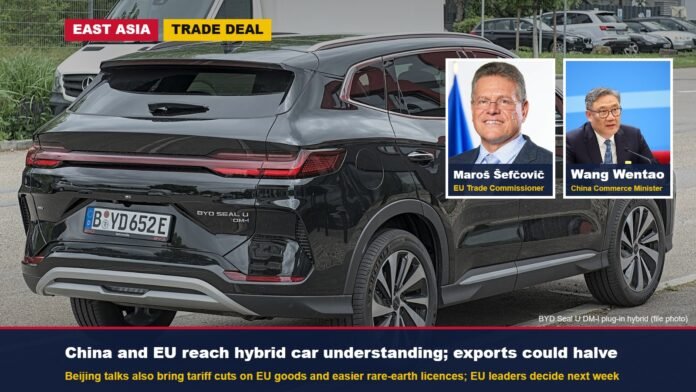
October 10: China and the European Union have reached a “shared understanding to moderate China’s export of hybrids and plug-in hybrids to the European Union”, EU Trade Commissioner Maroš Šefčovič said after two days of talks in Beijing, adding that it opens “the prospect of cutting China’s exports by more than 50 per cent”. China’s commerce ministry said it had reached an understanding with the EU on hybrid vehicle trade after intensive consultations and that it complies with WTO rules, but it did not disclose terms. The talks also produced Chinese tariff cuts on some EU goods and easier licensing for rare earths. EU leaders will take the final decision at the European Council on October 15 and 16.
Key highlights
- The understanding came two days after a media report that China had rejected an EU request for voluntary curbs on hybrid exports.
- According to the EU’s readout, as summarised by Geopolitechs, the cut of more than 50% is measured against a no-change projection over four years, and Šefčovič said it would prevent “several million cars” from being exported.
- Neither side has published the mechanism, the baseline or a timetable. Šefčovič said there are “various ways of going about this” and that technical details still need to be discussed.
- China will cut most-favoured-nation tariffs on EU goods such as car parts, olive oil and footwear, products with nearly €4 billion in current exports. Šefčovič estimated duty savings of “at least €225 million”.
- Šefčovič called the EU’s trade deficit with China “unsustainable” and said: “This is far from the end.”
What was agreed
| Area | What the EU says | What China says | Sources |
|---|---|---|---|
| Hybrid and plug-in hybrid cars | “Shared understanding” to moderate exports; prospect of a cut of more than 50% | An “understanding” reached after intensive consultations, in line with WTO rules; no terms disclosed | Public record |
| Tariffs on EU goods | Lower MFN tariffs on car parts, olive oil, footwear and more; nearly €4 billion of exports; at least €225 million in duty savings | Both sides will explore lower tariffs on certain goods within the WTO framework | Public record |
| Rare earths and magnets | Shared understanding to further ease export licensing | Will keep facilitating licences through a “green channel” | Public record |
| Battery-electric cars | No new figures; January guidelines on price undertakings remain valid | Procedures on company price undertakings and reviews will continue | Geopolitechs |
| Next steps | European Council decides on October 15–16; ministers meet by January; third consultation in March | Ministerial video conference in January 2027; third meeting in March | Public record |
What is still not known
The most important details are missing. Neither side has said how the cut would work, whether through quotas, a price arrangement or another tool, how long it would last, or what level of exports it starts from. In our earlier report we noted that a standard WTO safeguard has to apply to imports “irrespective of its source”; Šefčovič said only that the procedures would be WTO-compliant, according to Geopolitechs. Whether hybrids made by non-Chinese brands are affected therefore remains unclear.
The numbers
| Item | Figure | Source |
|---|---|---|
| Chinese hybrid imports into the EU, October 2024 | About 3,800 a month | Industry figures |
| Chinese hybrid imports into the EU, July 2026 | About 50,000 a month | Industry figures |
| Planned reduction | More than 50%, against a no-change projection over four years | EU readout and Geopolitechs |
| EU exports covered by China’s tariff cuts | Nearly €4 billion | Šefčovič |
| Expected duty savings | At least €225 million | Šefčovič |
| Average saving on those exports | About 5.6% | Our calculation (€225 million ÷ €4 billion) |
Because no baseline has been published, it is not yet possible to say how many cars a year would be allowed. As a rough illustration only: if the July 2026 level of about 50,000 a month were the starting point, halving it would mean about 25,000 a month. The actual reference point is a projection, not the July figure.
How we got here
| Date | Event | Source |
|---|---|---|
| October 30, 2024 | EU duties on Chinese battery-electric cars take effect; hybrids not covered | European Commission |
| September 17, 2026 | Media reports said the EU wanted China to curb hybrid exports voluntarily | Public record |
| October 7, 2026 | Media reports said China rejected voluntary curbs and the EU was preparing an import cap | Public record |
| October 8–9, 2026 | Šefčovič and Wang Wentao hold the second EU–China trade consultations in Beijing | Public record |
| October 9, 2026 | Both sides announce an understanding on hybrids | Public record |
| October 15–16, 2026 | European Council to take the final decision | Public record |
| January 2027 | Ministers to meet again by video | Public record |
| March 2027 | Third round of consultations | Public record |
What it means for Asia
For China’s carmakers, Europe’s fastest-growing route around the 2024 duties is set to narrow sharply. Beijing has accepted a negotiated limit two days after the reports of a possible unilateral EU cap, and in return the EU has secured tariff cuts and easier rare-earth licensing. For Brussels, the deal is a test of whether talks can deliver results without a trade war, and Šefčovič has made clear that the EU will use its own tools if they do not. For other Asian exporters, the question to watch is whether the final mechanism applies only to China.
What to watch
- The European Council’s decision on October 15–16.
- Publication of the mechanism, baseline and duration of the hybrid arrangement.
- China’s list of 16 outcomes from the talks, referred to in the EU readout but not yet published in full.
- Whether rare-earth licensing actually speeds up for European companies.
Our earlier report: China rejects EU call to curb hybrid car exports as Brussels weighs an import cap.

The Business Desk covers markets, the economy, companies and personal finance. Stories are checked against at least two credible sources before publication.