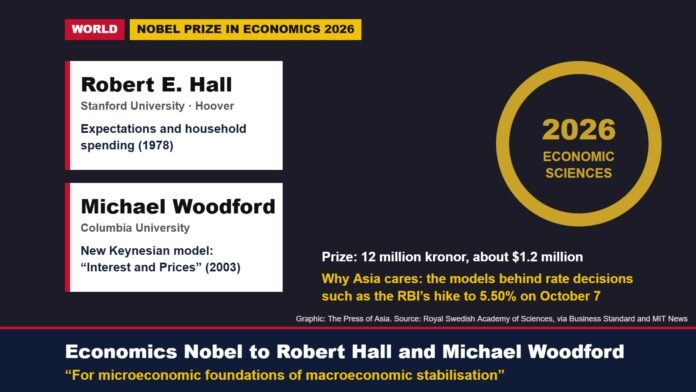
October 12: Americans Robert E. Hall and Michael Woodford won the 2026 Nobel Memorial Prize in Economic Sciences “for microeconomic foundations of macroeconomic stabilisation”, the Royal Swedish Academy of Sciences announced on Monday, Business Standard reported. Their work underpins the models that central banks use to set interest rates, from the US Federal Reserve to the Reserve Bank of India. The prize, worth 12 million Swedish kronor, about $1.2 million, is the last of this year’s Nobel awards, ABC News reported.
Key highlights
- Hall, of Stanford University and the Hoover Institution, showed in a 1978 paper that if households use all available information, changes in their spending cannot be reliably predicted, Business Standard reported.
- In 1982, Hall and Frederic Mishkin found that about 80% of households in their data behaved as the theory predicted, while the rest lived “hand to mouth”.
- Woodford, of Columbia University, set out a complete New Keynesian model built on microeconomic foundations in his 2003 book “Interest and Prices”, linking household spending, business price-setting and central bank policy, MIT News reported.
- The Nobel citation credits them with “new macroeconomic models that have significantly improved our ability to implement effective stabilisation policy”.
- Both earned their doctorates at MIT: Hall in 1967 and Woodford in 1983.
The laureates
| Robert E. Hall | Michael Woodford | |
|---|---|---|
| Current position | Professor of economics, Stanford University; senior fellow, Hoover Institution | John Bates Clark Professor of Political Economy, Columbia University |
| PhD | MIT, 1967 | MIT, 1983 |
| Best-known contribution | How households’ expectations shape consumption (1978); with Mishkin, evidence that most households smooth spending (1982) | The New Keynesian framework set out in “Interest and Prices: Foundations of a Theory of Monetary Policy” (2003) |
| Key ideas | Rational expectations in consumption; the role of information | The natural interest rate, sticky prices, the output gap, and the power of central bank credibility and communication |
What they changed
In the 1970s, oil shocks produced high inflation and unemployment at the same time, which the older models could not explain. Robert Lucas, who won the prize in 1995, argued that relationships seen in past data cannot be relied on when policy changes, Business Standard noted. Hall and Woodford helped answer that challenge by building models from how households and firms actually decide, so that policymakers could judge how people would react to a change in interest rates. Woodford’s emphasis on expectations explains why central banks now publish forecasts, explain their decisions and try to guide markets about future rates.
Why it matters in Asia
| Idea from the prize-winning work | How it shows up in Asian policy today |
|---|---|
| Expectations drive spending and prices | Central banks publish inflation forecasts and explain decisions; India’s Monetary Policy Committee releases a statement and minutes after its meetings |
| Credibility of the central bank matters | India targets consumer inflation with a band of 2% to 6%, a range the RBI has defended as appropriate (Business Standard, 2021) |
| The natural interest rate and the output gap | Used to judge whether policy is tight or loose; behind decisions such as the RBI’s increase in the repo rate to 5.50% on October 7, its first hike since February 2023 (Angel One) |
| Stabilisation in shocks | Relevant to Asia’s oil importers facing high energy prices this year, a risk the World Bank highlighted in its October outlook for East Asia |
The second column is our analysis of how the ideas are used, not a claim made by the Nobel committee. The timing is apt: central bankers and finance ministers from across Asia are in Bangkok this week for the IMF and World Bank annual meetings, where the IMF publishes its World Economic Outlook on Tuesday.
What to watch
- The laureates’ first interviews, and whether they comment on today’s high energy prices and rate rises.
- The IMF’s World Economic Outlook on October 13, and how central banks in Asia respond to it.
- The prize ceremony in Stockholm on December 10.
What it means
This is a prize for the toolkit rather than for a single discovery. Most people never hear of the New Keynesian model, but its logic sits behind every rate decision they read about, including the RBI’s hike last week. The award also comes at a time when that toolkit is being tested again by war-driven energy shocks, much as the 1970s tested the models that came before. For Asian economies that import most of their oil, the question Hall and Woodford helped answer, how far a central bank can steady prices without choking growth, is once again a practical one.
Sources
- Business Standard: Nobel Economics Prize 2026: How Hall and Woodford changed policymaking
- MIT News: Economists Robert E. Hall PhD ’67 and Michael Woodford PhD ’83 share Nobel prize
- ABC News: Nobel memorial prize in economics to be awarded in Stockholm
- Angel One: RBI increases repo rate to 5.50%, first hike since February 2023
- Business Standard (2021): Inflation range of 2-6% is appropriate for monetary policy: RBI report
- The Nation Thailand: IMF-World Bank 2026 agenda puts global outlook, AI and Thailand in focus

The Business Desk covers markets, the economy, companies and personal finance. Stories are checked against at least two credible sources before publication.