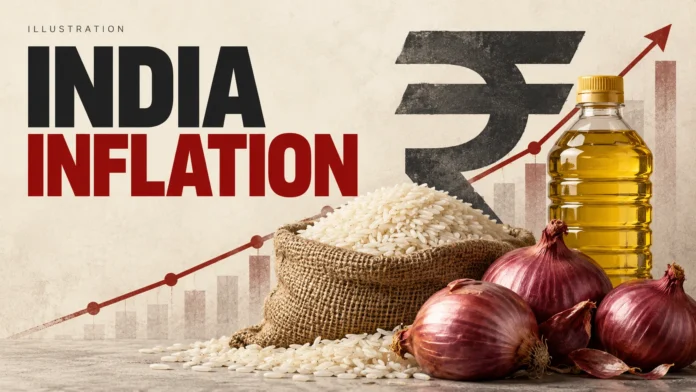
India’s September inflation rose to approximately 5.5%, up from 4.8% in August, according to The Hindu’s report on official Consumer Price Index data released on October 12. The report described the September 2026 reading as the highest since October 2024 and attributed the rise to accelerating food and fuel inflation. The Hindu’s report on the new CPI figures
Why the comparison matters
The headline figure describes the change in the price index compared with the same month a year earlier. It is not a statement that every product became 5.5% more expensive during September alone. Nor does it mean that every family’s spending increased by that exact amount.
The published rounded readings imply a rise of roughly 0.7 percentage points between August and September. That is a comparison of inflation rates, not the month-to-month increase in the price index itself. Keeping those two measures separate avoids overstating the immediate change in household costs.
A simple example of what an index does
Illustrative calculation: Suppose a price index stood at 100 a year ago and reaches 105.5 now. The year-on-year inflation rate would be 5.5%. This example explains the calculation; it is not the actual published index value.
Now imagine that a household spends unusually heavily on an item whose price rises faster than the average. Its experience can be worse than the headline rate. Another household with a different shopping basket may experience a smaller increase. An aggregate index is useful for comparisons, but it cannot replace a family’s own expense record.
What households can learn from the release
Our analysis: The practical question is which recurring expenses have changed. Comparing quantities as well as bills can help distinguish a price increase from increased consumption. A higher grocery bill may reflect costlier products, a larger purchase, or both.
Likewise, lower inflation would not necessarily mean prices are falling. It can mean prices are still increasing, just more slowly. This distinction matters when comparing a current bill with one from several years ago rather than with last month’s bill.
What we are not predicting
This release alone does not establish what the Reserve Bank of India will do next or how a particular market will move. Those outcomes require additional evidence. We have also not inferred city-level or item-level price changes from the national headline.
Reporting basis: The Hindu’s October 12 account of the official release; rates are rounded as reported. This explainer is not personal financial advice. Graphic: The Press of Asia; explanatory illustration.

The Business Desk covers markets, the economy, companies and personal finance. Stories are checked against at least two credible sources before publication.