NEW DELHI, October 19, 2026: Namo Bharat has recorded more than 4.5 crore passenger journeys since operations began in October 2023, the Ministry of Housing and Urban Affairs said as NCRTC marked three years of the regional rail service. The anniversary offers a useful moment to look beyond the celebration and ask what the numbers mean for everyday travel.
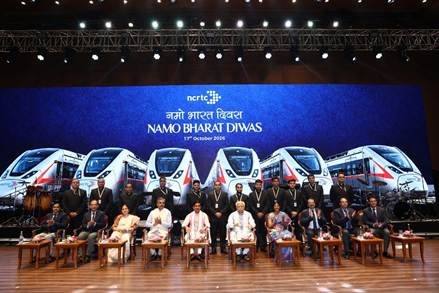
The figures were released on October 18 following a Namo Bharat Diwas event held in New Delhi on October 17. They describe cumulative journeys across the service’s development, not 4.5 crore different individuals and not the ridership of a single year.
From a priority section to the full corridor
According to the ministry’s PIB release, the service started with the 17-km Sahibabad–Duhai Depot priority section. The full 82-km Delhi–Ghaziabad–Meerut corridor was dedicated on February 22, 2026, alongside Meerut Metro.
The release put current daily use at over 1.1 lakh commuters and the highest single-day ridership at approximately 1.68 lakh. Akashvani’s national news coverage also reported the anniversary and Housing and Urban Affairs Minister Manohar Lal’s assessment of the service as a regional-connectivity project.
These measures answer different questions. Cumulative journeys show use over the life of the system; a daily figure indicates present demand; a record day describes an exceptional peak. Treating them as interchangeable would exaggerate what any one statistic establishes.
Why the whole journey matters
A rapid train can make the middle of a commute faster. The passenger still needs to reach the departure station and continue from the destination station. That is why dependable feeder services, walking access and connections to other modes matter when assessing whether a new rail service is useful.
NCRTC’s anniversary review highlighted first- and last-mile links and multimodal connectivity. For a commuter, the practical comparison is the total time and cost from origin to destination, including waiting, transfers and the final local journey. An attractive train journey does not automatically mean every possible trip becomes cheaper or faster.
Solar plans and expansion are different stages
The official review discussed Solar on Track and the development of a 110 MW captive solar power plant. It also described the Delhi–Panipat–Karnal and Delhi–Gurugram–Behror corridors as awaiting expected approvals, while Ghaziabad–Jewar and Noida–Faridabad–Gurgaon remained at the detailed-project-report stage.
Readers should distinguish a proposal, an approval, construction and an operating service. The announcement does not give passengers a basis to assume that these additional corridors are already open, or that a commissioning date has been fixed.
What to check before travelling
- Look up the current operating timetable rather than using an old inauguration announcement.
- Check the precise boarding station and any interchange needed.
- Compare the complete journey cost, including feeder transport.
- Allow time for security, walking and connections at unfamiliar stations.
Tickets, concessions and service conditions should be checked with the operator at the time of travel. This report is not a fare quotation and does not claim to have tested every route combination.
The next test is everyday reliability
Strong use is a meaningful signal, but the anniversary figures alone cannot demonstrate profitability, the financial position of every commuter or the environmental impact of each journey. Those questions require their own evidence and clear methods of comparison.
For residents, the most useful follow-up is whether trains, feeder services and interchanges work together consistently. The three-year milestone shows how far the service has developed. Its next phase will be judged on whether more people can make convenient complete journeys, rather than on the train segment alone.
Image: Namo Bharat Diwas event held October 17, 2026; official photograph published October 18. Credit: Ministry of Housing and Urban Affairs / PIB. Used with source acknowledgement under PIB’s reproduction policy.

The National Desk covers India's politics, governance, security and public-interest news. Stories are checked against at least two credible sources before publication.