October 26: Busan’s maritime calendar brings shipping safety, cleaner mobility and autonomous navigation into focus this week. The International Maritime Organization lists its 2026 World Maritime Day Parallel Event in the South Korean port city for October 26–27, alongside a separate maritime technology exhibition running through October 28.
Key highlights
- The IMO parallel event is scheduled for October 26–27 in Busan.
- The Korea Maritime Mobility·Safety Expo runs October 26–28 at BPEX, according to the oceans ministry.
- Exhibition themes include autonomous navigation, carbon neutrality and AI-assisted disaster response.
- An exhibition announcement should not be confused with approval of a new international shipping rule.
Several events, different purposes
The IMO’s events calendar confirms the parallel-event dates. It identifies “From Policy to Practice: Powering Maritime Excellence” as its World Maritime Day theme for 2026–2027. The Busan gathering is a parallel celebration, rather than a change to the annual World Maritime Day observance in September.
South Korea’s Ministry of Oceans and Fisheries separately announced the ninth Maritime Mobility·Safety Expo at the Busan Port International Exhibition & Convention Center. Its published programme includes exhibition areas for smart autonomous navigation, environmentally friendly mobility and carbon neutrality, and advanced safety and AI disaster response.
The programme at a glance
| Activity | Published dates | How to distinguish it |
|---|---|---|
| World Maritime Day Parallel Event | October 26–27 | International maritime gathering listed by IMO |
| Maritime Mobility·Safety Expo | October 26–28 | Technology exhibition at BPEX |
| Business Hall activities | Within the expo programme | Buyer consultations and technical briefings, not regulatory approvals |
The ministry’s earlier announcement also describes export consultations with invited buyers and technology briefings. These are planned programme elements; they do not establish that contracts have already been signed or that a demonstrated system has entered commercial service.
What maritime technology readers should ask
The useful distinction is between a product demonstration, a trial and an authorised operating service. An autonomous-navigation display may show technical capability without answering where a vessel may operate, under whose supervision, or with what contingency arrangements. Those questions require the operator and regulator’s actual documentation.
Similarly, “AI disaster response” describes a technology theme rather than a guarantee that an incident can be prevented. A meaningful assessment would ask what information the system receives, who makes the final decision and how the crew is expected to respond when a sensor or connection fails.
Why Asian shipping businesses are watching
For a port operator, shipowner or equipment supplier comparing exhibits, a practical checklist starts with the intended operating environment. A system demonstrated in sheltered water may face a different task in a busy approach channel. That is an operational comparison, not a claim about any particular exhibitor’s performance.
Cleaner-vessel proposals should likewise be read with attention to what is being measured. Equipment capability, fuel availability and a completed emissions assessment are separate pieces of evidence. A headline about a carbon-neutrality exhibition zone alone cannot settle all three.
What to watch
Official session conclusions, published technical material and identifiable project announcements will provide the next developments. Until those appear, the verified news is the scheduled Busan programme and its stated themes. The calendar does not by itself announce new global rules or completed commercial deals.
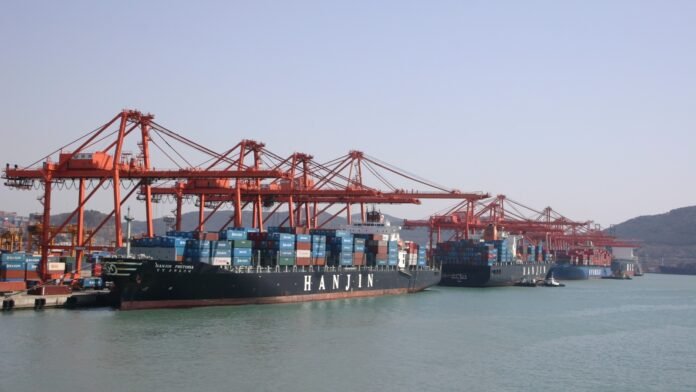
File photo: Busan Container Terminal, March 29, 2006. Credit: Niels Johannes; CC BY-SA 4.0. Cropped/resized for 1600×900. Not a photograph of the current event. Image source; Licence. Adaptation shared under the same licence.
Sources
- IMO: World Maritime Day Parallel Event 2026 dates
- South Korea MOF: Maritime Mobility and Safety Expo programme
- South Korea MOF: World Maritime Day commemorative event in Busan

The Business Desk covers markets, the economy, companies and personal finance. Stories are checked against at least two credible sources before publication.