October 26: A S$1 million haze-relief commitment from DBS is aimed at vulnerable seniors and migrant workers in Singapore, with the bank projecting support for 275,000 people. The October 23 announcement combines mask distribution with air-purifier assistance; its projected reach should not be mistaken for a verified count of people who have already received supplies.
Key highlights
- DBS announced S$1 million for the first phase of its haze-relief effort.
- The plan includes 500,000 N95 masks for migrant workers and 50,000 for vulnerable seniors.
- The bank also announced air-purifier support through social-service partners and for homebound seniors.
- Community donations do not replace employers’ workplace safety responsibilities.
What the bank announced
DBS said it would work with dormitory operators and the Ministry of Manpower on migrant-worker mask distribution. Its senior-support plan includes 100 air purifiers for partner agencies and purifiers for 500 homebound seniors living alone.
The bank’s statement advertised a recreation-centre distribution starting on Sunday, October 25, on a first-come basis. That date has passed. Readers should check present availability with the relevant operator rather than travel on the assumption that the original announcement guarantees stock today.
The announced support at a glance
| Group | Announced provision | Important distinction |
|---|---|---|
| Migrant workers | 500,000 N95 masks | Planned supply, not a current stock count |
| Vulnerable seniors | 50,000 N95 masks | Distribution through social-service partners |
| Partner agencies | 100 air purifiers | Institutional support rather than one purifier for every recipient |
| Homebound seniors living alone | Purifier support for 500 people | A targeted component of the programme |
What official workplace guidance says
In an October 6 parliamentary answer, Singapore’s Ministry of Manpower said employers must assess haze-related risks and take protective measures. For a 24-hour PSI of 101–200, its guidance calls for reducing prolonged or strenuous outdoor work; at 201–300, such work should be avoided.
When the 24-hour PSI exceeds 300, employers should minimise outdoor work. The ministry also points to job rotation, indoor rest breaks, hydration and deferral of non-essential work. It identifies more stringent precautions for susceptible workers. These are thresholds in published guidance, not a statement of today’s PSI.
Why the pollution measure matters
The National Environment Agency explains that PM2.5 is the predominant pollutant during transboundary haze. It publishes one-hour PM2.5 readings alongside the 24-hour PSI through official channels including myENV and its haze information service. The two measures refer to different time windows.
For readers checking a warning, the location, observation time and type of index are therefore essential. Reposting an old screenshot without those details can turn a valid reading into a misleading description of present conditions. This report does not substitute an earlier pollution reading for a live update.
What recipients should check
Contact the relevant charity, dormitory or recreation-centre operator for current distribution arrangements. A general funding pledge is not a personal collection appointment. For workplace concerns, ask what exposure controls apply to the task as well as whether protective equipment is available.
What to watch
DBS said further measures would depend on conditions and community needs. The next useful update is confirmed distribution progress or a new official advisory. Projected beneficiaries, pledged funds and completed deliveries should continue to be reported separately.
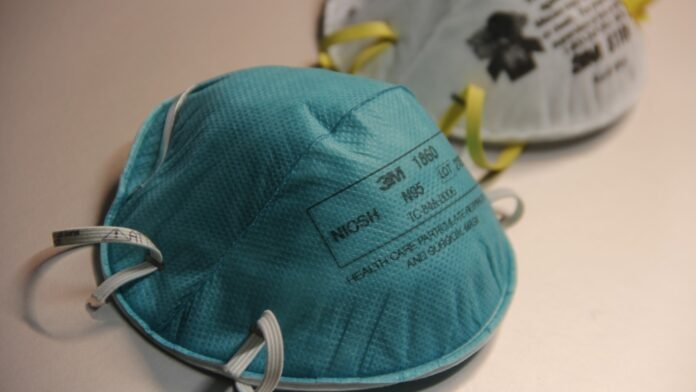
Representational image: an N95 respirator photographed by the CDC, 2013. Credit: CDC / Debora Cartagena; Public domain — US federal government. Cropped/resized for 1600×900. The pictured product is an illustration, not a mask identified as supplied by DBS. Free source: CDC, via Wikimedia Commons. Image source; Licence.
Sources
- DBS: S$1 million haze-relief commitment
- Singapore MOM: Haze protections and outdoor-work thresholds
- Singapore NEA: Air-pollution and haze information

The International Desk covers world and Asian affairs, diplomacy and conflict, with a focus on what they mean for India. Stories are checked against at least two credible sources before publication.