October 27: South Korea’s economy expanded 1.0% in the third quarter from the preceding three months, the Bank of Korea’s advance estimate released today showed. Export and investment growth contrasted with a small decline in private consumption, leaving a mixed picture beneath the stronger headline.
Key highlights
- Real GDP increased 1.0% quarter on quarter and 3.4% year on year.
- Exports rose 2.3%, while facilities investment increased 4.1%.
- Private consumption fell 0.2%; government consumption rose 1.9%.
- These are advance estimates and can be revised.
What the latest GDP release shows
The Bank of Korea said semiconductor and machinery shipments supported exports. Investment in machinery, including semiconductor-manufacturing equipment, helped facilities spending. Construction investment increased 0.7%, with civil engineering contributing to the improvement.
The figures measure changes in real output, after accounting for price movements. The quarterly comparison describes momentum since April–June; the annual comparison measures the difference from July–September last year. Those two rates answer different questions and should not be treated as interchangeable.
At a glance: the components
| Measure | Q3 change from Q2 |
|---|---|
| Real GDP | +1.0% |
| Private consumption | −0.2% |
| Government consumption | +1.9% |
| Facilities investment | +4.1% |
| Construction investment | +0.7% |
| Exports / imports | +2.3% / +2.4% |
Source: Bank of Korea advance national accounts. Component growth rates are not percentage-point contributions to GDP.
Why stronger output need not mean stronger household demand
A country can produce more while consumers remain cautious. Factories may sell to overseas buyers, and businesses may order equipment, even when households hold back. In this release, that distinction is visible in the opposite directions of exports and private consumption. It is a reason to read the composition of growth alongside the total.
Separate September labour-market data from the Ministry of Data and Statistics showed 29.266 million employed people, up 113,000 from a year earlier. The employment-to-population ratio nevertheless fell 0.2 percentage points to 63.5%. Those are economy-wide monthly measures, not direct evidence of how every household experienced the third quarter.
What this means for Asian supply chains
For businesses supplying chips, machinery or components into Korea’s production network, the investment breakdown is a useful demand signal. It is not a guarantee of future orders: higher investment this quarter may reflect equipment deliveries ordered earlier, while import growth also accompanies the purchase of overseas inputs. A larger export growth rate alone cannot establish whether net trade added to growth without the relevant contribution calculations.
What to watch
The next tests are whether domestic spending improves, whether equipment investment continues and how later national-account releases revise the advance figures. For a fuller recovery, readers should look for evidence across production, household spending and employment rather than assume that one strong GDP number settles all three.
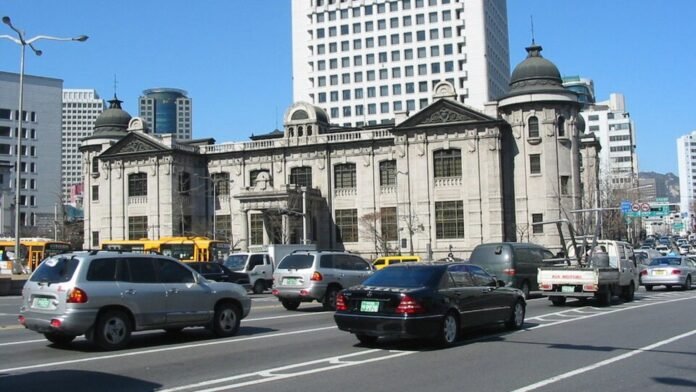
File photo: the historic Bank of Korea main building, now its money museum, in Seoul, March 2, 2004. Credit: Otraff; CC BY-SA 3.0. Cropped/resized to 1600×900. Not a photograph of the current event. Image source; Image-use terms. Adaptation shared under the same licence.
Sources
- Bank of Korea: Real Gross Domestic Product, Q3 2026 (advance estimate)
- Ministry of Data and Statistics: Economically Active Population Survey in September 2026

The Business Desk covers markets, the economy, companies and personal finance. Stories are checked against at least two credible sources before publication.