October 27: Indonesia’s energy ministry has outlined a government-led approach to buying crude oil, fuel and liquefied petroleum gas from abroad, presenting it as a way to strengthen supply certainty amid geopolitical disruption. The October 26 statement describes changes to procurement arrangements; it is not evidence that every planned supply agreement has already been signed.
Key highlights
- The ministry describes government-to-government and government-to-business purchasing.
- A public-service agency would play an intermediary role before Pertamina purchases supplies.
- The ministry also describes exceptions for urgent supply conditions.
- New contracts, delivered volumes and final prices require separate confirmation.
What the ministry says is changing
The Energy and Mineral Resources Ministry said procurement previously centred on business-to-business tendering would shift toward direct cooperation involving the government. Minister Bahlil Lahadalia described a public-service agency, known in Indonesia as a BLU, participating in negotiations, with Pertamina then buying through that arrangement.
The ministry said direct imports could still be used in circumstances such as low national reserves or geopolitical supply disruption, with coordination through the agency. It also described planned engagement with India and China. Planned visits or discussions should not be confused with completed transactions.
At a glance: separate the stages
| Stage | What it does—and does not—show |
|---|---|
| Procurement framework | Establishes how purchasing may be organised |
| Negotiation | Explores terms; does not guarantee agreement |
| Signed supply contract | Creates specific obligations, subject to its terms |
| Delivery | Shows physical supply has reached the buyer |
| Price assessment | Requires comparable delivered-cost information |
Why a buying framework is not the same as energy independence
Changing who negotiates an import purchase does not eliminate the need for imported energy. It changes the relationship between government, intermediary and operating company. To assess whether the approach improves security, readers need to follow the actual contracts, delivery schedules and resilience of the supply routes.
A government-level relationship may support longer-term arrangements, but the label alone cannot establish that a deal is cheaper or more reliable. The useful comparison is delivered cost and dependable volume under comparable conditions, rather than simply the identity of the negotiating party.
The wider regional context
Energy security is also under discussion in neighbouring Singapore. In separate official remarks on October 25, minister Tan See Leng identified supplier diversification, standby LNG and reserve arrangements as safeguards against disruption. That statement concerns Singapore’s system; it is not an endorsement or evaluation of Indonesia’s new procurement approach.
The two announcements illustrate different tools: one changes how imported supplies are purchased; the other emphasises alternative sources and operational backup. Neither can be judged solely by the size of a headline announcement.
What to watch
The next evidence to examine is the implementation guidance, the agency’s defined responsibilities, named supply agreements and actual deliveries. Claims of savings or guaranteed availability should be tested against those outcomes. This report describes the ministry’s announcement and its practical implications; it does not offer a legal interpretation of procurement obligations.
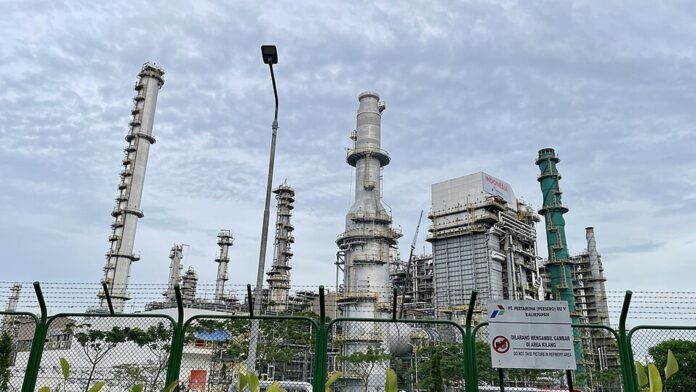
File photo: Pertamina’s refinery facilities in Balikpapan, Indonesia, February 24, 2026. Credit: Annidafattiya; CC BY 4.0. Cropped/resized to 1600×900. Not a photograph of the current event. Image source; Image-use terms.
Sources
- Indonesia Energy Ministry: Government changes procurement of crude, fuel and LPG
- Singapore Ministry of Energy, Trade and Industry: Gas-supply resilience and diversification measures

The Business Desk covers markets, the economy, companies and personal finance. Stories are checked against at least two credible sources before publication.