October 27: NASA has reported a construction milestone for NEO Surveyor, its future infrared asteroid-hunting mission: solar arrays have been integrated with the spacecraft’s large sunshade and related testing has advanced. The October 26 update concerns hardware preparation, not the discovery of an asteroid on a collision course.
Key highlights
- The sunshade will help keep the telescope cool while its solar cells generate power.
- NASA describes 864 solar cells with a maximum output of about two kilowatts.
- The mission uses a 50-centimetre telescope operating in two infrared bands.
- JPL lists launch as no earlier than September 2027.
What the hardware update means
NASA said the sunshade stands about six metres high and is roughly 2.4 metres across at its base. Its solar arrays must perform two complementary jobs: provide electricity and support the thermal design that shields the observing instrument from the Sun.
The update described the progression from array installation through environmental and functional checks, with further sensor work. This is one part of building and testing the observatory. It should not be read as an announcement that the complete spacecraft is ready to launch.
At a glance: the mission and the milestone
| Feature | Purpose or status |
|---|---|
| Large sunshade | Limits direct solar heat and glare |
| Solar arrays | Provide electrical power |
| 50 cm infrared telescope | Detects heat from near-Earth objects |
| Two infrared bands | Help characterise detected objects |
| Launch status | Future mission; no earlier than September 2027 per JPL |
Why infrared observations help
JPL says NEO Surveyor is designed to detect both bright and dark asteroids, including objects that are difficult to identify through reflected visible light. Its planned five-year baseline survey aims to find at least two-thirds of near-Earth objects larger than 140 metres.
An object’s visible brightness depends on more than its size. The European Space Agency’s definitions explain the role of albedo—the fraction of sunlight reflected—as well as distance. A relatively small reflective object and a larger dark one can therefore be hard to distinguish using brightness alone. Thermal observations offer another way to estimate size.
Finding an object is also only the start. Repeated observations are needed to understand its orbit, and a near-Earth classification does not by itself mean a collision is predicted. ESA defines the category using orbital characteristics, not a claim that every member threatens an impact.
Why this matters beyond the United States
Asteroid detection is relevant to every region, including Asia, because the useful outcome is better knowledge of objects and their trajectories. The public value lies in earlier, more reliable assessment—not in making routine construction progress sound like an emergency. A photograph of flight hardware or an artist’s concept is evidence about a mission, not evidence of a newly identified impact threat.
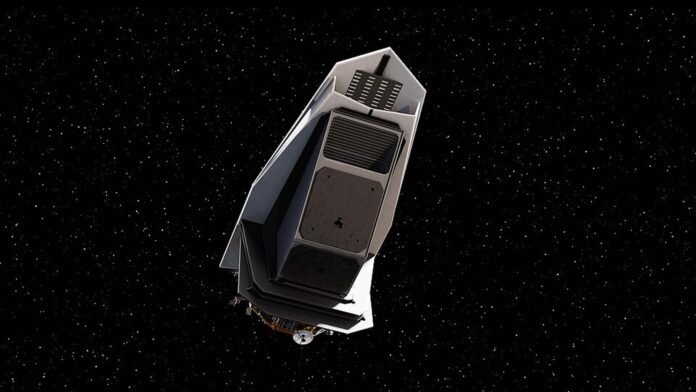
This article uses an official artist’s concept, clearly labelled, so readers can see the mission design without mistaking an illustration for a photograph taken in space.
What to watch
Further integration and test updates will show how the telescope and spacecraft move toward launch. The schedule remains subject to mission readiness. Any future impact-risk report should be based on the relevant tracking and risk-assessment data, separately from this engineering milestone.
Representational image: an artist’s concept of NASA’s NEO Surveyor spacecraft, August 28, 2024 (published). Credit: NASA/JPL-Caltech; JPL image-use policy. Cropped/resized to 1600×900. Official artist’s concept, not a photograph of a launched spacecraft. Image source; Image-use terms.
Sources
- NASA: Sunshade for NEO Surveyor ready for its day in the Sun
- NASA/JPL: Near-Earth Object Surveyor mission overview
- ESA Near-Earth Object Coordination Centre: Definitions and assumptions

The Tech Desk covers technology, artificial intelligence and cybersecurity. Stories are checked against at least two credible sources before publication.