HONG KONG, November 3: The University of Hong Kong is Asia’s top university for a second year in the QS World University Rankings: Asia 2027, published on Tuesday, and Hong Kong now holds five of the ten top places, more than any other higher-education system. India has the second-largest number of ranked institutions, 325, behind mainland China’s 448, and IIT Delhi is again the country’s best-placed, at 66th.
Key highlights
- The 2027 edition ranks 1,722 universities across 26 higher-education systems, including 195 new entrants, according to QS.
- The top three are the University of Hong Kong, Peking University and Tsinghua University. Five of the top ten are in Hong Kong, three in mainland China and two in Singapore.
- India has 325 ranked institutions. Mainland China has 448 and Japan 153.
- Six Indian institutions are in the top 100: IIT Delhi (66), IISc Bangalore (joint 79), IIT Bombay (joint 83), IIT Madras (85), IIT Kharagpur (joint 90) and IIT Kanpur (joint 97).
- Chandigarh University (104) and the University of Delhi (106) are the highest-ranked Indian institutions outside the IITs and IISc.
Asia’s top ten
| Rank | University | System |
|---|---|---|
| 1 | The University of Hong Kong | Hong Kong SAR |
| 2 | Peking University | Mainland China |
| 3 | Tsinghua University | Mainland China |
| 4 | City University of Hong Kong | Hong Kong SAR |
| 5 | The Chinese University of Hong Kong | Hong Kong SAR |
| =6 | Fudan University | Mainland China |
| =6 | National University of Singapore | Singapore |
| 8 | Nanyang Technological University | Singapore |
| =9 | The Hong Kong Polytechnic University | Hong Kong SAR |
| =9 | The Hong Kong University of Science and Technology | Hong Kong SAR |
South Korea’s best are just outside the top ten: Yonsei University is 11th and Korea University 12th. QS said Tsinghua rose to third and that CityUHK and CUHK moved into the top five, while Singapore’s two leading universities dropped out of it.
How India fared
| Rank | Institution | City |
|---|---|---|
| 66 | IIT Delhi | New Delhi |
| =79 | Indian Institute of Science | Bengaluru |
| =83 | IIT Bombay | Mumbai |
| 85 | IIT Madras | Chennai |
| =90 | IIT Kharagpur | Kharagpur |
| =97 | IIT Kanpur | Kanpur |
| 104 | Chandigarh University | Mohali |
| 106 | University of Delhi | New Delhi |
| 120 | IIT Guwahati | Guwahati |
| =124 | IIT Roorkee | Roorkee |
| =128 | Jawaharlal Nehru University | New Delhi |
| 154 | Lovely Professional University | Phagwara |
QS said IIT Delhi slipped in this edition but remains India’s highest-ranked institution. Other Indian names in the top 200 include VIT Vellore (156), BITS Pilani (joint 161), O.P. Jindal Global University (joint 165), Symbiosis International (175), Amity University (181), and Jamia Millia Islamia and UPES, both joint 183rd.
Our calculation
- Share of the table: India’s 325 institutions are 18.9% of the 1,722 ranked. Mainland China’s 448 are 26.0% and Japan’s 153 are 8.9%. India and China together account for 44.9%.
- Breadth versus the top: India has the second-largest list, but only six of its 325 institutions (1.8%) are in the top 100, all of them IITs or IISc.
- Concentration in Hong Kong: a single city-system holds half of the top ten.
What it means
For Indian students choosing where to study in Asia, the ranking shows a wide field at home, with more than 300 ranked options, but a thin top tier compared with Hong Kong, mainland China and Singapore. QS’s indicators include academic reputation, citations per paper and papers per faculty, along with measures of international engagement and the share of staff with doctorates. Those factors favour older, research-heavy institutions, which is where India’s top 100 entries come from.
“Research excellence, international engagement and reputation remain the foundations for success,” QS Senior Vice-President Ben Sowter said in the company’s release.
What to watch
- The government’s own NIRF ranking for 2027, which uses different measures and often ranks Indian institutions differently.
- Whether Indian universities outside the IITs, such as the University of Delhi and Chandigarh University, can break into the top 100 next year.
- Hong Kong’s push to attract international students, on which its strong international indicators depend.
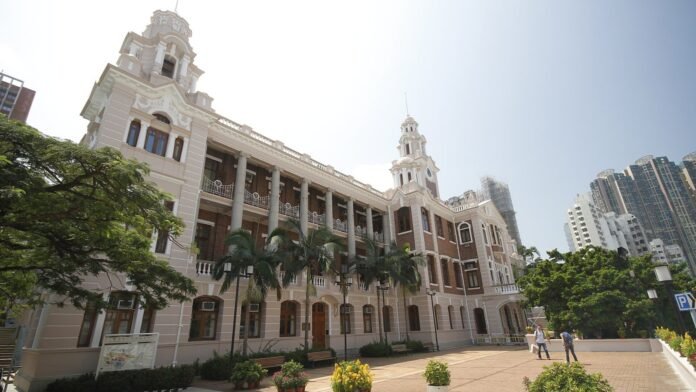
File photo: The Main Building of the University of Hong Kong. Image: Ka-Fai,So, CC BY-SA 3.0, via Wikimedia Commons. Photo source · Licence
Sources

The International Desk covers world and Asian affairs, diplomacy and conflict, with a focus on what they mean for India. Stories are checked against at least two credible sources before publication.