NEW DELHI, November 4: The Indian Navy’s annual Indo-Pacific Regional Dialogue (IPRD-2026) opened in New Delhi on Tuesday, November 3, with speakers from across the region discussing how science, technology and academic links can be turned into practical maritime cooperation, from sharing ocean data to protecting undersea cables and pipelines. The three-day conference is organised with the National Maritime Foundation (NMF), the Navy’s knowledge partner.
Key highlights
- Theme: ‘Science, Technology and Academic Cooperation in the Indo-Pacific’.
- Opening addresses: Admiral Dinesh K Tripathi (Retd), Chairman of the NMF and former Navy chief, and Vice Admiral Biswajit Dasgupta (Retd), National Maritime Security Coordinator.
- Day one sessions: academic networks and research, with perspectives from France, Indonesia, Japan and the Maldives; and maritime awareness and protection of critical maritime infrastructure.
- Diplomats: the High Commissioner of Sri Lanka and the ambassadors of the Philippines and Norway took part in a special interaction.
- Release: a monograph, ‘Sea Blindness and Maritime Heritage in India’, was launched.
What was discussed
The first session explored a wider Indian Ocean academic network, including cooperation among universities in coastal cities of the Indo-Pacific and closer links among think tanks, universities and governments. The second looked at the challenge of protecting seaborne trade and undersea infrastructure. It examined the Indo-Pacific Partnership for Maritime Domain Awareness (IPMDA), especially the practical side of sharing information, and discussed building a cooperative Indo-Pacific framework for underwater domain awareness. The Indian Ocean Commission presented its views on protecting critical maritime infrastructure.
| Item | Detail |
|---|---|
| Organisers | Indian Navy with the National Maritime Foundation |
| Dates | November 3–5, 2026, New Delhi |
| Session 1 | Academic networks, research and human capital development |
| Session 2 | Maritime situational awareness and protection of critical maritime infrastructure |
| Countries and bodies named on day one | France, Indonesia, Japan, Maldives, Sri Lanka, the Philippines, Norway, Indian Ocean Commission |
Background
The IPMDA was launched by the Quad (Australia, India, Japan and the United States) at its Tokyo summit in May 2022 to help countries in the region track activity at sea. Undersea cables carry most of the world’s internet and data traffic, which is why their protection has become a regular subject at regional security meetings.
What it means
The dialogue comes in a busy week for Indian maritime diplomacy, after the Navy’s exercise with South Korea at Busan, the Tiger Triumph exercise and talks with Sri Lanka’s Coast Guard (our report), and the rescue of the hijacked fishing vessel Azini off Somalia (our report). Its focus on shared data and research suggests India wants smaller Indian Ocean states to see it as a partner in science and ocean knowledge, not only in security.
What to watch
- Recommendations from the remaining two days of the dialogue.
- Any new data-sharing or academic agreements announced by participating countries.
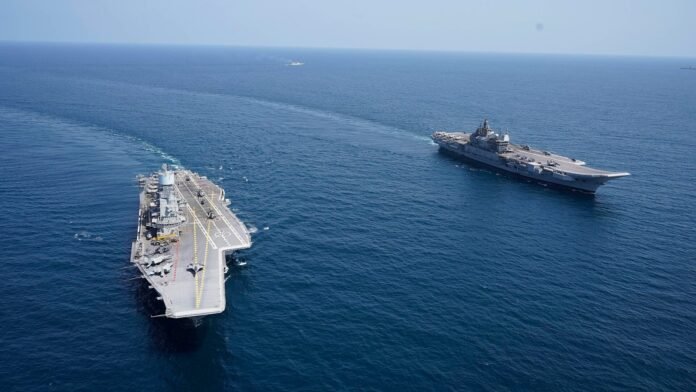
Indian Navy aircraft carriers INS Vikrant and INS Vikramaditya during an exercise. Image: Indian Navy, GODL-India, via Wikimedia Commons. Photo source · Licence
Sources

The International Desk covers world and Asian affairs, diplomacy and conflict, with a focus on what they mean for India. Stories are checked against at least two credible sources before publication.