SINGAPORE, November 3: Factory activity kept growing across Asia’s biggest manufacturing economies in October, but at a slower pace in five of the six surveys we tracked. South Korea and Taiwan slowed the most. Southeast Asia was the exception: the ASEAN manufacturing PMI rose to its highest since February, with new orders growing at a record rate. India’s PMI eased to 54.7 but stayed the highest of the group.
Key highlights
- All six purchasing managers’ indices stayed above 50, the line that separates expansion from contraction.
- South Korea’s PMI fell to 51.3 from 53.9, its weakest since February, and factory jobs fell after four months of gains.
- Taiwan’s PMI eased to 54.9 from 56.7, a more than five-year high in September.
- ASEAN’s PMI rose to 53.1 from 52.1, and business confidence there hit a four-year high.
- India’s PMI slipped to 54.7 from 55.1, but export orders grew at a six-month high and selling-price rises were the weakest in nearly four years.
October PMIs at a glance
| Economy | October | September | Change | What stood out |
|---|---|---|---|---|
| India (HSBC) | 54.7 | 55.1 | −0.4 | Export orders at a six-month high; slight hiring |
| Taiwan | 54.9 | 56.7 | −1.8 | Output and orders still rising markedly, but more slowly |
| Japan | 53.3 | 54.1 | −0.8 | Lowest in seven months; job creation near an 8½-year high |
| ASEAN | 53.1 | 52.1 | +1.0 | Record growth in new orders; confidence at a four-year high |
| China (RatingDog) | 52.0 | 52.1 | −0.1 | 11th month above 50; output at a six-month high |
| South Korea | 51.3 | 53.9 | −2.6 | Weakest since February; employment fell |
The price picture
Costs are behaving differently across the region. In Japan, input price inflation picked up for the first time in five months, and South Korea’s input costs rose sharply, led by raw materials. ASEAN producers raised selling prices at a three-month high. In China, factory-gate prices fell for the second time in three months amid strong competition, and export charges fell for the first time in nearly a year. India stood out at the other end: input cost inflation was the lowest since February and output price rises were the slightest in just under four years.
Our calculation
- Average reading: the six PMIs average 53.2, still solid growth.
- Biggest drop: South Korea, down 2.6 points, followed by Taiwan, down 1.8. Both are big chip exporters, so the slowdown in their surveys is worth watching for the electronics cycle.
- Only riser: ASEAN, up 1.0 point.
- India’s lead: India’s 54.7 is 2.7 points above China’s 52.0 and 3.4 points above South Korea’s 51.3.
What it means
The October surveys point to a cooling, not a stall. Demand linked to semiconductors and AI is still supporting North Asia, but growth there has lost speed. For India, the combination of strong export orders and soft price pressures is helpful for inflation, though the survey showed business confidence fell and stayed below its long-run average. Southeast Asia’s jump in orders suggests supply chains continue to shift into the region, but S&P Global warned that ASEAN remains exposed to shocks that could slow its momentum.
What to watch
- Services PMIs for China and India, due this week.
- Whether South Korea’s job losses in manufacturing continue in November.
- Price data in Japan and South Korea, where input costs are rising again.
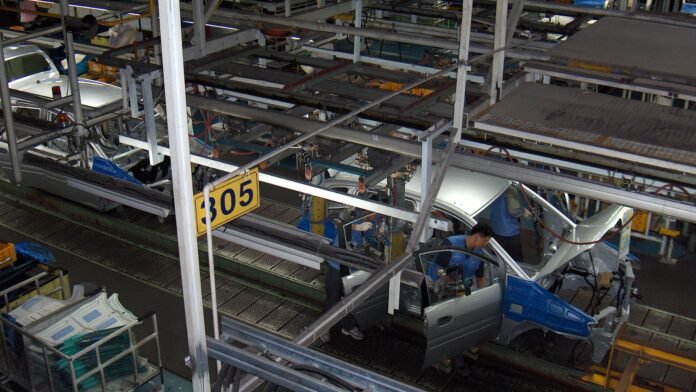
File photo: Cars on an assembly line at a Hyundai plant. Image: User: Anonyme, CC BY 2.5, via Wikimedia Commons. Photo source · Licence
Sources
- S&P Global / HSBC: HSBC India Manufacturing PMI, October 2026
- S&P Global / RatingDog: China General Manufacturing PMI, October 2026
- S&P Global: Japan Manufacturing PMI, October 2026
- S&P Global: South Korea Manufacturing PMI, October 2026
- S&P Global: Taiwan Manufacturing PMI, October 2026
- S&P Global: ASEAN Manufacturing PMI, October 2026

The Business Desk covers markets, the economy, companies and personal finance. Stories are checked against at least two credible sources before publication.