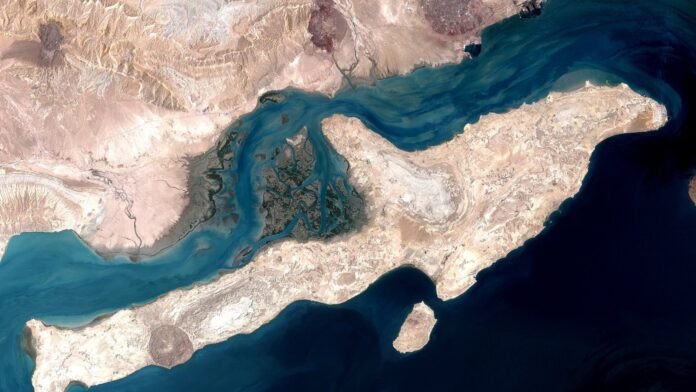
NEW DELHI, November 3: The United States struck targets on Iran’s Qeshm Island in the Strait of Hormuz on Monday, according to US officials who spoke to reporters on condition of anonymity, while Iranian state media reported several explosions on the island. The Pentagon and US Central Command had not issued any public statement by Tuesday evening India time. The strikes came on the eve of the US midterm elections, on the same day that President Donald Trump said he was not planning new strikes on Iran after the vote.
Key highlights
- Iranian state media reported several explosions on Qeshm Island on Monday, November 2.
- US officials, speaking anonymously, described “defensive strikes” against Iranian forces that had used surface-to-air missiles against US assets. One said the action did not mean a return to major combat operations.
- No targets, casualties or damage have been officially disclosed by either side.
- Asked on Monday whether he was considering strikes on Iran after the elections, Trump said “No.” He said Iran wants a deal and repeated that Iran will never be allowed a nuclear weapon.
- Iran’s Foreign Ministry spokesperson Esmaeil Baghaei said on Monday that dialogue was continuing but the issues were complex.
What is confirmed and what is not
| Point | Status as of Tuesday evening (IST) |
|---|---|
| Explosions on Qeshm Island on November 2 | Reported by Iranian state media |
| The US carried out the strikes | Stated by US officials speaking anonymously; no on-record Pentagon or CENTCOM statement |
| Reason | Anonymous US officials: response to Iranian surface-to-air missile fire at US assets |
| Targets, casualties, damage | Not disclosed by either government |
| A return to full-scale war | Denied by an anonymous US official; Trump said “No” to post-election strikes |
| Diplomacy | Continuing, according to Iran’s Foreign Ministry and US Vice President JD Vance |
What leaders said on the record
Speaking at the Lincoln Memorial in Washington on Monday, Trump told supporters that oil prices had fallen by $10 that day and would fall “a lot further because we’re winning with Iran, easily winning.” He said Iran’s navy and air force were “gone” and that “they want to make a deal”, adding: “We’re not going to allow Iran ever to have a nuclear weapon.”
Vice President JD Vance said the US had held “a number of good conversations” with Iranian representatives. In Tehran, Foreign Ministry spokesperson Esmaeil Baghaei said dialogue was going on but the matter was complex. Contacts have been taking place through mediators, including Qatar.
Why Qeshm and Hormuz matter
Qeshm is the largest island in the Persian Gulf and lies inside the Strait of Hormuz, the narrow channel between Iran and Oman through which tankers leave the Gulf. According to the US Energy Information Administration (EIA), about 20 million barrels a day of oil, roughly a fifth of global petroleum liquids consumption, and about a fifth of the world’s liquefied natural gas trade passed through the strait in 2024.
| Measure (2024) | Figure |
|---|---|
| Oil flow through Hormuz | About 20 million barrels a day |
| Share of global petroleum liquids consumption | About 20% |
| Share of global LNG trade | About one-fifth |
| Crude and condensate going to Asia | 84% |
| LNG going to Asia | 83% |
| Share received by China, India, Japan and South Korea together | 69% of crude and condensate flows |
Our calculation
- Asia’s exposure: with 84% of Hormuz crude going to Asian buyers, about 16.8 million of the 20 million barrels a day that pass through the strait end up in Asia, based on the EIA’s 2024 figures.
- Four big buyers: China, India, Japan and South Korea take 69%, or roughly 13.8 million barrels a day.
- Timing: the reported strikes came less than a day before polls opened in the US on November 3.
What it means for India
India buys most of its crude oil abroad, and a large part comes from Gulf producers whose cargoes pass through Hormuz. Any fighting near the strait raises freight and insurance costs and puts upward pressure on oil prices, which feed into India’s import bill, inflation and the rupee. Many Indian seafarers also work on ships in the region. So far, both Washington and Tehran are signalling that talks continue, which would limit the damage if the strikes stay a one-off.
What to watch
- Any on-record statement from the Pentagon or US Central Command giving targets and reasons.
- Iran’s response, including any move against shipping in the strait.
- Whether the mediated talks produce a framework after the US election.
- Oil prices and shipping advisories for the Gulf in the coming days.
This report is based on public statements by US and Iranian officials and on reporting of anonymous US officials’ comments; it will be updated if the Pentagon or US Central Command issues an official statement.
Satellite view of Qeshm Island in the Strait of Hormuz. Image: NASA, public domain, via Wikimedia Commons. Photo source
Sources
- US Energy Information Administration: Amid regional conflict, the Strait of Hormuz remains critical oil chokepoint (June 16, 2025)
- US Department of State: Iran travel advisory

The International Desk covers world and Asian affairs, diplomacy and conflict, with a focus on what they mean for India. Stories are checked against at least two credible sources before publication.