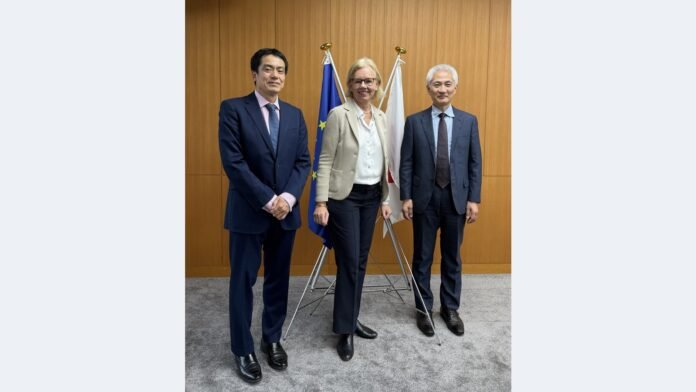
November 6: Japan and the European Union discussed AI-related cyber risk, digital assets and financial stability at their seventh Joint Financial Regulatory Forum in Tokyo on November 4–5, according to a joint statement released on November 6. The meeting also covered sustainable finance, banking, insurance and capital markets.
Key highlights
- The forum brought Japanese and European financial authorities together in Tokyo.
- AI, stablecoins, tokenisation and cyber risk were among the subjects discussed.
- Transition finance and disclosure interoperability also featured.
- The statement records a regulatory dialogue, not a new single rulebook for both jurisdictions.
Who met and what the statement says
The Financial Services Agency published the joint statement after the two-day meeting. It identifies FSA Vice Commissioner for International Affairs Ozaki Yu and European Commission Deputy Director-General Alexandra Jour-Schroeder as co-chairs, with other European financial authorities represented.
The statement places the discussion against financial-stability risks, including inflation, uncertainty and possible reassessment of market expectations around AI. That is a description of risks discussed, not a prediction that a particular market correction will occur.
AI and digital assets: cooperation without automatic harmonisation
The authorities discussed cryptoassets, stablecoins and tokenisation, as well as responsible and transparent use of AI and cyber risks associated with frontier systems. The EU provided an update on implementation of its Markets in Crypto-Assets framework.
A discussion about implementation is different from a new law being adopted at the meeting. Firms should not treat the joint statement as permission to offer the same product in both markets without checking local requirements. The practical value of dialogue is the exchange of approaches and supervisory concerns, not the removal of every regulatory difference.
For Asia-based institutions doing business with Europe, those differences matter. A product, technology supplier or reporting process can have cross-border exposure even when the institution is headquartered in only one jurisdiction. This is an implication of the subjects discussed, not a claim that the forum imposed a new compliance obligation on every Asian business.
Transition finance and disclosure
The statement also addresses sustainable and transition finance and the interoperability of disclosure approaches. This is a significant area for companies seeking capital across borders: investors need information they can compare, while companies need to understand which reporting standard applies.
Interoperability should not be confused with every standard becoming identical. It concerns how information and requirements can work together. A useful follow-up would identify the actual reporting guidance or implementing measure, rather than assume the forum statement itself changes a company’s filing duties.
Banking, insurance and capital markets
The authorities discussed implementation of Basel III, insurance frameworks and initiatives to strengthen capital markets. The statement notes Japan’s implementation of the final Basel III elements and describes the EU’s market-integration and supervision package as being in the legislative process.
That status matters. A measure still under legislative consideration should not be reported as already enacted. Likewise, an exchange on supervisory practice does not establish that banks or insurers in both jurisdictions now face identical requirements.
The forum brings several parts of financial regulation into one discussion, but the consequences depend on subsequent decisions by the relevant authorities. The most reliable way to assess impact is to follow those decisions individually.
What to watch
The next annual forum is planned for Brussels in 2027. Before then, watch for specific implementation notices on digital assets, AI governance, disclosures and capital-market measures. The verified news from Tokyo is the scope of cooperation and the issues discussed, rather than a newly binding Japan–EU financial treaty.
At a glance
| Item | What the official record says |
|---|---|
| Meeting | Seventh Japan–EU Joint Financial Regulatory Forum |
| Location and dates | Tokyo, November 4–5, 2026 |
| Statement released | November 6 |
| Digital themes | AI, cyber risk, cryptoassets, stablecoins and tokenisation |
| Other themes | Transition finance, banking, insurance and capital markets |
| Next forum | Brussels, 2027 |
Sources
- FSA: Seventh Japan–EU Joint Financial Regulatory Forum
- Japan and EU: Joint statement of the seventh financial regulatory forum

The Business Desk covers markets, the economy, companies and personal finance. Stories are checked against at least two credible sources before publication.