NEW DELHI, November 8: China is proposing to add 40 technologies in artificial intelligence, biomedicine and solar power to its list of technologies that are banned or restricted from export, including AI tools that generate malicious code and production technology for advanced perovskite solar modules. A spokesperson for the Ministry of Commerce (MOFCOM) said the revision is routine and “does not target any specific country, region or entity”, and that most AI technologies could still be exported freely.
Key highlights
- The proposal: MOFCOM and the Ministry of Science and Technology issued Announcement No. 48 of 2026 on October 16, seeking public comments on revising the Catalogue of Technologies Prohibited and Restricted from Export.
- 40 technologies: 14 proposed for an export ban and 26 for export restrictions.
- AI: 23 technologies linked to AI large models, intelligent agents, computing clusters and information processing.
- Biomedicine: 5 technologies involving pathogenic microorganisms, cell and gene therapies and small nucleic acid drugs.
- Interim step: pre-export registration is already required for the relevant technologies under interim measures.
| Category | Examples named by MOFCOM |
|---|---|
| Proposed export bans (14) | AI-driven malicious code generation and mutation; proprietary cell and gene therapy technology and process platforms; production technology for perovskite and tandem solar cell modules |
| Proposed export restrictions (26) | AI-assisted vulnerability discovery; discovery and validation of new targets for universal cell and gene therapy; polysilicon engineering technology with single-line capacity of 30,000 tonnes a year or more |
What stays open
MOFCOM said the controls are “precise and limited”: most cover technologies with specific technical thresholds, and products made with those technologies are not covered. Technologies already in the public domain through open-source release or academic papers would be excluded. Facilitation measures such as automatic licensing, which MOFCOM described as “immediate approval upon filing”, would apply to cases such as open-sourcing AI, Chinese firms running their own computing centres abroad, chip tape-out and manufacturing overseas, cross-border joint R&D and work on international standards.
What it means for AI models abroad
MOFCOM said the key test is whether restricted technology is transferred out of China. For AI technologies in the restricted category, deploying a model locally overseas would fall under export management, though deployment on a company’s own overseas cloud could qualify for automatic licensing. Offering a restricted large model to foreign users through an API, an app or webpage, software-as-a-service or lightweight on-device deployment would not count as a technology export, it said.
Our calculation
- Of the 40 technologies, 23 are in AI and 5 in biomedicine, leaving 12 in photovoltaics.
- AI makes up more than half (57.5%) of the proposed additions.
What it means for India and Asia
China dominates global production of solar panels and polysilicon, and limits on exporting advanced production know-how could slow the transfer of that technology to manufacturers elsewhere in Asia, including India, which is building its own solar supply chain. The AI rules matter for Asian companies that work with Chinese AI developers, though MOFCOM’s explanation suggests access to Chinese models through apps and APIs would not be affected. The move also adds to the wider pattern of major economies tightening technology export controls.
What to watch
- The final version of the catalogue after the public consultation.
- Detailed lists of technical thresholds in the original announcement.
- Responses from trading partners and solar manufacturers.
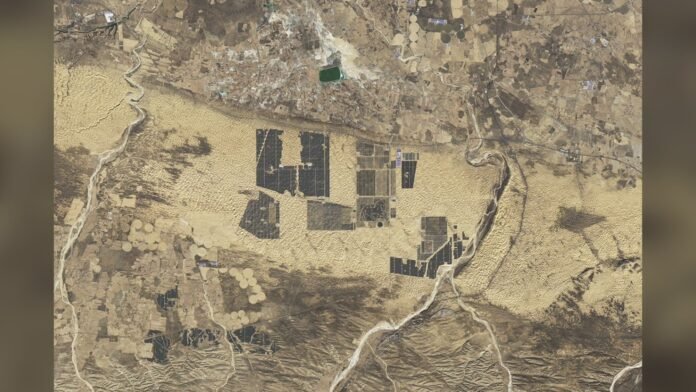
A satellite view of a large solar installation in China, December 2024. Photovoltaic technology is one of the three fields in China’s proposed export-control list. Image: NASA Earth Observatory (Landsat data, US Geological Survey), Public domain, via Wikimedia Commons. Photo source
Sources

The Tech Desk covers technology, artificial intelligence and cybersecurity. Stories are checked against at least two credible sources before publication.