NEW DELHI, November 7: Japan has turned from “a workshop of the world into a financier to the world”, Bank of Japan Governor Kazuo Ueda said in a lecture at the International Monetary Fund, explaining why the country has run a current account surplus for about four decades even as its population ages. The speech, given in Washington on November 6 and published by the Bank of Japan on November 7, did not discuss the outlook for interest rates.
Key highlights
- The shift: Japan’s goods trade surplus, more than 4% of GDP in the mid-1980s, has turned into a deficit, while its income from foreign investment has risen to more than 6% of GDP.
- The puzzle: households saved less as the population aged and the government ran deficits, yet the surplus did not disappear because companies became “chronic, massive net savers” from the late 1990s.
- Where the money went: since 2012, foreign direct investment (FDI) has been the main channel for Japan’s capital outflows, with returns above 8% for much of the period.
- Signs of change: more than 70% of firms in a Bank of Japan survey said they invested more at home in 2023–2024, mostly to cope with labour shortages.
- Lending: bank lending is growing at more than 5%, the fastest in three decades, excluding 2020.
| Point | What Ueda said |
|---|---|
| Current account surplus | Generally 2–4% of GDP for roughly four decades |
| Goods trade | Surplus of over 4% of GDP in the mid-1980s, now a deficit |
| Primary income (returns on foreign assets) | Negligible in the mid-1980s, now more than 6% of GDP |
| Historical parallel | Britain around 1900, when net foreign investment income neared 8% of national income |
| Outward FDI returns | Above 8% for much of the period after balance-sheet repair |
| Firms investing more at home (2023–2024) | More than 70% |
| Bank lending growth | More than 5%, fastest in three decades (excluding 2020) |
Why firms kept saving
Mr Ueda traced the surplus to the collapse of Japan’s asset bubble around 1990. Companies were left with assets that had lost value but debts that had not, and spent years repaying loans and cutting investment. Even after their balance sheets were repaired, they kept saving, and expectations of weak growth at home, reinforced by a shrinking population, led them to invest abroad instead. Profits earned by overseas affiliates were often reinvested abroad, adding to Japan’s income surplus.
He rejected the idea that labour shortages pushed capital abroad in the 1990s and 2000s, noting that the Bank’s output gap was almost always negative between 1993 and 2012 and unemployment averaged above 3%. Demographics mattered, he said, because firms expected a shrinking market at home, not because they could not find workers.
Is the pattern changing?
Mr Ueda said there are “tangible signs of structural change”: business investment after the pandemic has passed its early-1990s peak, and “corporate risk appetite appears to be reawakening” with the return of moderate inflation. But he called it “an open question” whether Japan is finally achieving growth led by domestic demand, and said net income from abroad will remain “an enduring pillar” of Japan’s external accounts for years. He ended: “Japan’s surplus has been remarkably persistent. The reasons for it have been rather less so.”
Our calculation
- Japan’s income from foreign assets (over 6% of GDP) is now larger than the whole current account surplus has typically been (2–4% of GDP), which means the other parts of the current account, mainly trade, are in deficit.
- The return on outward FDI that Ueda cited (above 8%) is several times the Bank of Japan’s 1.25% policy rate.
What it means for India and Asia
Japanese companies are among the biggest investors in Asia, including India, and Mr Ueda’s account explains why: for three decades they found better returns abroad than at home. If labour shortages and higher growth expectations keep more of that money in Japan, Asian countries hoping for Japanese factories may face more competition from Japan itself. The Bank of Japan held its policy rate at 1.25% last month, as covered in our report on that decision.
What to watch
- Japan’s current account figures for September, due from the Ministry of Finance.
- Whether Japanese domestic investment keeps rising in the Bank of Japan’s next Tankan survey.
- Any further remarks from Mr Ueda on interest rates.
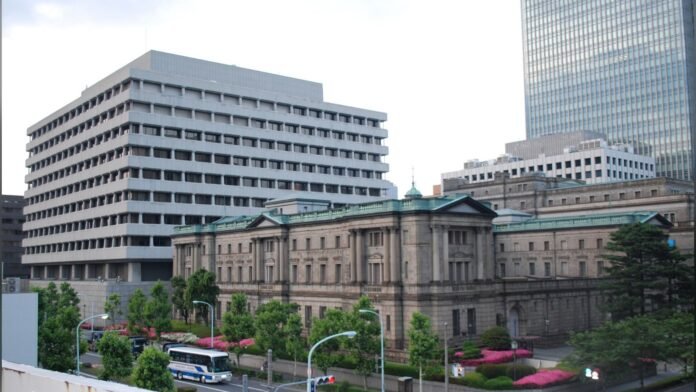
The Bank of Japan head office in Tokyo. Image: katorisi, CC BY-SA 3.0, via Wikimedia Commons. Photo source · Licence
Sources
- Bank of Japan: Speech by Governor Ueda, “Japan’s Current Account Surplus and Corporate Adjustment”, 2026 Michel Camdessus Central Banking Lecture, IMF, November 6, 2026
- Bank of Japan: Full text of the speech (PDF)

The Business Desk covers markets, the economy, companies and personal finance. Stories are checked against at least two credible sources before publication.