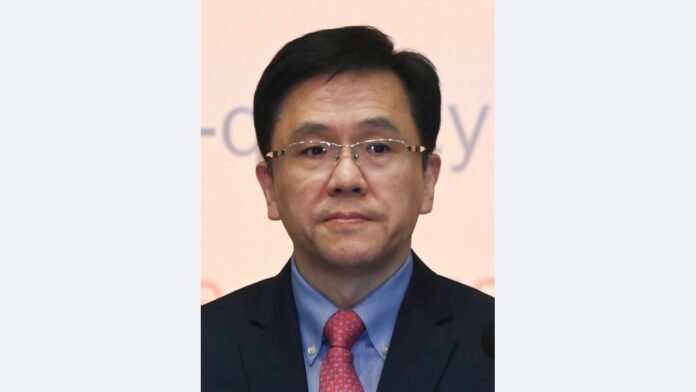
November 9: Hong Kong plans to connect its expansion of artificial intelligence with stronger safety and ethics requirements in selected government projects, technology secretary Professor Sun Dong said on Monday. His speech paired investment in computing infrastructure with adoption programmes and a pilot approach to procurement safeguards.
Key highlights
- Sun identified infrastructure, adoption and safety as linked priorities.
- Selected public-facing government AI projects would require bidder declarations.
- The speech cited a further HK$1 billion for the AI Subsidy Scheme.
- Sandy Ridge’s planned capacity remains a future target after 2030.
What changes in procurement?
Speaking at the Hong Kong International Computer Conference 2026, Sun said the Digital Policy Office would select pilot departments to require safety and ethics compliance declarations from bidders for public-facing AI projects. That is a targeted procurement initiative, not an announcement that every AI system in Hong Kong is subject to a new universal approval law.
A declaration makes a supplier’s assurances explicit. Its practical value will depend on what must be declared, how officials evaluate supporting evidence and how a project is monitored after deployment. The speech sets a direction; detailed tender documents will determine the obligations in individual procurements.
For a member of the public using an AI-enabled government service, the key question is how the service handles an incorrect answer or an unsuitable action. Transparency about limitations and a route to human assistance can matter as much as headline model performance. These are implementation questions to assess when projects are released.
Computing investment remains central
Sun cited a further HK$1 billion for the AI Subsidy Scheme, alongside the Hong Kong AI Research and Development Institute and InnoHK research clusters. The spending reference concerns support for computing and research, rather than a cash payment available automatically to every company describing itself as an AI business.
He also discussed the Sandy Ridge Data Facility Cluster, saying it is expected to support 180,000 petaflops after 2030, around 36 times the present capacity in the comparison used in his speech. Those figures are prospective capacity claims. They should not be reported as computing power already installed and operating today.
Large capacity targets also need context. The usefulness of computing depends on access, hardware, software, energy and the workloads being run. A future aggregate performance figure alone does not reveal the cost or speed that an individual researcher or small business will experience.
Adoption and skills alongside safety
The secretary pointed to the Digital Transformation Support Pilot Programme for smaller businesses and the AI for All Inclusive Programme for public skills. He also referred to industry-led governance frameworks and planned guidance on AI-agent safety.
Together, these measures show an effort to address different stages of adoption: providing resources, helping people use systems and setting expectations for responsible deployment. Training participation, subsidy support and a successful live service remain separate outcomes, each of which will need its own evidence.
At a glance
| Item | Detail |
|---|---|
| Speaker | Professor Sun Dong, technology secretary |
| Event | Hong Kong International Computer Conference 2026 |
| Procurement proposal | Declarations for selected public-facing AI projects |
| Additional subsidy cited | HK$1 billion |
| Sandy Ridge target | 180,000 petaflops after 2030, according to the speech |
What to watch
The most consequential follow-up will be the identity of pilot departments, published procurement conditions and the timetable for agent-safety guidance. Businesses should read the applicable scheme and tender requirements before assuming a broad policy speech creates an immediate entitlement or compliance duty.
Sources

The Tech Desk covers technology, artificial intelligence and cybersecurity. Stories are checked against at least two credible sources before publication.