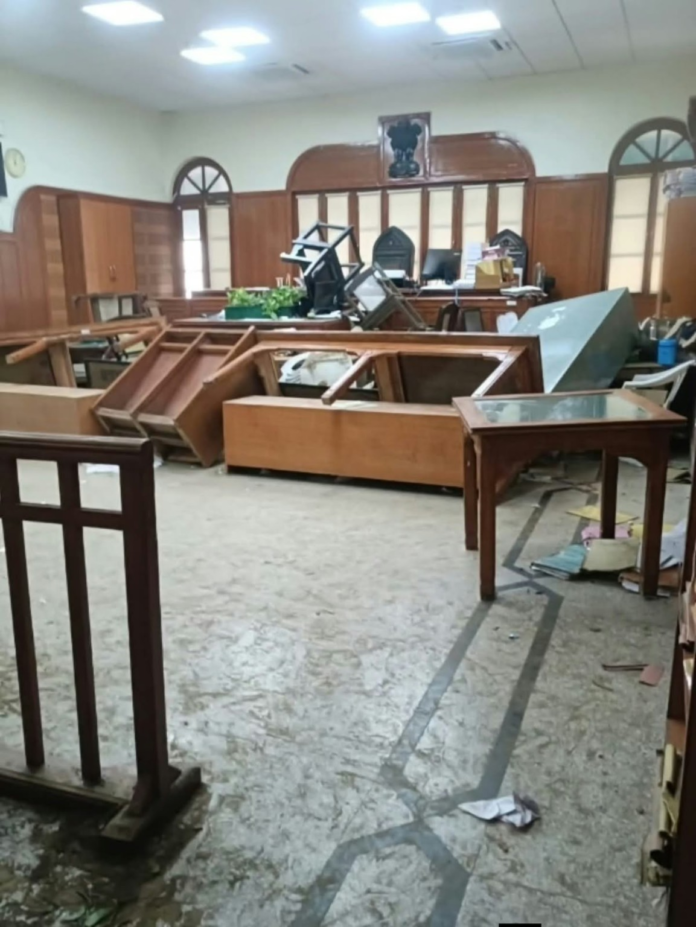
October 28, 2026: The Allahabad High Court has ordered a review of CCTV footage to identify advocates who disrupted proceedings outside Court No. 66, as a dispute over the alleged treatment of a lawyer in another courtroom escalated into protests. Photographs supplied to The Press of Asia by reporter Deepak Dube show overturned furniture and damage inside a courtroom.
The controversy involves three developments that require separate examination: a Bar Association complaint concerning an October 27 incident, the subsequent protest and reported courtroom damage, and an October 28 judicial order concerning interference with proceedings.
Key highlights
- A letter bearing the High Court Bar Association’s name alleges that an advocate was humiliated during proceedings before Justice Ajay Bhanot on October 27.
- The letter seeks intervention from the Chief Justice and warns of a boycott of Justice Bhanot’s court.
- Photographs supplied by Deepak Dube show overturned benches, chairs and other courtroom furniture.
- Justice Arun Kumar Singh Deshwal’s October 28 order directs identification of advocates involved in disruption outside Court No. 66.
- The order provides for possible disciplinary and contempt proceedings after identification; it does not announce a final punishment.
What the Bar Association’s letter alleges
A copy of the Hindi letter dated October 27, reviewed by The Press of Asia, is addressed to the Chief Justice through the Registrar General. It concerns proceedings in Court No. 49, where Justice Ajay Bhanot was sitting.
According to the letter, a superintendent of police was seated in a row behind the Additional Government Advocate. An advocate asked the officer to move to a row farther back, saying that the seat was not meant for him.
The association alleges that the Additional Government Advocate reprimanded the lawyer and subsequently complained to the judge. It further alleges that the lawyer was threatened with imprisonment and required to apologise to the police officer.
The letter also alleges that senior advocate V.P. Srivastava was mocked during the exchange. It presents these incidents as an affront to the dignity of advocates and asks the Chief Justice to intervene.
The copy bears the names of newly elected association office-bearers Dr C.P. Upadhyay and Santosh Kumar Mishra.
These allegations represent the association’s account. The letter is a complaint seeking action, rather than a judicial finding establishing misconduct. A response from Justice Bhanot is not included in the material reviewed for this report, and no inference should be drawn from that absence.
What the photographs show
The images supplied by Deepak Dube show furniture overturned in front of a judicial dais, displaced chairs and benches, and papers scattered around the room. One photograph also shows uniformed security personnel inside the courtroom.
The images document the visible condition of the room. They do not, by themselves, establish who overturned individual items, the sequence in which the damage occurred or the responsibility of every person present.
Those questions require examination of fuller footage, witness accounts and official records. Someone appearing in an aftermath photograph cannot automatically be identified as a participant in damaging property.
The chronology at a glance
| Date or development | Material examined | What it establishes |
|---|---|---|
| October 27 | Copy of the Bar Association’s letter | The association’s allegations about an exchange in Court No. 49 and its request for intervention |
| October 28 | Photographs supplied by Deepak Dube | The visible condition of courtroom furniture in the supplied images |
| October 28 | Order in Devendra Kumar v. State of U.P. | Directions concerning disruption outside Court No. 66 |
| November 19 | Next listing specified in that order | Deadline linked to submission of the CCTV identification report |
What the October 28 court order actually says
The Press of Asia examined the two-page order in Criminal Miscellaneous Bail Application No. 32917 of 2026, Devendra Kumar v. State of U.P., passed by Justice Arun Kumar Singh Deshwal.
The order records that certain advocates raised their voices in the corridor outside Court No. 66 and interrupted proceedings. It also records that the court was informed of a protest connected with the incident in Court No. 49.
Justice Deshwal described the conduct as “absolutely contemptuous” and directed the Registrar (Protocol) to obtain the relevant CCTV footage, identify the advocates involved and submit a report by the next listing.
After identification, the order says the matter may be referred to the Uttar Pradesh Bar Council for disciplinary proceedings, alongside initiation of contempt proceedings.
The distinction matters: the direction concerns the disruption recorded outside Court No. 66. It should not be presented as a completed investigation identifying everyone responsible for damage in Court No. 49.
Why the bail hearing was adjourned
The order contains another detail that can easily be lost in accounts of the confrontation.
At the beginning of the hearing, the applicant’s counsel sought time to place witness statements on record in compliance with an earlier direction. The court granted the request and listed the matter for November 19.
The disturbance is recorded separately, later in the same order.
It would therefore be inaccurate to state that the bail hearing was adjourned solely because of the protest. Reading the complete order prevents an important procedural fact from being replaced by an assumption.
Disciplinary proceedings and contempt are different processes
Professional disciplinary proceedings concern an advocate’s conduct as a member of the legal profession. Section 35 of the Advocates Act, 1961 provides for referral to a State Bar Council’s disciplinary committee where there is reason to believe professional or other misconduct has occurred.
The legislation requires an opportunity to be heard. Possible outcomes include dismissal of a complaint, reprimand, suspension from practice or removal from the State roll, depending on the findings. None of those outcomes should be treated as automatic in this incident.
Contempt proceedings concern protection of the administration of justice. The Contempt of Courts Act, 1971 includes interference with judicial proceedings and obstruction of the administration of justice within its definition of criminal contempt.
An observation describing conduct as contemptuous is significant. It nevertheless needs to be distinguished from a final determination against identified individuals following the applicable proceedings.
The wider issue: addressing grievances while protecting hearings
The dispute raises two questions that deserve examination on their own evidence.
First, what happened during the October 27 exchange, and how should the association’s complaint be addressed? Second, who participated in the subsequent disruption or damage, and what responsibility can be established against each person?
An allegation against a judge does not establish the guilt of protesters. Equally, misconduct by particular protesters would not, by itself, resolve the original complaint.
The Supreme Court’s December 2002 judgment in Ex-Captain Harish Uppal v. Union of India addressed the damage that lawyers’ strikes and boycotts can cause to litigants. The concurring opinion emphasised grievance-redress mechanisms and representations as ways of addressing complaints while protecting the functioning of courts.
For litigants, the practical concern is access to a functioning hearing. People with cases before other benches should not lose that access because a dispute has arisen elsewhere in the court complex.
What remains to be established
The next important records will be the CCTV identification report, any subsequent judicial directions and any action formally taken by the Bar Council.
The association’s complaint also requires a documented response or decision from the appropriate authority. Until those records emerge, claims about confirmed punishments, arrests, a final finding against the judge or the responsibility of particular individuals should be checked against the relevant official document.
The central reporting task is to establish responsibility accurately while giving both the original grievance and the subsequent disruption a fair, evidence-based examination.
Reporting credit
Reporting material, photographs and a copy of the Bar Association’s letter were supplied to The Press of Asia by Deepak Dube. The legal explanation draws on the court order and statutory material listed below.
Sources
- High Court Bar Association, Allahabad: Letter dated October 27, 2026; copy supplied with the reporter’s material.
- Allahabad High Court: October 28 order in Devendra Kumar v. State of U.P., Bail Application No. 32917 of 2026
- India Code: Advocates Act, 1961
- India Code: Contempt of Courts Act, 1971
- Supreme Court of India: Concurring opinion in Ex-Captain Harish Uppal v. Union of India, December 17, 2002

The National Desk covers India's politics, governance, security and public-interest news. Stories are checked against at least two credible sources before publication.