NEW DELHI, November 6: The Union Cabinet has approved a ₹2,814-crore capital support scheme to help set up commercial-scale plants in India that process lithium and nickel into high-purity compounds, the government said on Wednesday. The scheme will offer a 30% capital subsidy for two lithium and two nickel processing plants over five years, from 2026-27 to 2030-31.
Key highlights
- Outlay: ₹2,814 crore over five years (FY 2026-27 to 2030-31).
- Plants: two lithium processing plants of at least 30 kilotonnes each and two nickel processing plants of at least 50 kilotonnes each.
- Subsidy: 30% of eligible investment, capped at ₹500 crore per lithium plant and ₹900 crore per nickel plant.
- Selection: a technical round, then financial bidding; the two bidders per mineral seeking the least support win.
- Cobalt: expected to be recovered as a by-product of nickel production.
| Mineral | Plants | Minimum capacity each | Maximum support each |
|---|---|---|---|
| Lithium | 2 | 30 kt | ₹500 crore |
| Nickel | 2 | 50 kt | ₹900 crore |
Why the government is doing this
The Cabinet note said processing of critical minerals is concentrated in a few places in the world, which exposes supply chains to geopolitical disruptions, price swings and export restrictions. India depends heavily on imports of refined and high-purity materials such as lithium, nickel and cobalt compounds, because domestic processing is at a nascent stage and projects face high capital costs, limited technology and constrained access to raw material. The processed materials are needed for electric vehicles, battery storage, electronics, defence and speciality steel.
Our calculation
- If all four plants receive the maximum support, the total comes to ₹2,800 crore (2 × ₹500 crore + 2 × ₹900 crore), nearly the entire ₹2,814-crore outlay.
- To qualify for the full cap at a 30% subsidy rate, a lithium plant would need eligible investment of about ₹1,667 crore and a nickel plant about ₹3,000 crore.
What it means
The scheme fits with the ₹14,500-crore battery storage scheme approved the same day: both aim to build India’s battery supply chain at home. Processing is the step where India is weakest, so even four plants would be a start. Bidding on the lowest subsidy sought should keep costs down, but projects will still need assured supplies of ore or intermediate products, much of which India will have to import.
What to watch
- Scheme guidelines and the bidding timetable.
- Which companies bid, and where the plants are located.
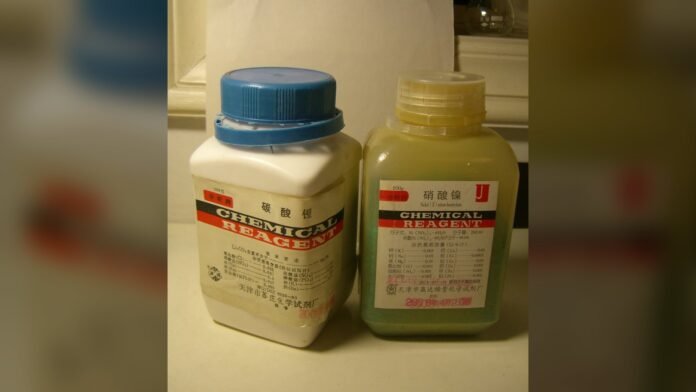
Samples of lithium carbonate and nickel nitrate, processed compounds of two critical minerals. Image: Choij (talk), Public domain, via Wikimedia Commons. Photo source
Sources

The Business Desk covers markets, the economy, companies and personal finance. Stories are checked against at least two credible sources before publication.