NEW DELHI, November 6: The Union Cabinet has approved a ₹14,500-crore Viability Gap Funding (VGF) scheme to support 92 gigawatt-hours (GWh) of new grid-scale energy storage, the government said on Wednesday. The scheme covers 60 GWh of pumped hydro storage, 30 GWh of battery storage and 2 GWh of newer technologies, and will run from 2026-27 to 2030-31.
Key highlights
- Support: ₹14,500 crore in VGF for FY 2026-27 to FY 2030-31.
- Capacity: 92 GWh in total: 60 GWh pumped storage, 30 GWh battery energy storage systems (BESS) and 2 GWh alternative technologies.
- Investment: an estimated ₹97,600 crore in total.
- Made in India: battery projects must meet a minimum 40% domestic content requirement.
- Allocation: through tariff-based competitive bidding; distribution companies are eligible for support for BESS and pumped storage.
| Technology | Capacity supported | Who is eligible |
|---|---|---|
| Hydro pumped storage plants | 60 GWh | Public and private electricity distribution companies |
| Battery energy storage systems | 30 GWh (40% domestic content) | Public and private electricity distribution companies |
| Alternative storage technologies | 2 GWh | Public and private sector entities |
| Total | 92 GWh | — |
Why storage matters
Solar and wind power vary through the day and the year. Storage lets the grid save surplus renewable power and use it in the evening or when the wind drops. The government said the scheme will add new capacity equal to 170% of India’s present grid-scale storage capacity and help meet the 411 GWh of grid-scale storage it says will be needed by 2031-32. It said the scheme would improve grid stability, cut reliance on conventional power for balancing, and boost domestic manufacturing of batteries.
Our calculation
- The VGF of ₹14,500 crore covers about 15% of the estimated ₹97,600-crore investment; the rest must come from developers and lenders.
- If 92 GWh equals 170% of present capacity, India’s current grid-scale storage is roughly 54 GWh.
- Even after this scheme, about 265 GWh more would be needed to reach the 411 GWh target by 2031-32 (411 minus 54 minus 92).
What it means
Storage is the missing piece in India’s renewable energy plans: without it, extra solar power at midday is wasted and coal plants are still needed for evening peaks. The 40% domestic content rule is meant to build a battery industry at home and reduce imports, most of which come from China. Pumped hydro, which makes up two-thirds of the planned capacity, takes years to build, so progress will depend on quick bidding and project approvals.
What to watch
- Scheme guidelines and the first bidding rounds.
- Tariffs discovered in the auctions, which will show how cheap storage has become.
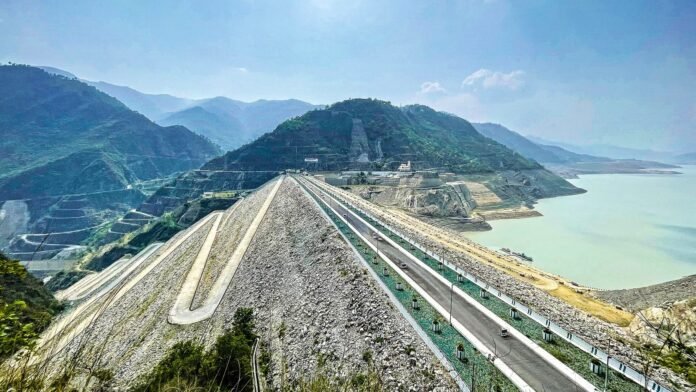
Tehri Dam in Uttarakhand, which hosts a pumped storage hydro plant. Image: Dr Vikramjit Kakati, CC BY-SA 4.0, via Wikimedia Commons. Photo source · Licence
Sources

The Business Desk covers markets, the economy, companies and personal finance. Stories are checked against at least two credible sources before publication.