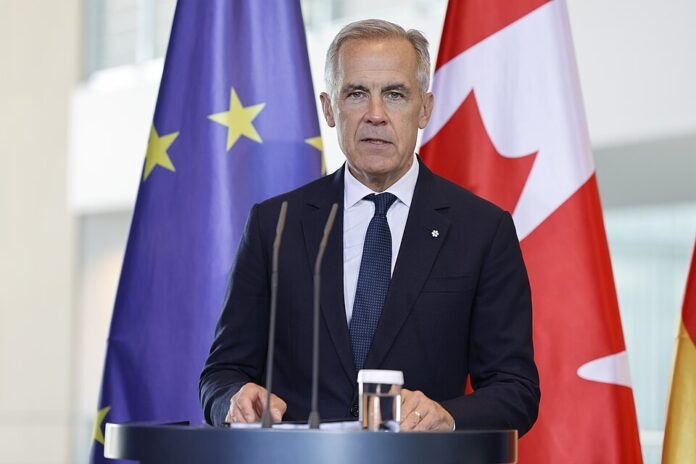
November 18: Canada and China have agreed to expand tariff relief following Mark Carney’s November 17 meeting with Xi Jinping in Shenzhen. Canada’s government says the additional access covers approximately C$400 million in Canadian exports, including selected frozen pork and seafood products, while Ottawa will extend and widen certain steel and aluminium tariff remissions.
Key highlights
- The Canadian announcement identifies C$116 million in frozen pork exports and C$285 million in fish and seafood exports.
- Canada will extend existing metals remissions by two years and add 32 tariff items with insufficient or unavailable domestic supply.
- A 2027 trade mission and an e-commerce initiative are also planned.
Which trade is covered
Canada’s detailed release lists particular seafood products, including certain frozen cold-water shrimp and prawns, molluscs, sea cucumber and Greenland halibut. The announcement is therefore product-specific. It should not be described as an unrestricted tariff exemption for every Canadian food export to China.
Our calculation: C$116 million plus C$285 million equals C$401 million. The government’s description of approximately C$400 million is a rounded total, not evidence of a discrepancy. These figures describe the export trade covered by the announcement; they are not a prediction that sales will immediately increase by the same amount.
What Canada is offering in return
Ottawa says it will extend by two years existing remission measures for selected Chinese steel and aluminium products that were due to expire at the end of 2026. It will add 32 tariff items where Canadian supply is insufficient or unavailable. A remission has a defined scope and should not be confused with the removal of every duty on all metals.
For an importer, the details that matter are the tariff classification, eligibility and operative notice. A political agreement can create a basis for relief, but the treatment of a shipment depends on the applicable rules. Businesses should distinguish the announcement of an arrangement from evidence that their own goods qualify.
A broader relationship with practical follow-up
The Canadian government also announced a major trade mission to China in 2027 and a Canada–China Year of e-Commerce. Its separate meeting readout records discussion of communication on security, customs cooperation and artificial-intelligence governance. China’s account likewise places the talks within the countries’ strategic partnership.
These parallel accounts demonstrate the scope of the engagement but do not remove the need to check each measure. A planned mission is not an export order, and an e-commerce initiative does not guarantee access for every seller. The strongest follow-up will identify actual participation rules, implementation dates and measurable trading results.
At a glance
| Canadian announcement | Coverage or timing |
| Additional export relief | Approximately C$400 million |
| Frozen pork cuts | C$116 million in exports |
| Selected fish and seafood | C$285 million in exports |
| Additional metals tariff items | 32 |
| Trade mission and e-commerce year | Planned for 2027 |
What to watch
Watch for customs implementation notices and product-level guidance on both sides. The commercial effects will depend on eligibility, demand and logistics as well as tariffs; the announcement does not, by itself, establish future export volumes.
Sources
- Canada PM: Expanded trade, commerce and cultural partnership
- Canada PM: Readout of Carney’s meeting with Xi
- China Foreign Ministry: Xi meets Mark Carney

The Business Desk covers markets, the economy, companies and personal finance. Stories are checked against at least two credible sources before publication.