BEIJING, October 27: Profits at China’s large industrial companies rose 14.4% year on year in September, more than three times August’s 4.2% pace, the National Bureau of Statistics (NBS) said on Tuesday. Electronics makers, whose profits more than doubled on demand linked to artificial intelligence, and metals and chemicals producers did most of the lifting. The same figures show foreign-invested firms and utilities falling far behind the average.
Key highlights
- September profits rose 14.4% from a year earlier, up from 4.2% in August.
- Profits for January–September reached about 6.03 trillion yuan, up 15.5%, on revenue of 106.21 trillion yuan, up 6.6%.
- The profit margin rose to 5.68%, up 0.44 percentage point, as costs per 100 yuan of revenue fell to 85.02 yuan.
- Computer, communication and other electronic equipment makers more than doubled profits (+103.8%); high-tech manufacturing now earns 25.5% of all industrial profits.
- Foreign-invested firms, including those from Hong Kong, Macao and Taiwan, grew profits by just 0.5%; utilities’ profits fell 14.3%.
What the statistics bureau said
In an interpretation published with the data, NBS chief statistician Yu Weining said industrial profits had kept up fast growth, helped by demand for AI computing and data storage, the build-out of data centres, firmer prices for some raw materials, falling unit costs and policy support. Costs per 100 yuan of revenue fell by 0.45 yuan from a year earlier.
Among the three broad sectors, mining profits rose 38.2% in January–September and manufacturing profits 17.0%, while profits in electricity, heat, gas and water supply fell 14.3%. High-tech manufacturing profits jumped 52.0%, raising its share of total industrial profits by 6.2 percentage points to 25.5%.
Where the profits came from
| Sector (January–September 2026) | Profit growth, year on year |
|---|---|
| All industrial firms above designated size | +15.5% |
| Mining | +38.2% |
| Manufacturing | +17.0% |
| Electricity, heat, gas and water | −14.3% |
| High-tech manufacturing | +52.0% |
| Computer, communication and other electronic equipment | +103.8% |
| Chemical fibres | +81.7% |
| Non-ferrous metal smelting and rolling | +79.7% |
| Coal mining and washing | +57.0% |
| Chemical raw materials and products | +49.2% |
Within electronics, the bureau said profits of electronic specialty materials rose 220%, optical fibre makers about 570%, computer peripherals 280% and complete computers 170%. Makers of electronic circuits rose 62.5%, optoelectronic devices 69.8%, discrete semiconductors 51.7% and optical cable 110%. Electronics alone added 9.6 percentage points to overall profit growth. In raw materials, petroleum processing swung to a profit of 84.22 billion yuan.
A strong year, but slowing from the mid-year peak
| Period (2026) | Year-to-date profit growth |
|---|---|
| January–February | +15.2% |
| January–March | +15.5% |
| January–June | +18.7% |
| January–July | +17.6% |
| January–August | +15.7% |
| January–September | +15.5% |
The year-to-date pace peaked at 18.7% in the first half and eased after a weak August. September’s rebound stopped that slide: cumulative growth was almost unchanged at 15.5%.
Who is earning: ownership and size
| Type of firm | Profits, Jan–Sep (trillion yuan) | Growth |
|---|---|---|
| Joint-stock enterprises | 4.67 | +20.8% |
| State-holding enterprises | 1.94 | +13.1% |
| Private enterprises | 1.51 | +8.7% |
| Foreign, Hong Kong, Macao and Taiwan-invested | 1.34 | +0.5% |
By size, large enterprises grew profits 18.8%, medium-sized firms 15.4% and small firms 8.7%. The NBS ownership categories overlap — many state-holding and private companies are also joint-stock companies — so the rows above do not add up to the total.
Our calculation
- The margin checks out: 106.21 trillion yuan of revenue at a 5.68% margin gives about 6.03 trillion yuan, matching the reported profit total.
- Shares of profit: state-holding firms earned about 32% of all industrial profits, private firms about 25% and foreign-invested firms about 22% (shares overlap with the joint-stock category).
- Large vs small: large firms’ profit growth (18.8%) was more than double small firms’ (8.7%) — a gap of 10.1 percentage points.
- Getting paid: receivables of 29.77 trillion yuan at end-September equal about 2.5 months of average monthly revenue (106.21 ÷ 9 = 11.8 trillion yuan). Receivables grew 10.0%, faster than revenue’s 6.6%.
- Stock building: finished-goods inventory rose 11.6% to 7.37 trillion yuan, also faster than sales.
What it means for Asia
The figures show the AI hardware cycle spreading well beyond chip designers. Chinese makers of optical fibre, servers, components and specialty materials are earning far more, just as South Korea’s exports lifted its third-quarter GDP and memory makers prepare to report earnings this week. For Japanese, Korean and Taiwanese companies operating in China, the near-flat 0.5% profit growth for foreign-invested firms is a reminder that the gains are not being shared evenly.
For India, which buys large volumes of Chinese electronic components and chemicals, fatter margins at Chinese suppliers remove some of the pressure to cut export prices. Indian importers will watch whether firmer supplier profits feed into prices over the coming months. The weak spots — slower private and small-firm profits, rising receivables and inventory — suggest domestic demand is still uneven.
What to watch
- China’s official purchasing managers’ indices for October, due on October 31.
- Signals on growth targets and industrial policy from the Communist Party’s Fifth Plenum.
- Industrial profit data for October, due from the NBS in late November.
- Whether receivables and inventory keep growing faster than revenue.
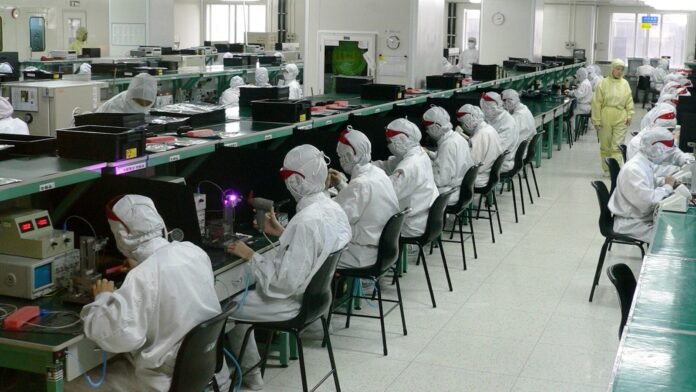
File photo (2005): workers assembling fibre-optic components at an electronics factory in Shenzhen, China. Image: Steve Jurvetson from Menlo Park, USA, CC BY 2.0, via Wikimedia Commons. Photo source · Licence
Sources
- National Bureau of Statistics of China: Industrial profits, January–September 2026 (Chinese)
- National Bureau of Statistics of China: Chief statistician Yu Weining on January–September industrial profits (Chinese)
- National Bureau of Statistics of China: Industrial profits, January–August 2026 (Chinese)
- National Bureau of Statistics of China: English press releases

The Business Desk covers markets, the economy, companies and personal finance. Stories are checked against at least two credible sources before publication.