BANGKOK, October 27: Thai authorities have seized more than 3.1 tonnes of elephant ivory hidden inside hollowed-out timber planks shipped from Zambia to Laem Chabang, the country’s main deep-sea port. The Customs Department, the Department of Special Investigation (DSI) and the Department of National Parks, Wildlife and Plant Conservation announced the haul at the port on Monday. They valued the ivory and other wildlife parts at more than 155 million baht and said the two containers were meant to be sent on to a third country, which they did not name.
Key highlights
- Officers found 469 tusks and tusk sections weighing 3,042.67 kg and 1,038 ivory fragments weighing 66.20 kg — 3,108.87 kg of ivory in all.
- The shipment also held 335 elephant tail hairs and the remains of one wild animal.
- The cargo was declared as 568 planks of sawn musivi hardwood weighing 56,000 kg; 32 planks had been hollowed out and sealed with wax.
- Intelligence from the UN Office on Drugs and Crime (UNODC) and the Wildlife Justice Commission helped officers target the two containers.
- The DSI has opened a special case and DNA tests are under way to trace where the elephants came from.
How the ivory was found
Customs Director-General Panthong Loykulnunt said the two containers were held after intelligence sharing and joint operations with international partners. When officers examined the timber, they found that 32 of the 568 planks had been cut open, packed with ivory and wildlife parts, and sealed with a greyish-white wax. The national parks department was called in for a joint inspection and to collect evidence, and has begun DNA testing to support prosecution.
Officials thanked the DSI, the national parks department, the police Natural Resources and Environmental Crime Suppression Division, UNODC and the Wildlife Justice Commission. No arrests or suspects were announced, and the consignee was not named.
The seizure in numbers
| Item | Quantity | Weight |
|---|---|---|
| Tusks and tusk sections | 469 pieces | 3,042.67 kg |
| Ivory fragments | 1,038 pieces | 66.20 kg |
| Total ivory | 1,507 pieces | 3,108.87 kg |
| Elephant tail hairs | 335 | 0.18 kg |
| Wildlife carcass | 1 | — |
| Declared cargo | 568 planks of sawn timber | 56,000 kg net |
| Planks used for concealment | 32 | — |
Our calculation
- Average piece: 3,042.67 kg across 469 tusks and sections works out to about 6.5 kg each.
- How much was hidden: the ivory made up about 5.6% of the declared cargo weight (3,108.87 ÷ 56,000 kg), and the doctored planks were also about 5.6% of the total (32 of 568).
- Value per kilogram: if the whole 155 million baht is attributed to the ivory, it comes to roughly 49,900 baht per kg. Officials did not give a breakdown.
The laws in play
Officials said the case involves possible offences under the Customs Act of 2017, the Elephant Ivory Act of 2015 and the Wild Animal Conservation and Protection Act of 2019, as well as Thailand’s obligations under the Convention on International Trade in Endangered Species of Wild Fauna and Flora (CITES). The DSI is handling it as special case No. 149/2569. Its international affairs and transnational crime division will trace domestic and foreign networks, follow the money and identify linked people and companies.
Under CITES, all commercial international trade in African elephant ivory is prohibited. Most African elephant populations are listed in Appendix I. The populations of Botswana, Namibia, South Africa and Zimbabwe are in Appendix II, but their ivory is treated as Appendix I. Asian elephants are also in Appendix I.
Why transit seizures matter
Shipments routed through a third country are harder to trace. Traffickers use large transhipment ports, mixed cargo and declared goods such as timber to break the link between where an elephant was killed and where its ivory is sold. DNA analysis of seized tusks can identify the population an elephant came from, which helps investigators link separate seizures to the same network. Seizure data are also fed into the CITES Elephant Trade Information System, which tracks illegal ivory flows worldwide.
UNODC’s 2024 World Wildlife Crime Report found that wildlife trafficking persists worldwide and affects more than 4,000 species, despite two decades of international action.
What it means
A three-tonne haul shows that large-scale ivory trafficking from Africa through Asian ports has not stopped, and that tip-offs from international partners remain vital. For Thailand, which has tightened its ivory laws over the past decade, the case is a test of whether investigators can move beyond seizing goods to charging the organisers and identifying the intended buyers.
What to watch
- DNA results that could show which elephant populations were targeted.
- Whether the DSI names the consignee, the exporter or the intended destination country.
- Any arrests, asset seizures or requests for cooperation with Zambia and other countries.
- How the seizure is reported to CITES and its Elephant Trade Information System.
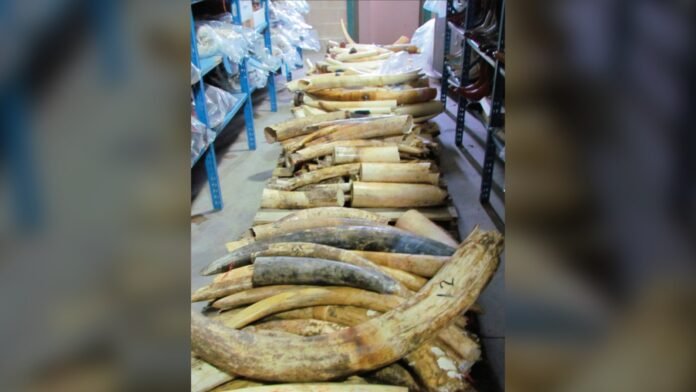
File photo: a pallet of seized raw elephant ivory held by the US Fish and Wildlife Service before it was crushed in November 2013; not the ivory seized in Thailand. Image: U.S. Fish and Wildlife Service, public domain, via Wikimedia Commons. Photo source
Sources
- CITES: Current rules on commercial international trade in elephant ivory
- CITES: Elephant Trade Information System (ETIS)
- UNODC: World Wildlife Crime Report 2024 press release
- Thai Customs Department
- Department of Special Investigation, Thailand

The International Desk covers world and Asian affairs, diplomacy and conflict, with a focus on what they mean for India. Stories are checked against at least two credible sources before publication.