NEW DELHI, November 7: Commonwealth leaders ended their summit in St John’s, Antigua and Barbuda, on November 4 with a communiqué that welcomed the United Kingdom’s agreement to hold a dialogue on the transatlantic slave trade, backed Bangladesh on the Rohingya crisis and rejected “unjustified trade restrictive measures”. The Commonwealth Secretariat said more than half a billion US dollars was mobilised in partnerships and deals at the meeting. For India, External Affairs Minister S. Jaishankar used the summit to sign three agreements with Guyana and announce a $500 million credit line.
Key highlights
- Summit: the 28th Commonwealth Heads of Government Meeting (CHOGM), held from November 1 to 4 under the theme “Accelerating Partnerships and Investment for a Prosperous Commonwealth”.
- Reparatory justice: leaders welcomed the UK government’s agreement to a “structured, time-bound, inclusive and good-faith dialogue” with affected parties on the transatlantic trafficking of enslaved Africans.
- Rohingya: support for Bangladesh, which hosts over 1.2 million displaced Rohingya, and a call for their safe and voluntary return to Myanmar.
- Trade: backing for the World Trade Organization and rejection of unjustified trade restrictions that hurt developing countries.
- India–Guyana: three agreements, including one on a UPI-like payments system for Guyana, and a new $500 million Line of Credit.
| Area | What the communiqué or partners said |
|---|---|
| Reparatory justice (OP47) | Welcomes the UK’s agreement to a structured, time-bound dialogue on the transatlantic slave trade and its historical harms |
| Bangladesh and Rohingya (OP48) | Support for Bangladesh; concern at atrocities in Rakhine; call for conditions for voluntary, safe, dignified return |
| Trade (OP3, OP31) | Rejects unjustified trade-restrictive measures; WTO at the core of a rules-based trading system |
| Climate | Calls for NDCs aligned with 1.5°C; looks forward to Australia and the Pacific’s role in a successful COP31 |
| Technology (OP39) | Commitment to tackle AI-enabled harms affecting women, children and young people |
| Investment | More than half a billion US dollars in partnerships and deals, according to the Secretariat |
The slavery dialogue
The most closely watched paragraph concerns reparatory justice. Recalling the 2024 Samoa communiqué, leaders noted the UN General Assembly resolution A/RES/80/250 on the trafficking of enslaved Africans and welcomed “the agreement of the Government of the United Kingdom to engage in a structured, time-bound, inclusive and good-faith dialogue with affected parties addressing the transatlantic trafficking of enslaved Africans and its historical harms”. The communiqué does not set out the format or timetable of that dialogue.
Asia in the communiqué
Under “country situations”, leaders reaffirmed support for Bangladesh, praised its humanitarian effort for the Rohingya, welcomed the role of the International Court of Justice and the UN’s Independent Investigative Mechanism for Myanmar, and urged Myanmar’s military authorities to give full access to UN and ASEAN envoys. They also called for the creation of conditions for the “voluntary, safe, dignified, secure and sustainable return” of the Rohingya.
India and Guyana
On the sidelines on November 4, Dr Jaishankar met Guyana’s President Mohamed Irfaan Ali. According to the Ministry of External Affairs, the two sides signed agreements on manufacturing projects for micro and small enterprises, on grants for quick-impact projects, and on cooperation in digital public infrastructure, including a UPI-like payment system in Guyana. India also announced a new $500 million Line of Credit for Guyana’s development and infrastructure projects.
Our calculation
- The communiqué has 52 operative paragraphs; four country situations are named: Bangladesh, Belize, Cyprus and Guyana.
- The Commonwealth says it represents 2.7 billion people in 56 countries.
What it means for India and Asia
For South Asia, the Rohingya paragraph keeps international attention on a crisis that weighs heavily on Bangladesh. For India, the Guyana deals show how New Delhi is using the Commonwealth to extend its digital payments model and development credit to the Global South. The trade language, rejecting unjustified restrictions, reflects concerns shared by many Asian and Caribbean members about tariffs and export curbs.
What to watch
- Details of the UK’s dialogue on the slave trade.
- COP31, which opens in Antalya on November 9, where Commonwealth members will push on climate finance.
- Implementation of the India–Guyana payments agreement.
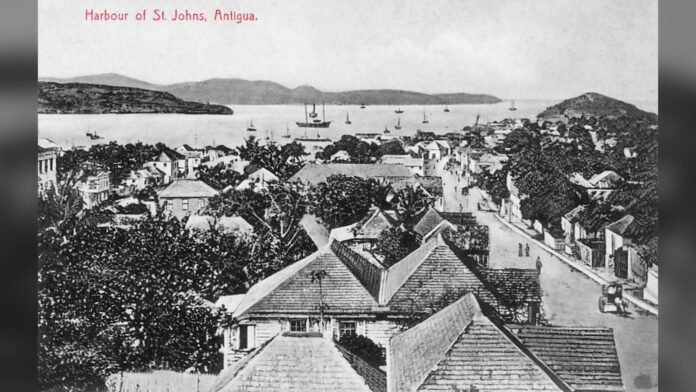
The harbour of St John’s, Antigua and Barbuda, host of CHOGM 2026. Image: John R. Anjo, Public domain, via Wikimedia Commons. Photo source
Sources
- Commonwealth Secretariat: Communiqué of the Commonwealth Heads of Government Meeting 2026 (PDF), November 4, 2026
- Commonwealth Secretariat: CHOGM 2026 page
- Ministry of External Affairs: EAM meets President of Guyana on the sidelines of CHOGM in Antigua and Barbuda (November 04, 2026)

The International Desk covers world and Asian affairs, diplomacy and conflict, with a focus on what they mean for India. Stories are checked against at least two credible sources before publication.