NEW DELHI, November 3: India will go to the UN climate summit COP31 in Antalya, Türkiye, asking for a formal start to work on climate finance and resisting any new top-down emission targets, Environment Minister Bhupender Yadav said on Tuesday. COP31 runs from November 9 to 20, and India will negotiate alongside the G77 and China, the Like-Minded Developing Countries and the BASIC group of Brazil, South Africa, India and China.
Key highlights
- India wants a COP31 decision to start the Climate Finance Work Programme.
- It says finance is an obligation of developed countries under Article 9.1 of the Paris Agreement, and should be predictable, mostly public and concessional, and not add to debt.
- The Global Stocktake and mitigation work should stay “Party-driven, facilitative and non-punitive”, with no new top-down targets, India says.
- Indicators for the Global Goal on Adaptation should be voluntary and should not decide access to finance.
- Participation in carbon markets should remain voluntary, and technology transfer barriers on cost, intellectual property and trade must be addressed.
India’s positions for Antalya
| Issue | India’s stated position |
|---|---|
| Climate finance | Start the Climate Finance Work Programme; finance is a developed-country obligation (Article 9.1), predictable, largely public and concessional |
| Mitigation and Global Stocktake | Party-driven, facilitative and non-punitive; respect nationally determined contributions; no new top-down targets |
| Adaptation | A priority; Global Goal on Adaptation indicators voluntary and not a condition for finance; more adaptation finance |
| Just transition | Continue the work programme through a Party-driven mechanism, seen through climate justice, the right to development and affordable energy |
| Technology | Transfer is a developed-country obligation; address cost, IPR and trade barriers |
| Carbon markets | Participation should stay voluntary |
| Presidency Action Agenda | Voluntary initiatives should stay separate from negotiations |
What India did at the other two summits
Yadav also reported on two other UN environment meetings. At the biodiversity summit, CBD COP17 in Yerevan, Armenia, India pressed developed countries to meet their funding obligations under Article 20(2) of the Convention, opposed expanding the group of contributors, and argued for fair benefit-sharing from genetic sequence data through the multilateral Cali Fund.
At the desertification summit, UNCCD COP17 in Ulaanbaatar, Mongolia, India was elected chair of the Asia-Pacific regional group. It repeated its pledge to restore more than 26 million hectares of land by 2030 and launched its first guide to grasslands and other open natural ecosystems.
Our calculation
- Length of the talks: COP31 runs 12 days, November 9 to 20.
- Negotiating blocs: India named three groups it will work with: the G77 and China, the LMDC and BASIC.
- Land pledge: 26 million hectares is about 260,000 square kilometres, close to 8% of India’s geographical area of about 3.29 million square kilometres.
What it means
India’s message is that the money question has to be settled before new demands are made of developing countries. By asking for a formal finance work programme and rejecting new top-down targets, New Delhi is setting up a familiar contest with richer countries that want faster emission cuts from large developing economies. India also wants adaptation, which matters greatly for its farmers, to get more money without new conditions.
What to watch
- Whether COP31 agrees to start the Climate Finance Work Programme.
- How the talks treat Global Goal on Adaptation indicators and any link to finance.
- India’s side events in Antalya, including LeadIT 3.0 with Sweden and panels on coastal resilience, forests and the International Big Cat Alliance.
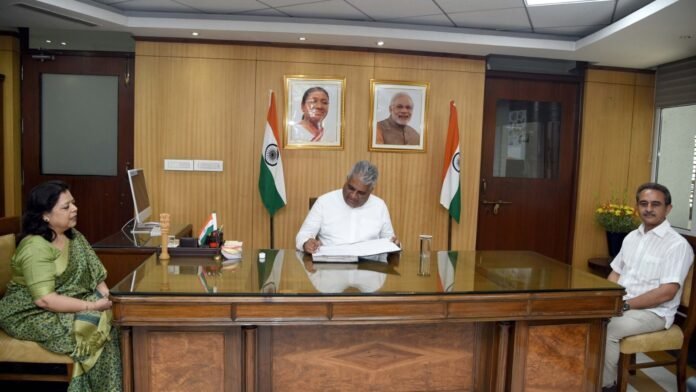
File photo: Union Environment Minister Bhupender Yadav in New Delhi. Image: Ministry of Environment, Forest and Climate Change, Government of India, Government Open Data Licence – India, via Wikimedia Commons. Photo source · Licence
Sources
- PIB (Ministry of Environment, Forest and Climate Change): India to pursue solution-oriented and equitable climate action at UNFCCC COP31 in Antalya (November 3, 2026)
- UNFCCC: Paris Agreement (text)

The International Desk covers world and Asian affairs, diplomacy and conflict, with a focus on what they mean for India. Stories are checked against at least two credible sources before publication.