PARIS/ROME, October 25: France’s CGT union has renewed its call for a major strike and demonstrations on November 5 after the October 24 mobilisation, while Italian authorities have set out stronger security measures following earlier unrest. The latest primary records point to continuing social pressure and a dispute over how demonstrations should be policed. They do not support treating every protest in the two countries as a single movement with an identical programme.
Key highlights
- CGT says nearly 800,000 people mobilised in France on October 24; this is the union’s estimate, not an independently verified or police total.
- The union’s October 24 statement repeats the November 5 strike call over living costs, wages and social demands.
- Italy’s government told Parliament on October 21 that its measures included 500 additional military personnel for Milan.
- Turin’s prefecture published local security measures on October 23 for the following day’s demonstration.
- Official September data show sharp annual increases in energy prices in both countries.
France: what changed after the October 24 mobilisation?
CGT’s statement published on Saturday says its count at 5.30 pm approached 800,000 participants, including young people, workers and retirees. It describes the mobilisation as a response to the cost of living and demands for decent conditions of study. The figure must remain attributed to CGT: an organiser’s count should not be presented as an agreed national attendance total.
The union says industrial action should now take a larger role and calls for workplace meetings to organise the November 5 mobilisation. This is a renewed call, not the first announcement of that date. CGT had published the strike appeal earlier in October. A call for action also does not establish that all transport services, schools or businesses will stop; operational disruption requires separate notices.
CGT criticises restrictions, late route changes and police conduct, and characterises the demonstrations as peaceful. These are the union’s account and criticisms. They should not be read as an independently established description of every gathering or incident.
What the French government has put on record
In a statement dated October 23, France’s Interior Ministry said its preparations were intended to prevent a repeat of the violence and looting it attributed to groups involved in the October 17 unrest. It instructed prefects to examine organisers, routes and risks to businesses, in consultation with mayors, and described checks at transport hubs and other routes.
The ministry also said force must be proportionate and used within the applicable legal framework. This pre-event statement explains the authorities’ approach; it is not a final account of October 24 arrests or injuries. The two documents establish a clear disagreement over policing, but do not themselves resolve disputed incidents.
Italy: security decisions and political scrutiny
Italy’s Chamber of Deputies record for October 21 provides a direct account of the government’s response to the previous weekend. Parliamentary Relations Minister Luca Ciriani defended preparations for October 17–18 and said the measures included increasing the military contingent in Milan by 500 personnel. This was a government statement about its response, not a new deployment announcement made on October 25.
During the same exchange, opposition deputy Giulia Pastorella criticised the government’s handling and questioned the consistency of its response. The record therefore contains both the government’s position and a challenge to it. An allegation made during a parliamentary question should not be confused with a court finding.
Turin’s prefecture subsequently published an October 23 notice about precautions for an October 24 city-centre demonstration. It described additional vigilance in gathering and shopping areas, cooperation with business groups and restrictions on specified objects and containers in defined areas. These were local arrangements; they should not be described as a nationwide ban on protest.
Timeline: keep the dates separate
| Date | Primary record | What it establishes |
|---|---|---|
| October 21 | Italy’s Chamber of Deputies | Government explanation of its response to October 17–18 unrest |
| October 23 | French Interior Ministry | Preparations for October 24 demonstrations |
| October 23 | Turin prefecture | Local precautions for the following day |
| October 24 | CGT statement | The union’s attendance estimate and renewed strike call |
| November 5 | Announced mobilisation date | A planned action, not a completed event |
Why living costs remain central
France’s INSEE reports that consumer prices rose 3.1% year on year in September, with energy prices up 21.3%. Italy’s Istat reports national consumer-price inflation of 4.2% and energy-price growth of 22.6% for the same month. Both are published final national figures, not estimates derived from protest attendance or social-media posts.
Those figures help explain the economic backdrop without proving that every participant has the same grievance. An annual inflation rate measures a change in prices, not the income of each household or the reason each person attends a demonstration. National indices also have their own methods and baskets, so the comparison is context rather than a precise ranking of household hardship.
What to watch next
The next substantive developments are any new government proposals on living costs, dated police accounts of specific incidents, and practical notices connected with the November 5 action. This article does not supply an unverified October 24 arrest or injury total for either country. Such figures need a clearly identified authority, place and reporting period.
For readers in Asia following events or planning travel, local notices matter more than a general claim that Europe is shut down. Demonstrations, restrictions and service interruptions can differ by city and time. The confirmed picture is continuing mobilisation, an announced next strike date in France and documented security decisions in Italy—not evidence that all of Europe is experiencing one uniform crisis.
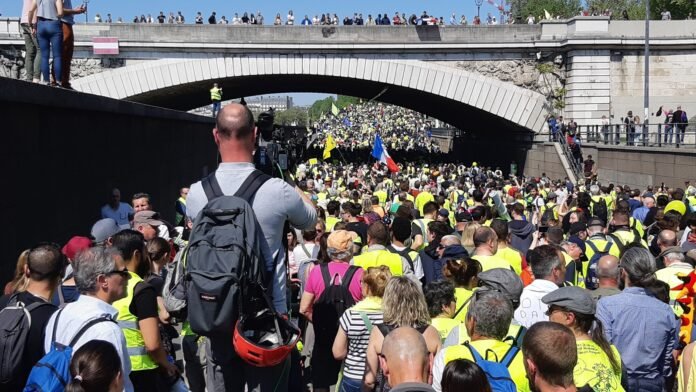
File photo: A Yellow Vest march in Paris on April 20, 2019. Photo: Tyseria, via Wikimedia Commons. This archival image illustrates protest activity; it does not show the October 2026 demonstrations in France or Italy. Photo source; CC BY-SA 4.0; this crop uses the same licence. Cropped and resized.
Sources
- CGT: Statement following the October 24 mobilisation
- CGT: November 5 strike appeal, published October 19
- French Interior Ministry: October 24 mobilisation, statement of October 23
- Italy Chamber of Deputies: October 21 sitting, question 3-02965 and government response
- Turin Prefecture: Security measures for the October 24 demonstration
- INSEE: Final September 2026 consumer-price results
- Istat: Final September 2026 consumer-price results

The International Desk covers world and Asian affairs, diplomacy and conflict, with a focus on what they mean for India. Stories are checked against at least two credible sources before publication.