STRASBOURG, October 25: The European Parliament has awarded the 2026 Sakharov Prize for Freedom of Thought to the International Criminal Court and its officials, giving the institution a prominent show of political support as it faces sanctions and pressure on its work. The decision was announced on October 22. The award ceremony is still ahead, during Parliament’s December plenary session in Strasbourg.
Key highlights
- The European Parliament has selected the ICC and its officials as the 2026 laureate.
- President Roberta Metsola announced the decision after the Conference of Presidents agreed on the winner.
- The ICC welcomed the recognition while highlighting challenges to its judicial work.
- An award is political recognition; it does not itself lift sanctions or decide a criminal case.
What Parliament announced
Metsola’s published announcement identifies both the Court and its officials as the recipients. She links the decision to Parliament’s support for international institutions and international law. The announcement also specifies the December ceremony, an important distinction between choosing a laureate and formally presenting the prize.
The decision should therefore be reported as an award already announced, not a ceremony already held. Nor should it be treated as a ruling by a judicial body. The European Parliament is recognising the institution’s work through its human-rights prize; it is not sitting as a court of appeal over the ICC’s decisions.
How the ICC responded
In its October 22 statement, the ICC thanked Parliament and placed the award in the context of challenges including sanctions. The Court said international cooperation was important for carrying out its mandate independently and impartially. Those are the institution’s stated concerns and priorities, rather than evidence that the award has already resolved the operational difficulties it describes.
The ICC subsequently recorded a visit by EU foreign-policy chief Kaja Kallas on October 23. Its account says she met Court President Tomoko Akane, Deputy Prosecutor Nazhat Shameem Khan and Registrar Osvaldo Zavala Giler to discuss challenges facing international justice and support for the Court’s mandate.
At a glance: three different developments
| Development | What it establishes | What it does not establish |
|---|---|---|
| Sakharov Prize decision | Parliamentary recognition of the ICC and its officials | The removal of sanctions |
| December ceremony | The planned formal presentation of the award | A new judgment in any criminal proceeding |
| Kallas visit | Official dialogue with Court leaders | An unannounced legal or financial protection package |
Why Europe’s response has practical stakes
The UN Regional Information Centre’s account of Parliament’s position describes calls by MEPs for protection against the effects of extraterritorial measures, including use of the EU blocking statute. It also records parliamentary support for continued financial assistance. A call for an instrument to be used, however, is different from a published decision bringing a particular measure into effect.
That distinction is the central issue to watch next. Political backing can draw attention to an institution and indicate the priorities of lawmakers. Practical protection needs identifiable decisions, the authority responsible for them and a clear account of their scope. Counting every expression of support as a completed legal action would give readers a misleading picture of what has changed.
Why the story matters outside Europe
The Court is based in the Netherlands, but its mandate concerns international crimes rather than European affairs alone. The UN’s explanation describes it as a treaty-based court that complements national justice systems. The relevance for readers in Asia is institutional: decisions about support for an international court can affect the wider system through which cross-border accountability is pursued.
Recognition of an institution must also be distinguished from a conclusion about an individual defendant. An award neither proves an allegation nor substitutes for the evidence and procedures required in a particular case. Keeping those questions separate allows readers to assess the political signal without confusing it with a verdict.
What to watch
Watch for the December presentation and for separately published EU decisions on practical support. Any proposed protective measure should be assessed from its actual text, not inferred from the prize announcement. The confirmed development is a parliamentary award, welcomed by the ICC and followed by a senior EU visit; the effects of further policy action require their own evidence.
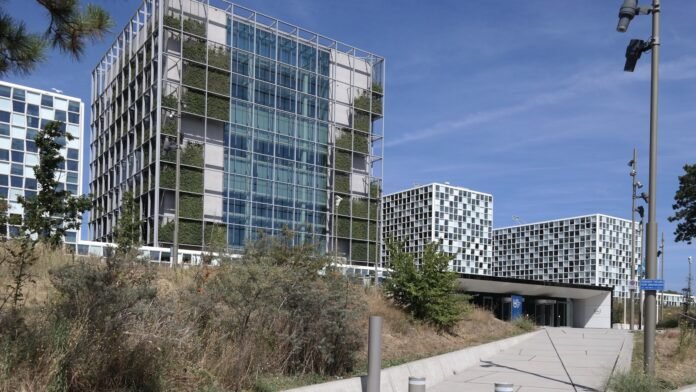
File photo: International Criminal Court premises in The Hague, Netherlands, on August 6, 2022. Photo: Choinowski; not a photograph of the 2026 award announcement. Photo source; CC BY-SA 4.0; this crop uses the same licence. Cropped and resized.
Sources
- European Parliament President: The 2026 Sakharov Prize awarded to the ICC and its officials
- International Criminal Court: Statement following the 2026 Sakharov Prize award
- International Criminal Court: Kaja Kallas visits the Court
- United Nations Regional Information Centre: ICC and its officials awarded the Sakharov Prize

The International Desk covers world and Asian affairs, diplomacy and conflict, with a focus on what they mean for India. Stories are checked against at least two credible sources before publication.