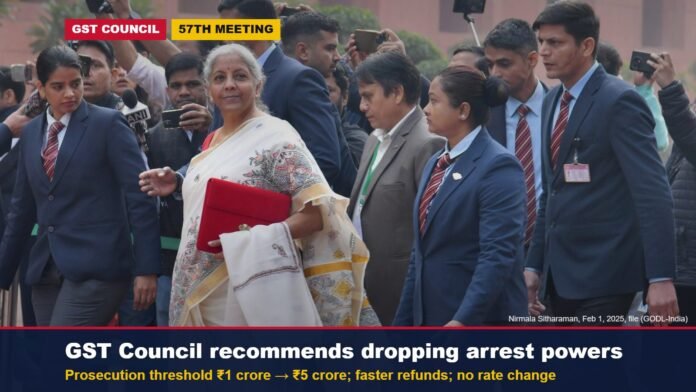
October 9: The GST Council, chaired by Finance Minister Nirmala Sitharaman, recommended at its 57th meeting on Thursday removing the power of arrest from GST law, raising the threshold for prosecution in tax evasion cases from ₹1 crore to ₹5 crore and cutting the general penalty from ₹25,000 to ₹10,000, LiveLaw and OfficeNewz reported. It also recommended faster refunds and input tax credit (ITC) on several expenses. Tax rates were not changed. These are recommendations; they take effect only after the law is amended and notifications are issued.
Key highlights
- A recommendation to delete Section 69 of the CGST Act, under which arrests are possible for some offences (LiveLaw).
- No show-cause notice for cases involving less than ₹10,000 of tax.
- 90% of refund claims for exports and inverted duty structures to be provisionally sanctioned on the basis of system risk assessment.
- Registration within 3 working days, without officer intervention, for low-risk applicants (OfficeNewz).
- Vehicles may be stopped for e-way bill checks only with the approval of a Joint Commissioner or higher officer.
- Sitharaman said rate matters will be taken up once a year at a separate meeting, OfficeNewz reported.
Old rules and the recommendations
| Issue | Now | Recommendation | Source |
|---|---|---|---|
| Arrest (Section 69) | Arrest possible for some offences | Delete the provision | LiveLaw |
| Prosecution threshold | ₹1 crore | ₹5 crore | LiveLaw; OfficeNewz |
| Minimum sentence | Prescribed | Remove; fine, jail or both at the court’s discretion | OfficeNewz |
| General penalty (Section 125) | Up to ₹25,000 | Up to ₹10,000 | LiveLaw |
| Show-cause notices | Even for small amounts | Not for tax below ₹10,000 | LiveLaw |
| Penalty in non-fraud cases | — | 5% if tax and interest are paid within 30 days (Section 73) or 60 days (Section 74A) of the order | LiveLaw |
| Pre-deposit in penalty-only appeals | — | Capped at ₹40 crore | LiveLaw |
| Acknowledgement of refund applications | 15 days | 10 days; deemed acknowledged if the officer does not act | LiveLaw; OfficeNewz |
| Refund order | Within 7 days of acknowledgement | Within 3 working days of acknowledgement | OfficeNewz |
| Balance in electronic cash ledger | Refund on application | Full refund automatically | LiveLaw |
By our calculation, the prosecution threshold rises five-fold and the maximum general penalty falls by 60%. For refunds, the combined time for acknowledgement and order falls from about 22 days to about 13 (10 days for acknowledgement plus 3 working days for the order), although working days and calendar days are counted differently. Sitharaman told a press conference that there would be no prosecution in cases below ₹5 crore, Bombay Samachar reported.
Other relief for businesses
| Area | Recommendation | Source |
|---|---|---|
| Input tax credit | ITC on employees’ health and life insurance, telecom towers, pipelines laid outside the factory, free samples and stock destroyed after expiry | OfficeNewz; LiveLaw |
| FMCG and pharma companies | Refund of tax paid on input services (for credit taken on or after November 1, 2026); refund of 1/60 of plant and machinery credit every month (from April 1, 2027) | OfficeNewz |
| Small businesses | Late fee waiver, with conditions, for filers with turnover up to ₹5 crore; in-principle approval for an optional scheme of one annual return and quarterly payments for those selling only to consumers | LiveLaw; OfficeNewz |
| E-commerce sellers | Option to declare an e-commerce company’s warehouse in another state as the principal place of business there | OfficeNewz |
| Export of services | Services through an overseas branch, and services on goods of foreign clients in India, to count as exports | OfficeNewz |
| Honest buyers | A committee of officers to report in three months on protecting buyers with valid invoices, delivered goods and full payment | OfficeNewz |
A year of GST 2.0: the numbers
| Measure | Before | Now | Change |
|---|---|---|---|
| Taxable supplies (monthly) | ₹40.19 lakh crore | ₹50.58 lakh crore | Up 25.8% |
| Supplies to consumers (monthly) | ₹5.98 lakh crore | ₹7.58 lakh crore | Up 26.7% |
| Total tax liability (monthly) | ₹5.85 lakh crore | ₹6.64 lakh crore | Up 13.6% |
| Effective tax rate on domestic supplies | 14.55% | 13.13% | Down 1.42 points (our calculation) |
When it takes effect
These are recommendations and will take effect only through circulars, notifications or amendments, LiveLaw reported. Deleting Section 69 and changing Section 132 require amendments to the CGST Act passed by Parliament, and states must amend their own GST laws. Only two dates are fixed, according to OfficeNewz: November 1, 2026 for input-service refunds and April 1, 2027 for plant and machinery refunds.
What to watch
- When a bill to amend the CGST Act comes to Parliament.
- The circulars and notifications that bring the refund and ITC changes into force.
- Decisions at the next meeting on the annual-return scheme for small businesses and on protecting honest buyers.
- The date of the separate annual meeting on rates.
What it means
This meeting was about reducing fear of the law and paperwork rather than tax rates. Removing arrest powers and raising the prosecution threshold lowers the risk of criminal action against small businesses, while serious fraud, such as claiming fake ITC without goods or invoices, remains an offence; LiveLaw reported that Section 132(1)(c) is being focused on that. Faster refunds will ease cash flow for companies such as pharma and FMCG makers. The real effect will show only when the amendments are passed and notifications issued.
Note: this article is general information, not tax advice. This article was first published in Hindi and has been translated. The Press of Asia now publishes in English only.
Sources
- LiveLaw: GST Council recommends dropping arrest powers, raising prosecution threshold to ₹5 crore
- OfficeNewz: 57th GST Council meeting: No GST rate change, FMCG and pharma get ITC relief; taxman’s arrest power removed
- Bombay Samachar: GST Council removes arrest powers, prosecution limit raised to Rs 5 crore

The Business Desk covers markets, the economy, companies and personal finance. Stories are checked against at least two credible sources before publication.