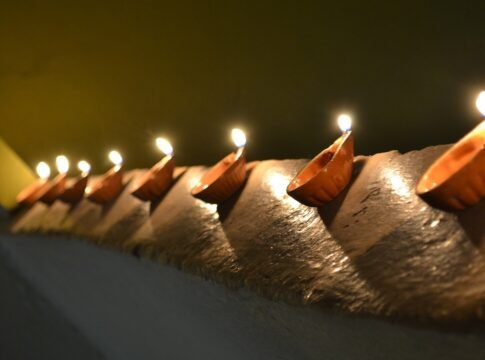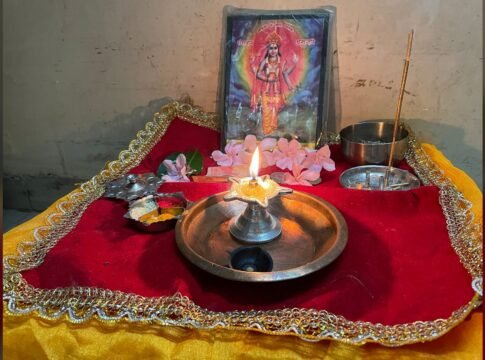
NEW DELHI, November 7: When India lights its lamps for Diwali on Sunday, November 8, it will be marking a festival whose roots run back more than a thousand years in written records, and much further in tradition. There is no single date on which Diwali “began”. Instead, Jain scripture, Sanskrit plays, Puranas and the notes of an 11th-century Persian-language scholar each show pieces of the festival of lamps taking shape, with different communities attaching their own stories to the same autumn new-moon night. In December 2025, UNESCO added Deepavali to its list of the world’s intangible cultural heritage.
Key highlights
- Name: Deepavali means “a row of lamps” (deepa, lamp; avali, row). Diwali is its common short form.
- Jain record: the Kalpa Sutra says that on the night Mahavira attained nirvana, kings lit lamps because “the light of intelligence is gone”.
- Medieval texts: the 7th-century play Nagananda, attributed to King Harsha, and the 10th-century Yasastilaka of Somadeva refer to a lamp festival.
- Eyewitness, about 1030 CE: the scholar Al-Biruni described “Dibali” on the new moon of Kartika, with bathing, festive clothes, gifts of betel and lamps lit everywhere at night.
- Many stories, one night: Rama’s return to Ayodhya, Lakshmi’s worship, Krishna’s victory over Narakasura, King Bali, Kali Puja, Mahavira’s nirvana and the Sikh Bandi Chhor Divas.
- Global recognition: Deepavali was inscribed on UNESCO’s Representative List of the Intangible Cultural Heritage of Humanity on December 10, 2025.
So when did Diwali begin?
No surviving record gives a founding year, and claims of an exact starting date should be treated with care. What the written sources show is a festival of lamps already established by the second half of the first millennium CE, and described in detail by the 11th century. The stories attached to it are much older in tradition, but the texts that record them were composed and compiled over many centuries, and scholars debate their dates.
The Jain lamps for Mahavira
One of the clearest early accounts comes from the Kalpa Sutra, a Jain scripture traditionally attributed to the teacher Bhadrabahu. Describing the night on which Mahavira, the 24th Tirthankara, attained liberation, it says the eighteen allied kings of Kasi and Kosala, with the Mallakis and Licchavis, held an illumination, reasoning: “Since the light of intelligence is gone, let us make an illumination of material matter!” Jains still mark Diwali as the anniversary of Mahavira’s nirvana, which their tradition dates to 527 BCE.
Plays, Puranas and the Kashmir lamps
Sanskrit literature gives more glimpses. Scholars point to Act IV of Nagananda, a 7th-century play attributed to King Harsha, for a festival at which gifts are given. The Nilamata Purana of Kashmir describes rows of lamps (dipamala) as part of a festival called Sukha Suptika, and the Yasastilaka, written by the Jain author Somadeva in the 10th century, describes a Dipotsava with rows of lights on city terraces. The Padma Purana prescribes a lamp for Yama on the thirteenth night of the dark fortnight of Kartika, the custom still followed on Dhanteras (our report).
Al-Biruni’s eyewitness account
Around 1030 CE, the Central Asian scholar Al-Biruni, who travelled in India in the time of Mahmud of Ghazni, described the festival in his book on India. On the new moon of Kartika, he wrote, “people bathe, dress festively, make presents to each other of betel-leaves and areca-nuts”, give alms at temples and play together until noon, and at night light many lamps everywhere, so that the air is clear. He recorded the story behind it as Lakshmi freeing King Bali once a year, and noted the festival was therefore also called Balirajya, the rule of Bali, a link that survives today in Bali Pratipada, celebrated the day after Diwali in parts of India.
One night, many stories
| Tradition | What is remembered |
|---|---|
| North India (Hindu) | Rama’s return to Ayodhya after 14 years of exile and his victory over Ravana; the city lit with lamps to welcome him |
| Lakshmi Puja | Worship of Lakshmi, goddess of prosperity, on the new-moon night; merchants traditionally open new account books |
| South India (Naraka Chaturdashi) | Krishna’s defeat of the demon Narakasura, celebrated with an early-morning oil bath |
| Bali Pratipada | The return of King Bali, recorded by Al-Biruni around 1030 CE |
| Bengal, Odisha, Assam | Kali Puja on the new-moon night |
| Jains | Mahavira’s nirvana; lamps lit as a symbol of lost light of knowledge |
| Sikhs | Bandi Chhor Divas, marking Guru Hargobind’s release from Gwalior Fort and his return to Amritsar; the Golden Temple is illuminated |
Diwali in art and in the modern state
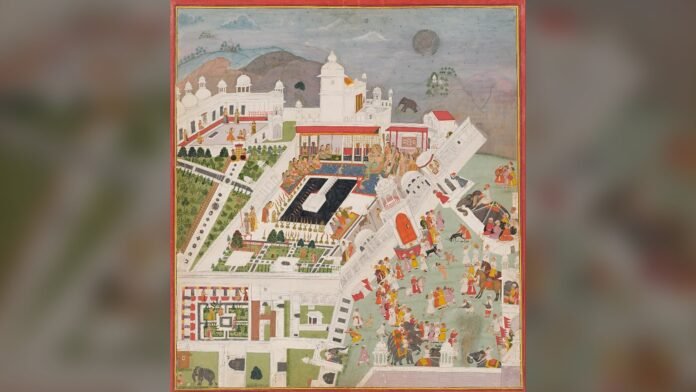
Court painters recorded the festival too. A painting of Diwali celebrations at Kotah in Rajasthan, dated to around 1690, shows a palace and town lit up for the night (our featured image). In modern India, Diwali is a national closed holiday for central government offices. In Ayodhya, the Uttar Pradesh government has held Deepotsav on the eve of Diwali since 2017, lighting lakhs of lamps on the banks of the Saryu; Vice-President C. P. Radhakrishnan attends this year’s edition on November 7. On December 10, 2025, at a UNESCO committee meeting held in New Delhi, Deepavali was inscribed on the Representative List of the Intangible Cultural Heritage of Humanity.
Timeline
| Date or period | Milestone |
|---|---|
| Jain tradition, 527 BCE | Mahavira’s nirvana; the Kalpa Sutra records kings lighting lamps that night |
| 7th century CE | Nagananda, attributed to King Harsha, refers to the festival (Act IV) |
| 10th century CE | Somadeva’s Yasastilaka describes a Dipotsava with rows of lights |
| About 1030 CE | Al-Biruni describes “Dibali” on the new moon of Kartika |
| About 1690 | Painting of Diwali celebrations at Kotah, Rajasthan |
| 17th century | Sikh tradition marks Guru Hargobind’s release from Gwalior Fort as Bandi Chhor Divas |
| 2017 | First Deepotsav in Ayodhya |
| December 10, 2025 | Deepavali inscribed on UNESCO’s intangible heritage list |
| November 8, 2026 | Diwali |
Our note on sources
We have relied on primary texts and their standard translations where possible, and on a scholarly survey for the Sanskrit literary references. Where a date comes from religious tradition rather than independent evidence, we have said so.
Diwali celebrations at Kotah, Rajasthan, an Indian painting dated to about 1690. Image: Indian Unknown Details on Google Art Project, Public domain, via Wikimedia Commons. Photo source
Sources
- Kalpa Sutra, para 128 (Jaina Sutras, Part I, tr. Hermann Jacobi, Sacred Books of the East, 1884)
- Alberuni’s India, Vol. 2, p. 182 (tr. Edward C. Sachau, 1910), Columbia University Libraries
- Sahapedia: The Festival of Lights in Various Religious and Literary Texts of South Asia
- Embassy of India, Minsk: Deepavali added to UNESCO’s Intangible Cultural Heritage list
- PIB (Vice President’s Secretariat): Vice-President to attend Deepotsav 2026 in Ayodhya

The History Desk tells the stories behind the news: the people, events and turning points of India, Asia and the world, with timelines and original sources. Stories are checked against at least two credible sources before publication.