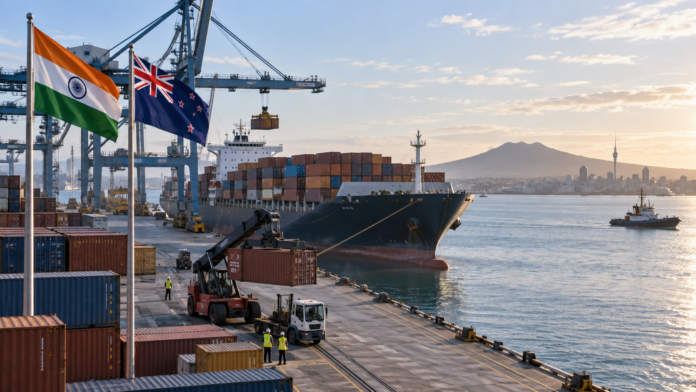
New Delhi, September 22: The free trade agreement (FTA) between India and New Zealand will come into force on October 20. The two countries announced the date on Monday after completing their domestic approval processes. According to India’s commerce ministry, from day one customs duty will be zero on all tariff lines of Indian exports to New Zealand. The New Zealand government has also confirmed the date.
The agreement was signed in April, but for businesses the real change has become clear only now that the entry-into-force date is fixed. This does not mean every product will arrive without any procedure: exporters must follow rules of origin and other applicable rules.
Key highlights
- In force from October 20: the date was announced on September 21 by commerce ministers Piyush Goyal and Todd McClay.
- Indian exports: zero duty on all tariff lines in New Zealand from day one; New Zealand duties of up to 10% are removed.
- New Zealand exports: 57% enter India duty-free from day one, according to the New Zealand government, including sheep meat, wool and coal.
- Protected in India: dairy, some meats, key farm goods, sugar and edible oils are excluded from concessions.
- People: a quota of 5,000 temporary employment entries for skilled Indians and 1,000 working holiday visas a year for young people.
What Indian exporters get
According to the Indian government, textiles and apparel, leather and footwear, gems and jewellery, engineering goods and processed food are among the sectors that could benefit immediately from the removal of duties. The ministry said New Zealand duties of up to 10% will go. That can help competitiveness, but sales will not rise on their own; quality, logistics and access to buyers also matter. Our earlier report on growth in India’s textile exports in August sets out the wider picture for that sector.
Who gets what
| Side | What opens up | What stays protected |
|---|---|---|
| Indian exports to New Zealand | Zero duty on all tariff lines from day one (duties of up to 10% removed) | Rules of origin and standards still apply |
| New Zealand exports to India | 57% duty-free from day one, including sheep meat, wool and coal; wide concessions on wood and forestry products | Dairy, some meats, key farm goods, sugar and edible oils excluded; quotas and price safeguards for apples, kiwifruit and manuka honey |
| Services and people | Openings in about 118 service sectors; 5,000 temporary employment entries; 1,000 working holiday visas a year; student mobility | Subject to eligibility and administrative rules |
Conditions for farmers and imports
The agreement is not a one-sided tariff cut. The New Zealand government says 57% of its exports to India will be duty-free from day one. These include sheep meat, wool and coal; wood and forestry products will also get wide concessions. Limited quotas and price-related safeguards have been kept for products such as apples, kiwifruit and manuka honey.
India’s commerce ministry has said sensitive categories such as dairy, some types of meat, key agricultural goods, sugar and edible oils have been kept out of tariff concessions. So it would be wrong to say that all New Zealand products are now duty-free. The scope of concessions differs on the two sides.
Services, jobs and students
According to the Indian government, the agreement provides opportunities for Indian service providers in about 118 sectors, a special quota of 5,000 temporary employment entries for skilled Indians and 1,000 working holiday visas a year for young people. Student mobility and post-study work rights are also mentioned. These provisions will be subject to eligibility and administrative rules and should not be taken as a guarantee of automatic visas.
New Zealand said its parliamentary and other domestic steps were complete. Commerce ministers Piyush Goyal and Todd McClay announced the date in a virtual meeting on September 21. New Zealand’s Ministry of Foreign Affairs and Trade has also listed October 20 as the effective date.
What to watch
- Product-wise rules, rules-of-origin certification and import standards that businesses now need to prepare for.
- Actual trade data in the first months after October 20, which will show whether exports or investment rise.
- How the quotas and safeguards on apples, kiwifruit and manuka honey work in practice.
What it means
For Indian exporters, the headline is full duty-free access to a small but high-income market; for New Zealand, the gain is access for farm and forestry goods outside India’s protected categories. The investment and trade ambitions the governments have announced are targets, not results; the real impact can only be judged from trade data.
This article was first published in Hindi and has been translated. The Press of Asia now publishes in English only.
Sources
- Press Information Bureau (Ministry of Commerce and Industry): India–New Zealand FTA to enter into force on October 20 (September 21, 2026)
- New Zealand Government: New Zealand and India ratify free trade agreement (September 21, 2026)
- New Zealand Ministry of Foreign Affairs and Trade: New Zealand–India Free Trade Agreement status

The Business Desk covers markets, the economy, companies and personal finance. Stories are checked against at least two credible sources before publication.