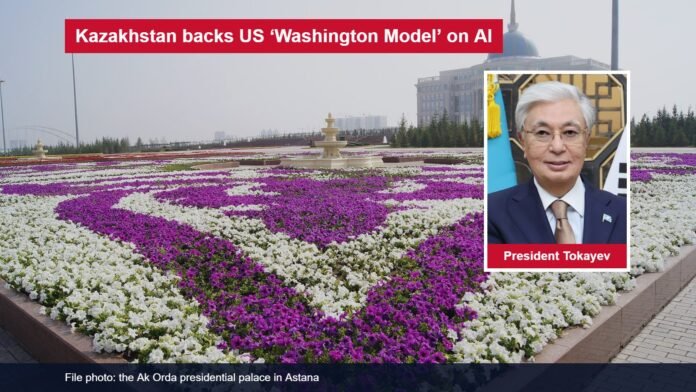
October 4: Kazakhstan’s President Kassym-Jomart Tokayev has endorsed the voluntary artificial intelligence safety accord signed at the White House last week and proposed that it be taken up worldwide. Speaking at the third meeting of Kazakhstan’s Artificial Intelligence Development Council on Friday, October 2, he said the accord could serve as a model for other countries and could become “a core of an International Treaty under the auspices of the UN”, according to the president’s official website, Akorda. Kazakhstan plans to present its own proposals at the G20 summit in Miami in December.
Key highlights
- What he backed: The voluntary accord on safe and responsible AI signed by US President Donald Trump and the heads of major technology companies.
- The label: The Times of Central Asia reported that Tokayev called it the “Washington Model”.
- The proposal: Use the accord as the basis for an international treaty under the United Nations.
- Kazakhstan’s offer: Tokayev said the country is “ready to serve as a platform for substantive international dialogue on these issues”.
- Next step: Council members have been told to prepare concrete proposals for the G20 summit in Miami in December.
What Tokayev said
Akorda’s account of the meeting says Tokayev noted that Trump and the leaders of major technology companies had recently signed a voluntary accord on safe and responsible AI development. He described it as “very important and timely”.
The Astana Times quoted him as saying: “I welcome this very important and timely initiative. It reflects a common understanding that the risks associated with artificial intelligence go beyond national borders.”
According to The Times of Central Asia, he listed the issues that need a cross-border response: cybersecurity, data protection, information integrity, algorithmic transparency and accountability for decisions. A day earlier, at the AI and Digital Bridge forum in Astana, he had said rules should be “strict, but not excessive” where safety and vital interests are involved.
What the White House accord is
The accord, formally the White House Accord on Super Intelligence, was announced on September 29, The Times of Central Asia reported. It was signed by the leaders of Google, Anthropic, Meta, OpenAI, xAI and Nvidia. It is voluntary. It relies on the companies’ own internal controls, dedicated monitoring, independent outside assessments and oversight by their boards. Trump has described it as “morally binding”.
A voluntary pledge by companies is very different from a treaty between states, which would bind governments and need long negotiation. That is the gap Tokayev’s proposal would have to cross. In the United States, the Federal Trade Commission has separately confirmed an investigation into AI companies. Read: US FTC confirms investigation into OpenAI, Anthropic and other AI firms.
Who was in the room
The council is a presidential body. Its foreign members at Friday’s meeting included Kai-Fu Lee, chief executive of Sinovation Ventures and 01.AI; Mansoor Al Mansoori of the UAE’s G42 International; Alexander Khanin, founder of Polynome Group; and Ya-Qin Zhang of Tsinghua University’s Institute for AI Industry Research, according to Akorda.
Much of the meeting was about using AI in Kazakhstan’s own industry. Tokayev told the government to pick enterprises for a full AI-based overhaul of production, to build sector-wise industrial datasets with quality standards, and to move faster from pilot projects to commercial use, Akorda and The Astana Times reported. The next council meeting will focus on transport and logistics.
“Enterprises must review the entire production chain and determine where AI can provide the greatest increase in efficiency,” he said, as quoted by The Astana Times. The newspaper reported that Kazakhstan’s industrial output was about 46 trillion tenge (roughly US$102.5 billion) in January to August, and that manufacturing grew 8.4% year on year.
Why Kazakhstan is taking this position
Kazakhstan has already adopted a law on artificial intelligence and a Digital Code, The Times of Central Asia noted. On June 25 it became the first country in the region to join Pax Silica, a US-led grouping on technology supply chains.
Kazakhstan describes its foreign policy as “multi-vector”, meaning it keeps ties with several powers at once. Friday’s meeting fits that pattern: Tokayev backed Washington’s approach in front of a council that includes Chinese and Gulf experts. Our reading is that a UN treaty would also give a middle-sized country a voice in a field dominated by the United States and China. For that rivalry, read: US-China AI safety talks.
What to watch
- The G20 in Miami: Whether Kazakhstan’s proposals get support from other members in December.
- Washington’s response: The reports reviewed for this article carry no reaction from the United States or other governments.
- The UN route: A treaty would need wide agreement among states, including China.
Disclosure: The Press of Asia uses AI tools for research and drafting, including a model made by Anthropic, one of the companies that signed the accord described in this report. See our AI Usage Policy.
Sources
- Akorda (official website of the President of Kazakhstan): President Tokayev chairs third meeting of the Artificial Intelligence Development Council
- The Astana Times: Tokayev urges AI-driven industrial transformation, proposes “Washington Model” for global AI governance
- The Times of Central Asia: Tokayev seeks to take Trump’s AI “Washington Model” global

The Tech Desk covers technology, artificial intelligence and cybersecurity. Stories are checked against at least two credible sources before publication.