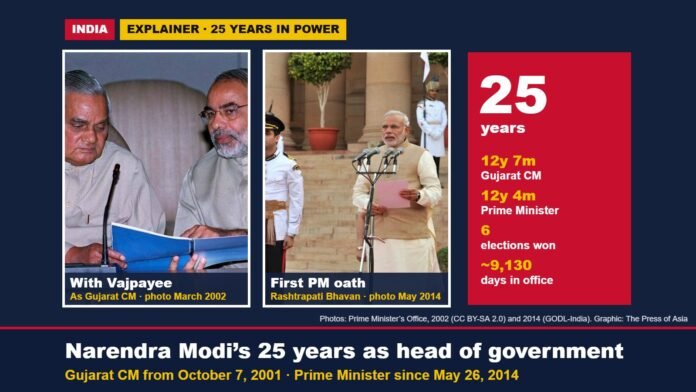
October 7: Narendra Modi on Wednesday completed 25 years as the head of an elected government. He took the oath as Chief Minister of Gujarat on October 7, 2001, held that post until May 2014, and has been Prime Minister since May 26, 2014. At a “Seva Jyoti” event at the Indira Gandhi Stadium in New Delhi, he said he had completed 25 years of continuous service as head of a government, Varta24 reported. The Union Cabinet had passed a congratulatory resolution a day earlier. This report puts the dates, election results, major decisions, controversies and challenges of these 25 years in one place.
Key highlights
- About 12 years and 7 months as Gujarat chief minister, followed by 12 years and 4 months as prime minister.
- On March 22, 2026, he completed 8,931 days to become the longest-serving head of an elected government in India, overtaking former Sikkim chief minister Pawan Kumar Chamling, All India Radio News reported.
- Under his leadership, the BJP won three Gujarat assembly elections (2002, 2007, 2012) and three Lok Sabha elections (2014, 2019, 2024).
- The 2002 Gujarat riots remain the biggest controversy of his tenure. A Supreme Court-appointed Special Investigation Team found no prosecutable evidence against him in 2012, a finding the Supreme Court upheld in 2022.
- The milestone comes as the opposition protests over the Special Intensive Revision (SIR) of voter rolls, and on the day the Reserve Bank raised interest rates.
What happened on the day
The Prime Minister offered prayers at the Shri Vinayak temple in Sarojini Nagar, Delhi, Aaj Tak reported, before the BJP’s main “Seva Jyoti” event at the Indira Gandhi Stadium. He said that when he took the oath in 2001 he had never imagined this moment, and recalled that his mother had told him two things when he became chief minister: always work for the poor, and never take a bribe, Varta24 reported. On the goal of a developed India by 2047, he said “we will do it”, described himself as still a student and said no distraction would stop the country, The Tribune reported. NDA leaders including Chandrababu Naidu, Eknath Shinde, Pawan Kalyan, Nara Lokesh and Chirag Paswan were on stage, Open magazine reported.
The Union Cabinet passed a resolution on October 6 congratulating him, Deccan Herald and Asianet News reported, linking his leadership to “Nation First” and “Citizen First”. The government’s own figures in the resolution:
| Area | Figure in the resolution |
|---|---|
| Jan Dhan accounts | 60 crore |
| Transfers to farmers under PM-KISAN | More than ₹4 lakh crore |
| Houses built for the poor | More than 4 crore |
| Government capital expenditure | From ₹2 lakh crore to more than ₹12 lakh crore |
| Electronics production | From ₹2 lakh crore to more than ₹13 lakh crore |
| National security steps listed | 2016 surgical strikes, 2019 Balakot air strike, Operation Sindoor in 2025, abrogation of Article 370 |
Vice-President C.P. Radhakrishnan, Home Minister Amit Shah, Defence Minister Rajnath Singh, External Affairs Minister S. Jaishankar, Finance Minister Nirmala Sitharaman and Lok Sabha Speaker Om Birla sent congratulations, India TV reported. Leaders including Nigeria’s President Bola Tinubu, Philippine President Ferdinand Marcos Jr., Bhutan’s Prime Minister Tshering Tobgay and Belgium’s Prime Minister Bart De Wever sent messages, ANI reported. In the reports we read, no major opposition leader commented directly on the milestone; the Congress was attacking the government that day over the FIR filed after Rahul Gandhi and Priyanka Gandhi Vadra entered Akashvani Bhawan during a protest.
25 years at a glance
| Date | What happened |
|---|---|
| October 7, 2001 | Sworn in as Gujarat chief minister, replacing Keshubhai Patel |
| February 2002 | Wins the Rajkot-2 by-election, becoming an MLA for the first time |
| February 27, 2002 | A train coach is set on fire at Godhra, killing 59 people; riots follow across the state |
| December 2002 | BJP wins 127 of 182 seats in the assembly election |
| 2007 and 2012 | Two more assembly victories: 117 and 115 seats |
| September 2013 | Named the BJP’s prime ministerial candidate |
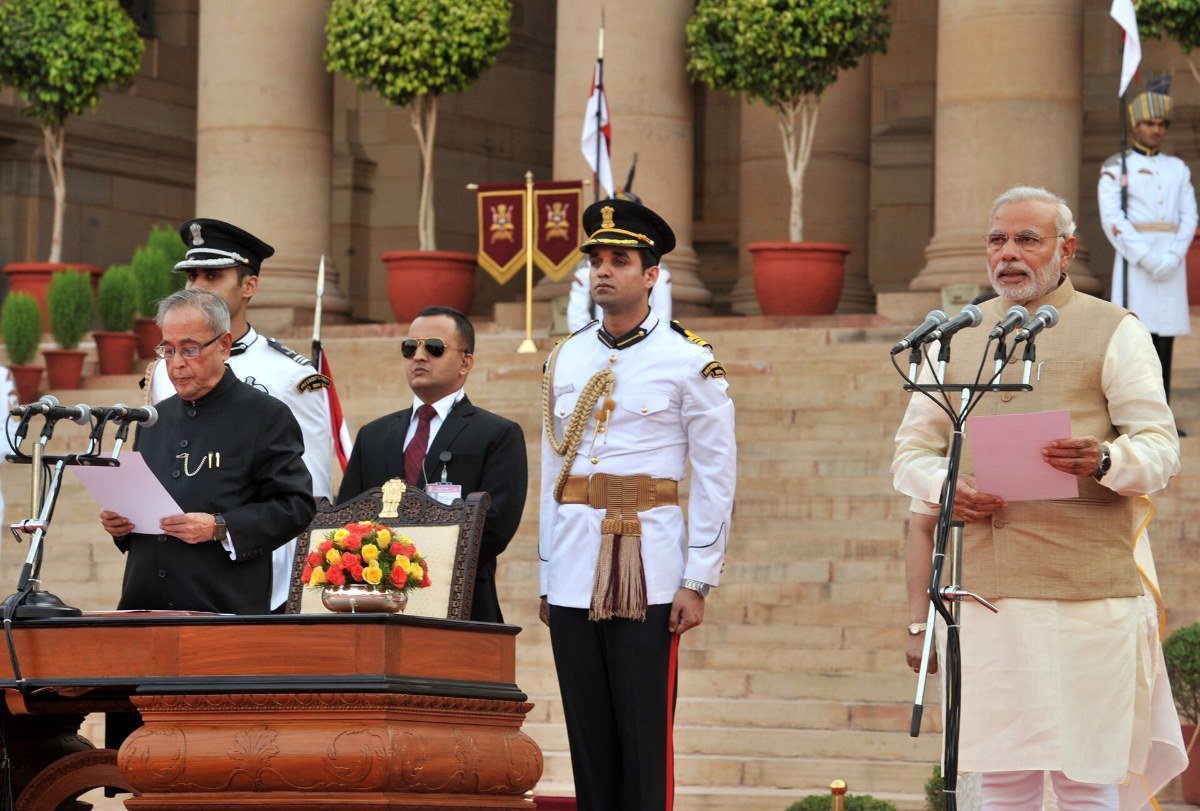
| May 26, 2014 | First oath as prime minister; BJP wins 282 Lok Sabha seats |
| May 30, 2019 | Second oath; BJP wins 303 seats |
| June 9, 2024 | Third oath; BJP wins 240 seats and governs with allies |
| March 22, 2026 | Completes 8,931 days, a record for an elected head of government in India |
| October 7, 2026 | 25 years as head of government |
From the organisation to government
Narendra Modi was born on September 17, 1950, in a small town in Gujarat, according to the Prime Minister’s Office profile. He worked first in the Rashtriya Swayamsevak Sangh (RSS) and then in the BJP organisation. Before 2001 he had never contested an election or served as a minister. In October 2001 the BJP made him chief minister in place of Keshubhai Patel, as the state was rebuilding after the January 2001 Kutch earthquake.
Twelve and a half years in Gujarat (2001–2014)
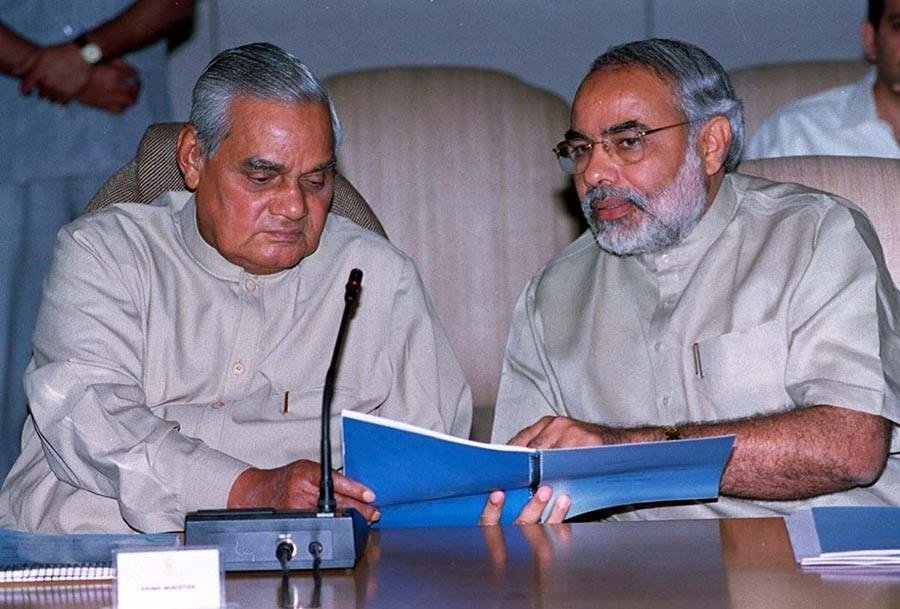
Within five months of his taking office, on February 27, 2002, a coach of the Sabarmati Express was set on fire at Godhra, killing 59 people. Communal riots followed in many parts of Gujarat. Official figures put the death toll at 1,044, including 790 Muslims and 254 Hindus, with 223 people reported missing; some non-official estimates are higher. The Supreme Court set up a Special Investigation Team (SIT) in 2008, which reported in 2012 that there was no prosecutable evidence against Modi. Zakia Jafri, widow of former MP Ehsan Jafri, who was killed in the riots, challenged the report; the Supreme Court dismissed her plea in June 2022. The United States denied him a visa in 2005, a bar lifted after he became prime minister. Critics still say the administration failed to stop the violence; Modi and the BJP point to the court rulings.
The BJP won 127 of 182 seats in December 2002, 117 in 2007 and 115 in 2012, and Modi became Gujarat’s longest-serving chief minister. His government focused on investment and infrastructure: the “Vibrant Gujarat” investor summits from 2003, the Jyotigram scheme for round-the-clock rural power, and the 2008 move of Tata Motors’ Nano plant from Singur in West Bengal to Sanand. Supporters called it the “Gujarat model”, the core of his 2014 campaign; critics said social indicators such as malnutrition and education did not improve as fast as industrial growth. In 2014 the BJP won 282 seats, the first single-party majority since 1984, and Anandiben Patel succeeded him as chief minister.
Twelve years as prime minister (2014–2026)
| Election | BJP seats | Result |
|---|---|---|
| Gujarat assembly 2002 | 127 / 182 | Formed government |
| Gujarat assembly 2007 | 117 / 182 | Formed government |
| Gujarat assembly 2012 | 115 / 182 | Formed government |
| Lok Sabha 2014 | 282 / 543 | Majority on its own; first term as PM |
| Lok Sabha 2019 | 303 / 543 | Majority on its own; second term |
| Lok Sabha 2024 | 240 / 543 | 32 short of a majority; third term with NDA allies |
He has represented Varanasi in the Lok Sabha since 2014. He is the first prime minister born after independence and the first non-Congress prime minister to take a third oath after two full terms, All India Radio News reported. Only Jawaharlal Nehru served longer as prime minister in a continuous stretch.
| When | What | In brief |
|---|---|---|
| August 2014 | PM Jan Dhan Yojana | Mass bank-account drive; 60 crore accounts, according to the Cabinet resolution |
| October 2, 2014 | Swachh Bharat Mission | National campaign for toilets and sanitation |
| November 8, 2016 | Demonetisation | ₹500 and ₹1,000 notes withdrawn overnight; upheld 4-1 by the Supreme Court in January 2023 |
| July 1, 2017 | GST | A single tax replacing many central and state levies |
| 2016 and 2018 | Ujjwala and Ayushman Bharat | Cooking gas connections and health insurance for poor families |
| February 2019 | Balakot air strike | Air action in Pakistan after the Pulwama attack |
| August 5, 2019 | Article 370 | Special status of Jammu and Kashmir ended; upheld by the Supreme Court in December 2023 |
| December 2019 | Citizenship (Amendment) Act | Passed by Parliament; protests across the country |
| March 2020 | Covid lockdown | Nationwide lockdown from March 25; later a large vaccination drive |
| 2020–2021 | Three farm laws | Repeal announced in November 2021 after a year of farmer protests |
| August–September 2023 | Chandrayaan-3 and G20 | Landing near the Moon’s south pole; G20 summit in New Delhi |
| September 2023 | Women’s reservation law | One-third reservation for women in Parliament and assemblies |
| January 22, 2024 | Ram temple, Ayodhya | Consecration ceremony |
| May 2025 | Operation Sindoor | Military action in Pakistan after the Pahalgam attack |
Controversies and criticism
No 25-year record is only a list of achievements. The most debated issues: the 2002 riots, where the SIT found no prosecutable evidence and the Supreme Court upheld it in 2022, though critics still question the administration of the time; demonetisation, presented as a strike on black money, after which RBI data showed almost all withdrawn notes returned to banks, while critics say small businesses and the cash economy were hit; the farm laws, which the Prime Minister himself announced would be withdrawn after a year of protests; the second Covid wave in April–May 2021, when shortages of oxygen and hospital beds drew sharp criticism; jobs and prices, the opposition’s oldest charge; and institutions, where the opposition questions the use of investigative agencies and the Election Commission’s neutrality, charges the government rejects. The current SIR dispute is the latest chapter of that debate.
| Supporters’ view | Critics’ view | |
|---|---|---|
| Economy | Record infrastructure spending, digital payments, GST | Too few jobs, the shock of demonetisation, rising inequality |
| Welfare | Bank accounts, houses, gas and toilets delivered directly | Big numbers, but questions on quality and durability |
| Security and foreign policy | Firm responses to terrorism; India’s greater global standing | Tension in the neighbourhood; the standoff on the China border |
| Democracy | Repeated election victories are the people’s verdict | Less autonomy for institutions and less room for dissent |
25 years in numbers
| Measure | Figure |
|---|---|
| Chief minister (Gujarat) | October 7, 2001 to May 2014: about 12 years 7 months |
| Prime minister | May 26, 2014 to October 7, 2026: 12 years, 4 months, 11 days |
| Total days as head of government | About 9,130 (All India Radio’s count of 8,931 on March 22 plus 199 days) |
| Elections won under his leadership | 3 Gujarat assembly and 3 Lok Sabha |
| Rank among prime ministers | Second to Jawaharlal Nehru in continuous tenure |
| Age | 76 (born September 17, 1950) |
What to watch
- The dispute over the Election Commission and the SIR, with opposition protests and petitions in the Supreme Court.
- Inflation and borrowing costs after the RBI raised the repo rate to 5.50% on the same day.
- The West Asia crisis, with oil above $100 a barrel and Indian seafarers caught up in attacks in the Gulf.
- Assembly elections in early 2027, including in Uttar Pradesh, and a government that has depended on allies since 2024.
What it means
Twenty-five years in continuous power is unique in Indian politics, and that fact is not in dispute. What is disputed is how to judge the period. Supporters see stability, infrastructure and the spread of welfare schemes, and point to repeated election wins as proof. Critics point to questions about institutions and minorities, from 2002 to today’s SIR row. Both can be true at once, and that may be the most accurate picture of this milestone: a leader chosen by voters six times, whose decisions have been debated just as long. He has named 2047 as his next goal; the nearer tests are inflation, oil and the questions over the Election Commission.
This article was first published in Hindi and has been translated. The Press of Asia now publishes in English only.
Sources
- Aaj Tak: 25 years of Narendra Modi in power: BJP programmes nationwide, Cabinet lists achievements
- Varta24: PM Modi completes 25 years in public life
- The Tribune: ‘We will do it’: PM Modi’s clarion call as he completes 25 years in public office
- Open: PM Modi reflects on 25 years in public office
- Deccan Herald: Cabinet adopts resolution marking 25 years in office
- Asianet News: 25-year journey from chief minister to prime minister
- India TV: Political leaders congratulate PM Modi for 25 years in public service
- ANI: PM Modi thanks global leaders for congratulatory wishes
- All India Radio News: PM Modi becomes longest-serving elected head of government in India (March 22, 2026)
- Prime Minister’s Office: PM’s Profile
- Wikipedia: Narendra Modi
- Wikipedia: 2002 Gujarat riots
- Wikipedia: 2007 Gujarat Legislative Assembly election

The National Desk covers India's politics, governance, security and public-interest news. Stories are checked against at least two credible sources before publication.