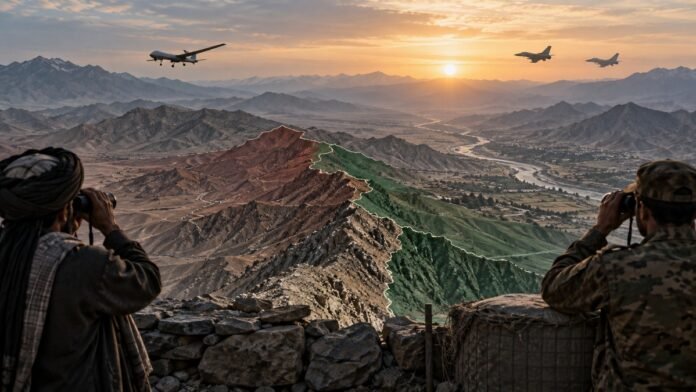
ISLAMABAD/KABUL, 24 September 2026: Pakistan says it carried out air and drone strikes against 10 locations inside Afghanistan early Thursday, sharply escalating a cross-border confrontation that had already produced deadly attacks this week. Afghanistan’s Taliban-led government says four civilians were killed in the latest strikes.
The two sides are giving conflicting accounts of what led to the operation. Pakistan’s Information Minister Attaullah Tarar said the sites were used to launch and store drones that entered Pakistani airspace on Wednesday. Afghan spokesman Zabihullah Mujahid denied that Taliban forces had carried out the alleged drone attack and described Pakistan’s action as aggression.
What is confirmed
- Pakistan publicly acknowledged strikes on 10 locations in Afghanistan.
- Islamabad described the action as self-defence after an alleged drone incursion.
- Afghan officials reported strikes in Kandahar, Paktia and Khost provinces.
- Kabul said four civilians were killed; that figure is attributed to Afghan authorities.
- No independently verified public assessment has established the full target list or damage at every location.
Pakistan’s account
Tarar said Pakistani air-defence systems detected and neutralised intruding drones before they reached their targets. He characterised the response as “deliberate, precise, calibrated and proportionate” and said it was limited to sites linked to the alleged launches. Pakistan has not published independently verifiable evidence for every target.
Islamabad has repeatedly accused armed groups operating from Afghanistan of attacking Pakistani security forces. Its central allegation is that the Afghan Taliban authorities have failed to prevent Tehrik-e-Taliban Pakistan and allied groups from using Afghan territory. Kabul denies providing such sanctuary.
Afghanistan’s account and civilian toll
Afghan authorities said the latest strikes hit three provinces and killed four civilians. Visual material distributed from Khost showed damaged buildings, but the complete circumstances and target identities could not immediately be independently verified. Civilian-casualty claims require caution in an active conflict, and figures may change as local authorities inspect affected areas.
The latest operation follows Pakistani strikes on September 21 that Islamabad said killed 28 militants. Afghan authorities and the United Nations mission reported civilian casualties from that earlier episode. The sequence shows that this is a new military development within an ongoing crisis, rather than a repetition of the same event.
Why the escalation matters for Asia
Repeated cross-border strikes increase the danger of direct retaliation and make regional mediation more difficult. China, Türkiye, Qatar and Saudi Arabia have all had interests in reducing Pakistan-Afghanistan tensions. A sustained conflict would also complicate trade routes, refugee management and counter-terrorism cooperation across South and Central Asia.
The escalation also tests the practical limits of air defence along a mountainous frontier. Drones can be hard to attribute quickly, while strikes launched on the basis of disputed attribution carry a high risk of miscalculation. If each incident produces a larger response, a cycle of retaliation could develop even if neither government formally seeks a wider war.
For civilians, the consequences extend beyond the immediate casualty count. Border closures can interrupt food and fuel supplies, separate families and strand commercial vehicles. Humanitarian agencies also face greater difficulty reaching communities when roads or crossing points are restricted. Any verified damage to homes or public facilities should therefore be documented separately from military claims.
Pakistan and Afghanistan share a long, difficult border and deep economic links. Security incidents can quickly affect crossings used by traders and families, while diplomatic deterioration can disrupt aid and movement. The Press of Asia’s earlier Pakistan-Afghanistan conflict backgrounder explains how the confrontation intensified earlier in 2026; Thursday’s strikes are a distinct fresh event with a new claimed trigger and new locations.
What happens next
The immediate questions are whether Kabul responds militarily, whether Pakistan releases evidence about the alleged drones and whether mediators can reopen communication. Independent casualty verification and any statement from the United Nations Assistance Mission in Afghanistan will also be important.
Readers should treat all battlefield claims as attributed until supported by independent evidence. Pakistan’s description of military targets and Afghanistan’s account of civilian harm are both official claims, not a single agreed record of events.
Sources / References
- Radio Pakistan carrying the information minister’s statement, 24 September 2026
- Reuters report on the strikes and Afghan casualty claim, 24 September 2026
- Associated Press report on the escalation, 24 September 2026

The International Desk covers world and Asian affairs, diplomacy and conflict, with a focus on what they mean for India. Stories are checked against at least two credible sources before publication.