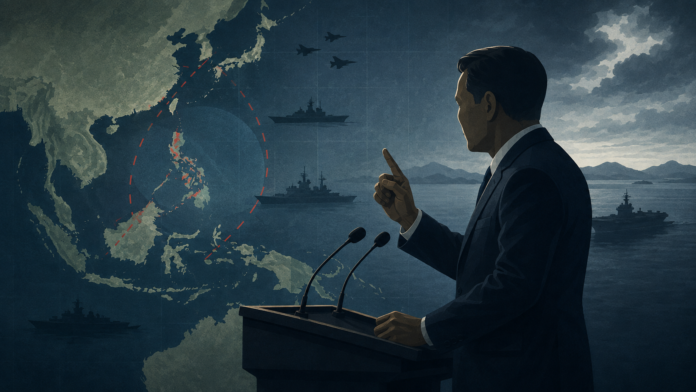

SEOUL, 7 September 2026: Philippine Defence Secretary Gilberto Teodoro warned that China could view recent reductions in US–South Korean military exercises as an opportunity to reassert itself in the Indo-Pacific. His comment was an assessment of strategic risk, not evidence that Beijing had launched a new operation, and he said Washington had assured Manila that US commitments to the Philippines were unchanged.
Teodoro spoke to Reuters on the sidelines of the Seoul Defense Dialogue. He said US–Philippine military activities had not been reduced and that Manila’s bilateral and multilateral security cooperation continued to expand. The distinction matters: the warning concerned how China might interpret changes elsewhere in the US alliance network, while operational cooperation between Washington and Manila remained active.
What Teodoro said—and what he did not
- He said China could exploit a perceived opening created by cuts to some US–South Korean exercises.
- He did not announce a confirmed Chinese military move caused by those cuts.
- He said US officials had reassured the Philippines that alliance commitments remained unchanged.
- He reported no reduction in US–Philippine military activity.
- No immediate Chinese response to his specific September 7 remarks was identified at publication time.
Why the Korea decision matters in Southeast Asia
The US alliance system in Asia is made up of separate treaties and partnerships, but rivals read them as a connected signal of political resolve. A reduction in one exercise can therefore create questions well beyond the Korean Peninsula. The Philippines faces repeated confrontations with China in the South China Sea, including around Scarborough Shoal and Second Thomas Shoal, and depends on credible external support as part of its deterrence strategy.
Teodoro’s concern is about perception. If Beijing concludes that Washington wants to reduce military friction or is less willing to sustain exercises, it could test the limits of allied responses elsewhere. That remains a hypothesis until matched by observable actions such as larger deployments, new exclusion zones, intensified coast-guard pressure or changes in air and maritime patrol patterns.
Not all US–Korea exercises were cancelled
President Donald Trump ordered parts of the annual US–South Korea exercise programme to be shortened, presenting the move as a way to support possible diplomacy with North Korean leader Kim Jong Un. Details of the reductions varied across exercises, and specialists warned that prolonged cuts could affect combined readiness.
At the same time, the five-day Freedom Edge exercise involving the United States, South Korea and Japan began on September 7 in international waters east and south of Jeju Island. South Korea’s Joint Chiefs of Staff said the multidomain drill would cover maritime, air and cyber cooperation, including air-defence and maritime-interdiction scenarios. Our Freedom Edge 2026 explainer details its schedule, purpose and North Korean response.
This mixed picture—some bilateral activity reduced while trilateral activity proceeds—shows why sweeping claims about a US withdrawal are premature. Washington may be trying to preserve deterrence while creating diplomatic room with Pyongyang, but allies will judge the policy by continuity, readiness and the clarity of treaty commitments.
China’s stated position
China’s Foreign Ministry has not endorsed Teodoro’s characterisation. Asked in August about cuts to US–South Korean exercises, spokesperson Lin Jian said a peaceful and stable Korean Peninsula and a political settlement were in the interests of all parties. Beijing has also repeatedly opposed what it calls bloc confrontation and foreign military pressure in the region.
That is China’s general stated position, not a direct answer to Teodoro’s September 7 warning. Beijing says its defence policy is defensive and accuses Manila and its partners of provoking tension. Philippine officials argue that stronger partnerships are a response to Chinese pressure and are needed to protect rights recognised under international law.
The South China Sea context
China claims most of the South China Sea through a broad historical line rejected by a 2016 arbitral tribunal in a case brought by the Philippines. Beijing rejects the ruling. The Philippines, Vietnam, Malaysia, Brunei and Taiwan also have overlapping claims in the waterway, which carries a large share of global trade.
Manila has increased coast-guard deployments, access arrangements and exercises with the United States, Japan and Australia. The Press of Asia previously examined the Philippines’ new Coast Guard command at Pag-asa Island. That step and Teodoro’s latest remarks fit a broader policy of making Philippine presence more durable while building external support.
What it means for India
India is not a treaty ally of the United States and is not part of Freedom Edge, but it has an interest in freedom of navigation, stable sea lanes and a regional balance that discourages coercion. Indian trade and energy flows cross the wider Indo-Pacific, and New Delhi works with the United States, Japan and Australia through the Quad while retaining strategic autonomy.
For India, the immediate lesson is not that one reduced exercise changes the balance of power. It is that signalling among major powers can affect the risk calculations of smaller coastal states. A crisis in the South China Sea could raise shipping, insurance and supply-chain costs even without involving India militarily. New Delhi will therefore watch both Chinese activity and the credibility of US alliance assurances.
What to watch next
Reliable indicators include the scale of future US–Philippine exercises, implementation of access agreements, Chinese coast-guard and naval deployments, and whether crisis-communication channels remain open. Analysts will also track whether cuts to US–South Korean training are temporary diplomatic gestures or part of a longer change in force posture.
Teodoro’s statement should be reported precisely. He issued a warning about a possible Chinese interpretation and paired it with reassurance about the Philippine alliance. It does not establish that China has already acted because of the Korean exercise changes. Evidence of any such link would require official records, operational data and independent reporting.